
The short answer
No. A cracked slate is replaced, not repaired, because sealant and adhesive cannot bring a split stone back to a watertight sheet. The new slate must match the old in size, thickness and colour, and it is held by a tingle or a hook where the nails cannot be reached.
Why a crack cannot be sealed
Slate is a natural stone that splits along thin layers. A crack through a slate leaves two pieces that move independently, and every day of sun, frost and wind works the edges a little. Rain runs into the split and falls onto the underlay below, where it can soak the battens.
Brushed-on sealants, bitumen strips and clear adhesives are sold for the purpose, and they can look sound for a season. They do not bond to wet, dusty stone for long, and when they lift they trap water against the slate and the batten beneath. The slate then dries slowly and rots the timber, which turns a small fault into a larger one.
Glue also fails for a mechanical reason. A cracked slate that stays in place is held only by nails that are likely to be near the damaged edge, and a glued crack cannot take the loads that the slate takes in the wind. The plain rule among roofers is to take the broken slate out and put a sound one in.
How the replacement is fixed
The cracked slate is released by sliding a long, flat tool called a slate ripper up beneath it and cutting or pulling the nails that hold it. The loose halves slide out, and the gap is clear. The new slate cannot take its nails in the original place, since the course above hides that spot, so a tingle or a hook holds it instead.
A tingle is a narrow metal strip, lead or copper, fixed to the batten by a nail and bent up across the foot of the new slate. A slate hook is a pin that grips the tail from below. Our guide to slate hooks against nails explains the choice, and Cupa, a slate supplier, reports hook fixings are not for pitches below 25º.
Either way the repair is a holding fix for one slate, and it relies on the slates around it being sound. If the neighbours are loose, one new slate will not stop the next from cracking.
Two ways to hold the new slate
Tingle
- Strip of lead or copper
- Nailed to the batten
- Folded over the tail
Hook
- Pin that grips the tail
- Not below 25 degrees
- Hidden under the slate
Matching size, thickness and colour
A replacement slate has to match the old one or it will not lie flat. A slate that is too thick lifts the tail of the slate above it and lets rain run in beside it. One that is too thin can flex and crack. If the size is out, the slate sits proud or leaves a gap with the slates beside it, which defeats the overlap that keeps the roof dry.
Colour matters for appearance. New slate is a fresh, even grey or blue, while slate that has weathered for decades is duller and can be patterned by lichen. A reclaimed slate from a similar roof can be a closer match than new stock, and our guide to reclaimed roof slates explains when it is used. HomeBuilding, last updated 30 September 2025, gives approximate lifespans of 50-80 years for reclaimed Welsh slate and 100+ years for new Welsh slate.
Because the choice affects the look of the whole slope, it is worth settling at the quote stage and not on the day the work starts. Ask to see a sample slate beside the old one, in daylight, so that you can judge size, thickness and colour yourself before it is fixed.
Before you call about a crack
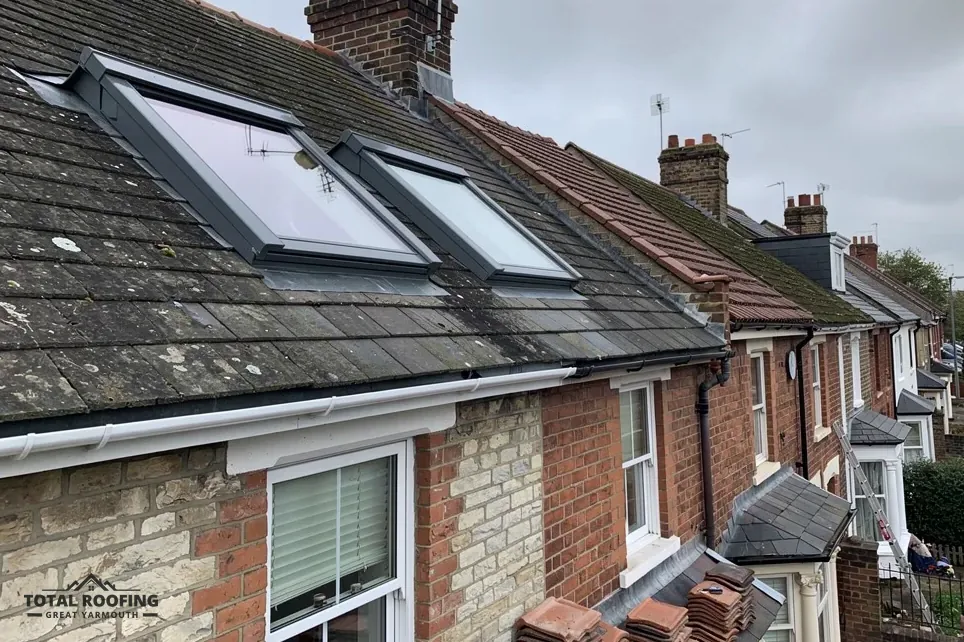
Look for cracks from the ground with binoculars, and note how many slates are involved. One or two cracked slates on an otherwise even roof is a routine repair. A scatter of cracks across a slope, or slates cracking again after a repair, suggests something wider: slates with failing fixings that move in the wind, or foot traffic on the roof by someone who should not have been there.
Check the loft for damp below the slope, and send a picture to 07880 284133 on WhatsApp, with the slates in the frame and the gutter below them if you can show it. At Total Roofing Great Yarmouth a survey covers the whole slope, and the job comes as one written total price. The slate roofing hub lists every kind of slate work, from one replaced slate to a new covering. Where cracks are spread across a slope, ask for the whole slope to be checked, and see our guide to slate roof repairs explained sets out when single repairs stop making sense.
