
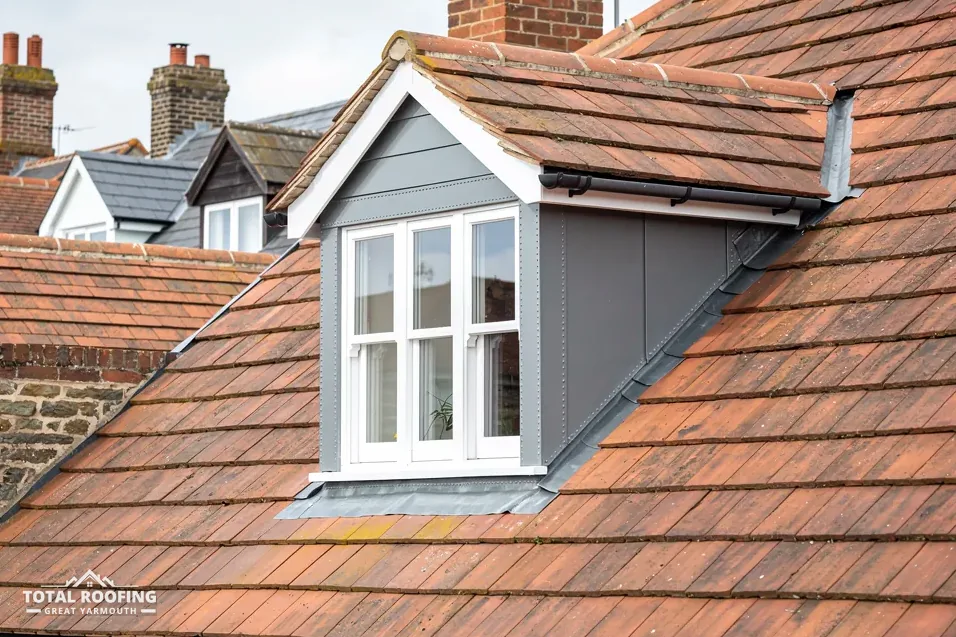
Why lead is on so many old roofs
Lead bends easily into the awkward junctions of a roof: the valley where two slopes meet, the flashing where a slope runs into a wall, the gutter hidden behind a parapet, and the cap over a chimney stack. Tiles and slates shed water down a slope, but the junctions between them need a sheet metal that can be folded and bossed into shape and then left to move with the building.
That is why a historic roof can hold more lead than the eye picks out from the street. The parts you can see, such as a flat over a bay or the cover on a porch, are only part of it. Much of the rest sits in the folds of the roof, under the first course of tiles or behind a coping stone, where nobody looks until water shows on a ceiling.
MyJobQuote says correctly installed lead flashing can last for over 80 years, and adds over 100 years for higher codes. For lead on a flat roof, HomeBuilding gives a range of 60-100 years and the roofing guide at Less gives 50 to 100 years. Those are published estimates for sound work, and they explain why old lead is worth keeping and repairing where it can be, rather than replacing at the first crack. The estimates also differ from one source to the next, so none of them is a date to plan a roof around.
Age alone does not tell you the state of a sheet. Lead expands and contracts with the temperature, and over decades a long run can creep, thin or split at a fold, while a short, well supported sheet in the same roof stays sound. So each run is looked at on its own, rather than the roof being judged by its age.
Places lead turns up on an older roof
- Valleys between two pitched slopes
- Flashings where a roof meets a wall
- Parapet and box gutters
- Flat roofs over bays and porches
- Chimney flashings, back gutters and aprons
- Dormer cheeks and roofs
Listed building consent for roof work
Listed building consent is a separate permission from planning permission. Under section 7 of the 1990 Planning (Listed Buildings and Conservation Areas) Act, works to a listed building need it when they are carried out "in any manner which would affect its character as a building of special architectural or historic interest". The roof forms part of that character, so a new covering, a change of metal, a different ridge or the loss of an old chimney can each touch it.
The permitted development rights for householders are not removed by listing. Classes B and C both stay, and the GOV.UK technical guidance says Class C covers re-roofing. Consent is a second layer on top, so the planning answer and the listing answer have to be worked out one after the other. Chimneys, flues and soil and vent pipes are outside Class C altogether, listed house or not, so lead work on a stack needs its own answer from the council.
Who you ask depends on the address. For most of the area around Great Yarmouth, it is the council, and inside the Broads executive area the Broads Authority is the local planning authority for land and properties there. The grade of a listing and the wording of its entry come from the national list for England, and a repair that looks small, such as replacing a cracked lead apron, is worth a call to the council before a roofer takes a sheet off.
Like-for-like repair and changing the lead
Repairing lead with lead is different in kind from swapping it for another material. Replacing a failed sheet with the same metal in the same pattern keeps the roof looking as it did. Putting a different metal, a membrane or a sealant-based product in its place changes how the junction looks and how it is built, and the council's conservation officer expects to be asked about a change like that first.
Lead sheet is graded by code from 3 to 8 under BS EN 12588. Leadworx, a lead flashing maker, says the LSTA sets these standards and that code 4 has become the standard choice for general flashing work. Each detail has its own code in the specification, so a historic roof might call for a heavier sheet in a gutter than at a flashing. Our guide to lead codes goes through what each one is used for.
| Code | Thickness | Weight per m² |
|---|---|---|
| Code 4 | 1.80 mm | 20.41 kg |
| Code 5 | 2.24 mm | 25.40 kg |
| Code 6 | 2.65 mm | 30.10 kg |
| Code 7 | 3.15 mm | 35.72 kg |
Weights differ between suppliers, which is why the table names Leadworx. On a listed building, matching the old thickness and the old details is a conservation decision as well as a technical one, so the sheet and its fixing method are agreed with the council where consent is needed.
Churches and the faculty route
A church in use does not go through listed building consent in the same way. The ecclesiastical exemption applies to buildings used for ecclesiastical purposes, and which system takes its place depends on the denomination. A Church of England church in use, including Great Yarmouth Minster, goes through the faculty system rather than listed building consent. The exemption replaces listed building consent only, so planning permission is still needed for outside work that requires it.
The Diocese of Norwich calls St Nicholas Church in Great Yarmouth "the largest parish church in the country", with the official title of Minster Church since 9 December 2011. An air raid in 1942 left only the Norman tower and the walls standing, and it was reconsecrated in 1961. That history shows why a church roof is treated as a long-term asset: lead laid on it is expected to be kept in repair for generations.
| Building | Route |
|---|---|
| Church of England church in use | The faculty system |
| Roman Catholic, Methodist or United Reformed church in use | That denomination's own system |
| Unitarian or Quaker meeting house | Listed building consent |
| Redundant church, or one held by the Churches Conservation Trust | Listed building consent |
| A minister's house | Listed building consent |
| Scheduled monument | Consent from the Secretary of State, sought through Historic England |
Baptist chapels are exempt only where they are held by a trust corporation for a church in the Baptist Union. If you are a churchwarden or a trustee, the parish or denomination's own officers will say which route applies before a lead specification is drawn up. Our page on church roof lead repairs covers the work itself.
Conservation areas, Article 4 and the neighbours
A house in a conservation area but not itself listed does not need listed building consent. A conservation area counts as article 2(3) land, and that takes away the Class B dormer rights only; re-roofing under Class C carries on. The exception is an Article 4 direction, which can take specified permitted development rights away for a defined area, and whether one covers a particular street in Great Yarmouth, the Broads villages or Lowestoft is a question for the council, so check with the council before a covering or a roof light is chosen.
The Broads add one more check. Inside the executive area the Broads Authority decides planning, while Building Regulations stay with the district council's building control team or a registered building control approver. The boundary follows the waterways, so the address matters more than the village name, and a house at the edge of a Broads village can fall on either side of the line.
In South Norfolk and Broadland, the councils say there are 21 conservation areas within Broadland and 52 within South Norfolk. Norwich City Council has directions in Bracondale and Heigham Grove and says that where one applies you need to apply for permission, even for small changes.
Lead work can reach the neighbour too. A flashing that is chased into a party wall, or cut into the wall between two terraced houses, is party structure work under the Party Wall etc. Act 1996. The notice comes from the person having the work done, and it has to be given at least two months before the date on which the proposed work will begin. Party wall questions go to a party wall surveyor, not to building control.
What a survey of an old lead roof looks at
The survey of a historic roof starts with what is visible from the ground and then moves up to the slopes and junctions. It takes in every slope and junction, and goes well beyond the single flashing that prompted the call. If the lead is cracked at a fold, split along a seam or lifted at an edge, you are told plainly, together with anything else seen nearby, such as a loose tile at the same junction.
- Look at each lead junction both from the ground and up on the roof.
- Check the laps, folds and edges for splits and lifting.
- Check the fixings and the wall or chimney the lead is tucked into.
- Note any other defect at the same junction.
- Check the consent route for the building with the council.
For a listed building or a conservation area, the planning or consent route is checked with the council, or with the Broads Authority inside its executive area, before work starts. Our quote arrives afterwards as one written total price. If scaffold stands over the pavement or the road, the county council issues the licence, and we arrange the licence with our scaffolder.
For a sense of scale on small jobs, MyJobQuote gives around £200 for a chimney lead flashing patch repair and around £570 for a full replacement, on its page dated 22 September 2026. Both figures relate to chimney leadwork only, not to valleys or flat roofs. Checkatrade, in its June 2026 table, gives lead flashing repairs at £50 to £70 per metre, exclusive of VAT, and a per-metre rate is not a total. A listed building's total depends on its access and its details, which is why it is priced after the survey.
If you manage a building for a parish, a trust or a group of owners, send a photograph on WhatsApp first. A picture of the failing junction, taken from a window or from the ground, lets us say what the survey will need to cover before anyone books a visit.
