
The short answer
A uPVC roofline retailer writes that, installed correctly, the boards "can typically maintain reliable performance for between 20 and 40 years". That is a seller's claim, not a promise. The timber behind the plastic, and how the boards were fitted, move a house towards either end.
The published range and what it assumes
The figure comes from a retailer of uPVC roofline products: "When installed correctly, they can typically maintain reliable performance for between 20 and 40 years". It is worth reading in three parts. It is a seller's statement about a product it sells. It says "typically", so it describes boards in general rather than every board. And it is conditional on "installed correctly", which puts the fitting alongside the plastic as a cause of how long a board lasts. None of the three makes it a promise about the boards on your house.
Twenty years separate the two ends of the range. A board fixed to sound timber, with its joints closed, cleaned now and then and kept free of overflowing gutters sits towards the top. One fixed to damp or rotting timber, or with open joints, sits towards the bottom.
The range is for the plastic. It says nothing about the timber behind the plastic, which is where uPVC fascia trouble starts, as the next section explains. A reader holding the figure up against a house should ask two further questions of it: who fitted the boards, and what they were fitted to.
What shortens the life of a uPVC fascia
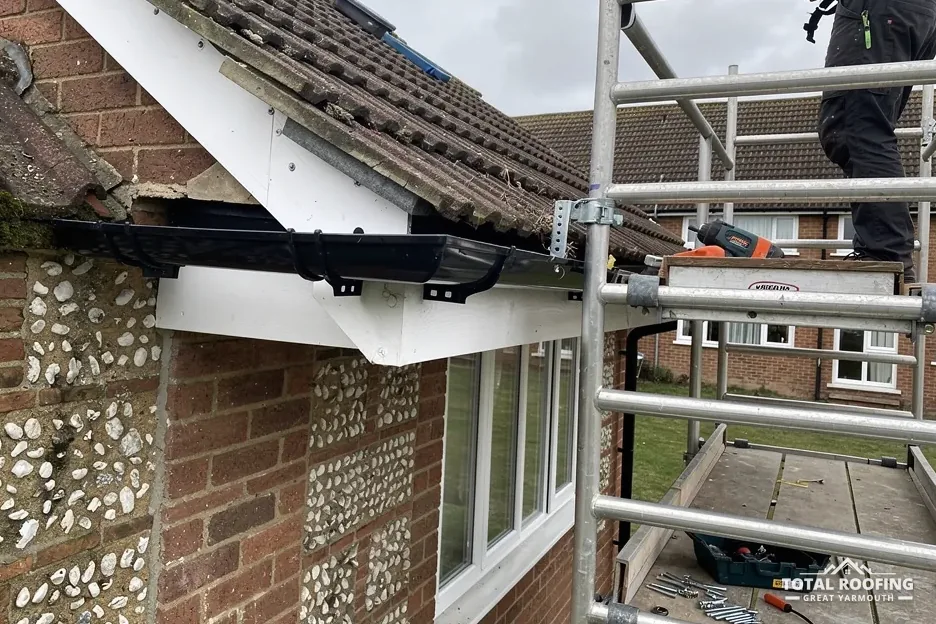
Plastic does not rot, but a uPVC board is fitted over timber, and the timber can. These are the points that cut a fascia's life short:
- Timber rot behind the cover. A leaking gutter or a failed joint soaks the wood hidden beneath the plastic, and the first anyone sees is a board that has sagged or a gutter that has pulled away.
- Poor fixing. Boards that are not fixed with enough support, or whose joints are left open, allow water behind the cover and let the sections move.
- Distortion and discolouration. Plastic can warp and go yellow or chalky, and a board that has changed shape no longer lines up with its neighbours.
- Damage from ladders, strimmers or birds working at the soffit joint.
None of these is a fixed number of years. A board's age is a rough guide, and its condition is the real evidence. A house with two gutter leaks and a rotten board may need the boards done long before another house with the same boards and no leaks. Gutters that overflow onto the board are worth fixing for that reason alone, since the water they spill lands on exactly the place the plastic is meant to protect.
Judging an older uPVC run
If your boards are already past twenty years, look at them rather than count. A board that is flat, firmly fixed and clean, with tight joints and no staining beneath the gutter, is doing its job. One that has bowed, cracked at a joint or turned a dull yellow is nearing the end, and one that moves under hand pressure has a failed fixing behind it. Check each board, including the short returns at corners, because one weak section can drag the rest.
Cleaning can restore a tired but sound board, and our page on cleaning uPVC fascias covers it. Cleaning does nothing for a board that has warped or cracked.
Where the run is sound but looks poor, capping is another route, and fascia capping against replacement sets out when it makes sense. MyJobQuote gives around £800 as the average cost of capping fascias and soffits (17 September 2026), a figure that shows scale and is no substitute for a quote on your house.
Getting an answer for your own boards
A look from the ground tells you less than one at the eaves, because the sound of a board, the give in a fixing and the state of a joint only show up close. Our survey takes in the boards, the gutter fixed to them and the roof above, and what turns up is reported to you in everyday terms, along with anything else we notice on the way.
Where a board has failed, you receive one written total for replacing it, and scaffold for a high run sits inside that single price. Where the boards are sound, you are told so, and the sensible step for the next few years may be to keep the gutters flowing.
A photograph of the run, sent on WhatsApp, shows the colour, the joints and any obvious distortion. The guttering, soffits and fascias hub covers the other parts of the roofline, and the survey is where the answer for your own boards comes from.
