
The short answer
Either board can make a sound flat roof deck when it is a grade rated for damp conditions, laid with the gaps and fixings the maker asks for and kept dry until it is covered. Plywood tolerates a wet edge better, OSB is cheaper and flatter, and a survey of the existing deck helps settle which suits.
What each board is
Plywood is made of thin veneers of wood, glued in layers with the grain of each layer turned at right angles to the next. That cross-lamination gives the sheet strength in both directions, and an edge that shows the layers.
Oriented strand board, called OSB, is made from long strands of wood pressed and glued into three layers, the outer ones lined up along the length of the board and the inner ones across it. It is made in several grades, and the grade sold for load-bearing use in damp conditions is the one a roof deck needs. A low grade intended for dry interior use is not suitable.
Both boards are timber products and both take up water. The covering over a flat roof deck seals the top, but the underside and edges can meet moisture from the ceiling space, from a leak or from rain during the build, which is why the grade and the care taken on site matter.
Moisture, edges and what each does under a flat roof
A flat roof deck has no slope to shed water in the build, so rain that lands on bare boards sits on them. The question is how each board reacts to being wetted and then dried.
- OSB can swell at the edges and cut faces when it gets wet, and the swelling may show through a thin covering as a ridge along a joint.
- Plywood generally takes a wet edge with less swelling, though it too delaminates if it stays wet for long or if the glue is not rated for the exposure.
- OSB is made in large, even sheets with a flat surface, which suits a covering bonded directly to the deck.
- Plywood costs more per sheet, and a rated exterior grade is the one that belongs on a roof.
These points lead some roofers to choose plywood where a deck may get wet and OSB where cost matters, though neither choice is a rule. A deck of either board that has been soaked, has swollen joints or feels soft underfoot is replaced, not covered over, as the page on flat roof replacement explains.
How either board is fitted
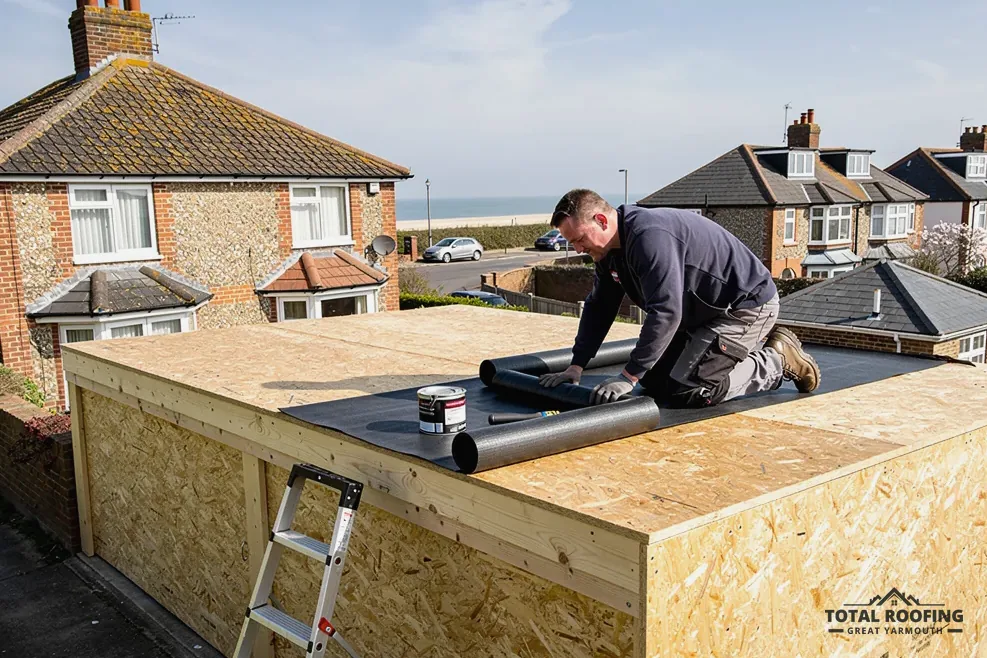
The way a deck is laid affects how it performs. Boards are laid with staggered joints and a small movement gap between sheets, which allows for expansion without lifting the covering. They are fixed to the joists at the spacing the board maker gives, and where the joists run across the fall, the edges of the sheets are supported on them.
The deck also has to be flat, and the falls are set separately. Boards cannot be forced into a slope, so the fall is made with tapered insulation or firring strips on the joists, as the page on flat roof falls explains. A deck that dips between joists will hold ponds whatever it is made of.
With a warm roof, boards lie below the insulation and stay close to the temperature of the rooms. With a cold roof they face a ventilated void, cold surfaces and the risk of condensation, which is harder on either material and makes the grade and the dryness of the timber more important. Our page on warm roof against cold roof compares the two constructions.
Which to choose for your roof
The right deck depends on the grade offered, the roof's exposure, the covering going on top and the budget. Ask any firm quoting which board it proposes, what its grade is and what the covering maker requires underneath it, so that two quotes can be read against one another.
When we survey a flat roof we look at the existing deck from above and from below, pressing for soft areas and looking for staining, and we say plainly what we see and what else the roof needs. If the roof has a loft hatch or a ceiling void beneath it, the underside of the boards can be seen from there, which shows staining that the surface never would. Send photos of any sagging or stained ceiling on WhatsApp to 07880 284133, or ring 01493 277103.
The price is a single written total that follows the survey, and the wider flat roofing section describes the coverings that go over the deck.
