
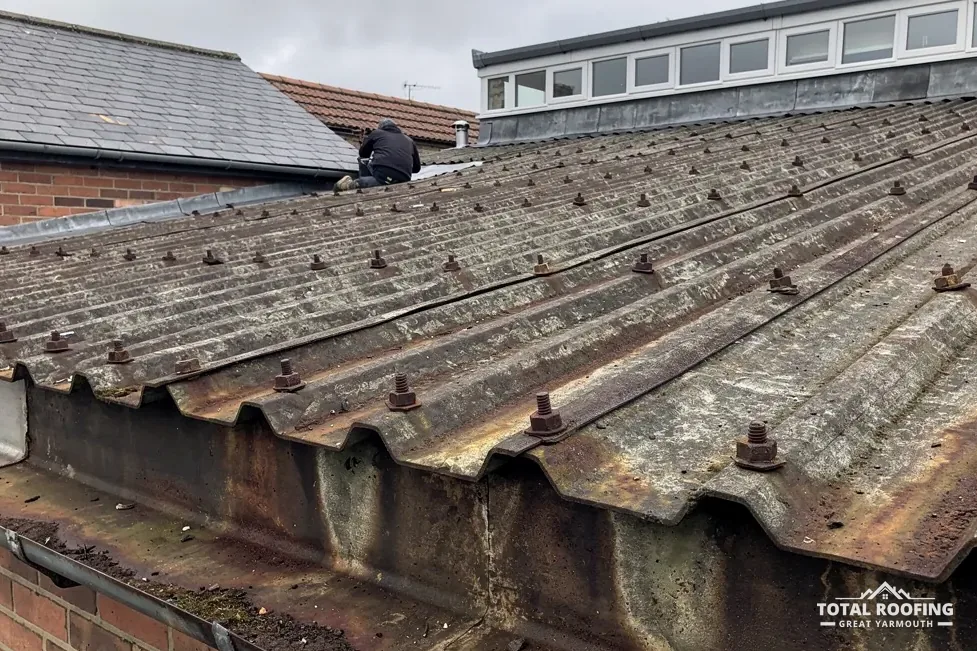
The flat roof behind the shopfront
A shop or office on a high street can present a pitched roof or a shopfront to the pavement and hide a flat roof behind it. The flat part covers the rear storeroom, the stairwell, a back extension or the whole upper floor. Nobody sees it from the pavement, so it gets looked at only when a stain appears on a ceiling.
A flat roof is not flat in the strict sense. It is built to a fall, a slight slope that takes water to an outlet. BS 6229:2025, now the current code of practice covering flat roofs with continuously supported flexible waterproof coverings, is dated 16 December 2025 and replaces the 2018 edition, which was withdrawn that day. NFRC reports that it sets "a minimum 1:80 finished fall for general roof areas and internal gutters", and IKO reports: "To achieve a 1:80 fall, the code of practice says that the roof should be designed for a fall of 1:40". Where a roof has settled, or was laid too flat, water stands on the membrane and finds the weakest point of it.
HomeBuilding and Less each give different lifespans for the common coverings, so no single figure fits every roof. HomeBuilding gives EPDM 25-30 years, GRP 25-30 and felt 10-15, while Less gives 30 to 50 for EPDM, 25 to 40 for GRP and 10 to 20 for felt, "depending on quality and installation". Neither is a promise, and the survey judges the roof it is looking at by its condition. A felt roof that looks tired and a rubber roof that looks fine are both assessed by their seams, upstands and outlets, not by the age printed in a guide.
Our commercial flat roofing systems guide sets out the coverings in more detail. This page deals with the parts that belong to shops and offices in particular: the parapet, the gutter behind it, the flats above, the pavement below and the neighbours either side.
Parapets, copings and box gutters
A parapet is the low wall that rises above the roof edge, and on a shop it can form part of the front elevation. It hides the roof from the street and keeps people from stepping off, and it also gives water a way in, because every junction between wall and roof is a joint that has to stay sealed for years. The membrane has to turn up the inside face of the wall as an upstand and finish under a flashing, and the top of the wall carries a coping that sheds water over both faces.
Each of those details can fail on its own. A cracked or lifted coping lets water into the wall head, where it runs down inside the masonry and shows as a stain in the room below, well away from the roof surface. A split in the upstand lets water behind the membrane. A flashing that has pulled from the brickwork opens a gap at the top of the upstand. Pointing that has weathered away from the wall around the flashing does the same.
Behind the parapet there can be a box gutter, a trough built into the roof and lined with membrane or metal. It carries the whole roof's water to a few outlets, so it has to be big enough and kept clear. A box gutter that blocks floods back over the upstand and into the building, and a lining that has failed leaks into the ceiling beneath. A survey looks at the lining, the outlets and the overflow, which is the safety opening that lets water escape before it reaches the upstand. It also looks at the size of the outlets against the roof area they serve, since a small outlet on a large roof backs up in a downpour even when it is clear.
Details checked on a parapet roof
- Coping stones or capping and their joints
- Pointing and brickwork behind the flashings
- Upstand height and the membrane laps
- Box gutter lining, outlets and overflows
- Fall of the membrane towards each outlet
- Ceilings below for stains and damp
Flats above shops and who looks after the roof
Some town-centre buildings hold a shop at ground level and one or more flats above it. The roof covers them all, but different people may own the parts. The freeholder may own the structure and the roof, with the shop and each flat held on separate leases, and the lease says who pays for roof repairs and how the cost is shared. A leak that appears in a flat's bedroom ceiling is a matter for everyone whose lease touches that roof.
That affects how a repair is commissioned. The client under CDM is the person who commissions the work, and a freeholder who has repairs carried out to a roof over occupied flats takes on that role. Our CDM guide explains what a business client must arrange. Where the flats are occupied, the people below the work need to know when it starts, and the access to their front door has to stay safe.
Flats have no householder permitted development rights at all, so any change to the roof's shape or appearance needs a conversation with the council first. Re-covering a flat roof like for like is a different matter from raising it or adding a roof terrace, and Great Yarmouth Borough Council is the place to check. Where the building is listed, the listed building consent route applies to anything that affects its character.
One survey of the whole roof serves the shop, the flats and the managing agent, and whoever pays what under the lease, the roof gets one written total.
Access from the street
A shop roof can be reached from the front when the back is a yard or a neighbouring wall. A scaffold on a high street stands on the pavement, narrows the walkway and sits close to shop doors. A highway licence from the county council is needed for scaffold placed on the pavement or the road, and we arrange the licence with our scaffolder. Norfolk County Council, which licenses scaffold in Great Yarmouth, charges £178.33 for the first 28 days of a licence, with the same charge repeated for each further 28 days.
The council says to allow 7 calendar days for processing, and a separate application is needed for each scaffold that is erected. Planning the roof job therefore starts a week or more before the scaffold does, and a licence that runs out mid-job means a renewal for the next 28 days. On a trunk road the licence is National Highways' instead, and it can be contacted on 0300 123 5000.
Pedestrians come first, and the scaffolder plans the walkway before the frame goes up. Shoppers, buggies and wheelchair users all need a clear, level route past the work, and a sign at each end tells them where it runs. A scaffold on a pavement needs a protected walkway or a diversion, lighting at night and clear signs, and the shop's own entrance has to stay open if the shop is trading. Deliveries need a gap in the scaffold or a time window, and fire exits from upper floors must not end at a scaffold pole. A mobile platform parked at the kerb can do small jobs without a full frame, but it still sits on the highway and still needs a licence where it obstructs it.
Neighbours and party walls
Terraced shops and offices share walls. A roof repair that cuts a new flashing into a wall that belongs to two owners is work to a party structure, and the Party Wall etc. Act 1996 applies. It is the building owner who serves notice on the neighbour, at least two months before the date on which the proposed work will begin. A late notice can delay the start.
A surveyor comes into it only if the neighbour dissents or does not reply inside fourteen days. A dissent triggers the surveyor process under section 10 of the Act. It is not a veto, so a neighbour cannot simply block the work. Questions about party walls go to a party wall surveyor, not to building control.
The roof is also shared in a practical sense. Water from one flat roof can run onto the next, a shared gutter may serve two buildings, and a parapet can be the boundary between them. The survey looks at which parts serve which owner, and a conversation with the neighbour before the scaffold goes up is worth having whatever the Act requires. A shared gutter that is cleared on one side only will overflow on the other, and a parapet wall that is repointed on one side leaves a mismatch that neighbours notice.
Trading while the roof is repaired
A shop that closes for a roof repair loses takings, so the work is planned around opening hours. Noisy and dusty stages can be placed outside trading hours where the building allows it, and the area below a section being opened can be cleared or covered. An office with staff under the roof has the same issue: desks below the work may need to move, and computers need protecting. A tenant who shares the building should hear about the dates from the landlord or the managing agent before the scaffold arrives, not from the noise on the first morning.
Asbestos has to be ruled out first on an older building. HSE says: "If the building was built or refurbished before 2000, assume that there is asbestos in it." The roof, its soffits and any boards around the plant are part of that question, and our commercial roof surveys guide explains what the survey looks at.
A shop or office roof is priced after the survey, with no figure picked from a table. The cost follows the roof's size and covering, the way in from the street and what the survey finds, then arrives as a single written total. WhatsApp 07880 284133 with a picture of the stain and it will be looked at.
Myth
A shop has to close for the days its roof is being repaired.
Fact
Work can be staged around trading, though some stages near the doors may need the shop shut.
