
The short answer
Who repairs a shared roof is set by the leases or title deeds of the units, not by the roof. A landlord can keep the structure and recover the cost through a service charge. Work that cuts into a party wall needs notice under the Party Wall etc. Act.
One roof, several units
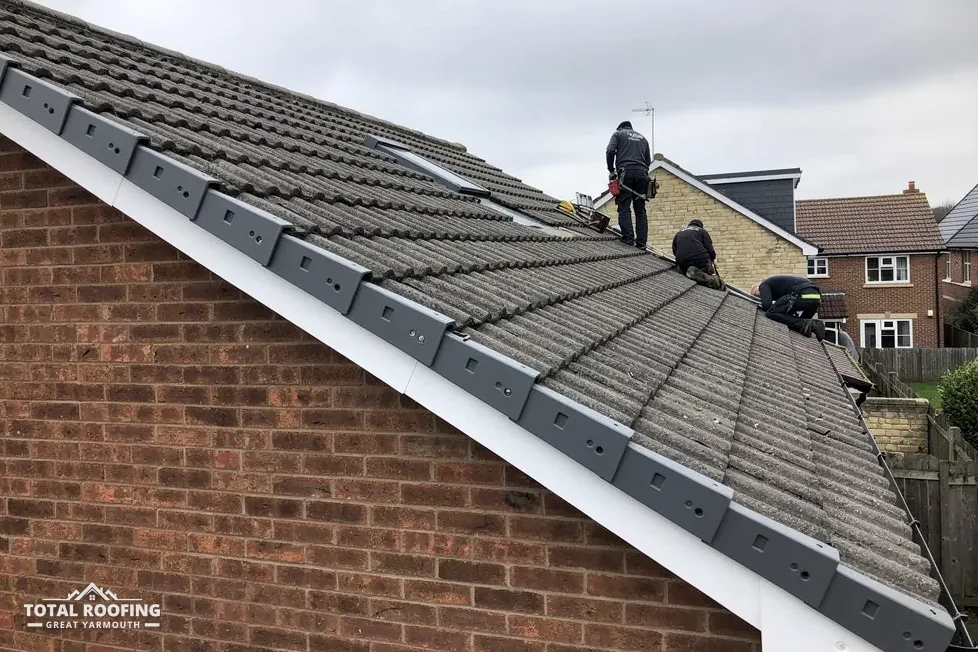
A terrace of business units can sit under one run of sheeting or by a line of linked bays, with party walls rising between the units and carrying the roof structure across them. A leak shows up in one unit while its cause lies in the bay next door, at the wall between them or in the gutter at the end of the run.
That arrangement raises a question the roof cannot answer: whose roof is it? The answer is in the documents. A lease may give the tenant the repairing duty for the roof over their unit. It may keep the roof with the landlord and pass the cost to tenants through a service charge. A freehold unit may carry a covenant to share the cost of the roof with its neighbours.
A roofer can establish where a leak starts, which bays are affected and what work each needs. Who pays is a separate matter, and nobody should guess at it: the leases and title deeds answer it, and a property solicitor can read them.
Who repairs which bay
- Landlord retains the roof: the landlord arranges and pays for repair and recovers it through the service charge. A tenant reports the fault and may be asked for access.
- Tenant repairs the roof over their own unit: a repair needs to stop at the unit boundary, and the line of that boundary on the roof is worth checking against the plan.
- Neighbours share by covenant: repair is agreed between owners, and the cost is divided as the deeds say.
Problems arise where the unit boundary falls in the middle of a sheet, a gutter or a valley. A fault that spans two units is a shared problem even where the leases split the roof, and a repair that stops at an invisible line can leave the neighbour's side leaking and the first unit wet again.
A survey of every bay, including the ones that are dry today, gives each party the same account of the faults. It makes agreement simpler, because everyone is looking at one description of the roof.
The Party Wall etc. Act and roof work
Where roof repairs touch a wall that two owners share, the Party Wall etc. Act 1996 can apply. Section 2 of the Act lets a building owner cut into an adjoining owner's wall to fit a flashing, and the notice for party structure work like that has to go out "at least two months before the date on which the proposed work will begin".
A new wall built on the boundary line is a shorter lead time: notice "at least one month before he intends the building work to start". The owner doing the work is the one who sends it. A neighbour can consent in writing. Silence is treated as dissent once "the period of fourteen days" passes, and from there the Act's surveyor procedure takes over; it is not a veto.
Party wall questions go to a party wall surveyor, not to building control. Serving notices is the owner's step, or their adviser's, so the notice period has to be built into the programme before a repair is planned. Two months is a long wait for a small job.
Planning repairs across units
Under CDM 2015, where several contractors are on the project, the principal contractor carries a domestic client's duties, and a construction phase plan has to be drawn up; HSE defines a domestic client as someone having work done on their own home, which a business unit is not, so the client duties on a unit need separate advice. A shared roof can involve more than one trade, so who is in charge on the roof matters. Our CDM on commercial roof work page covers the subject.
Access is a practical issue as well. A repair on one unit may need scaffolding or a platform that stands in front of its neighbour, or an agreed route across a neighbour's yard. A scaffold that obstructs a street needs a licence under Highways Act s169 from the county council, and we arrange the licence with our scaffolder.
At Total Roofing Great Yarmouth, the plan starts with surveying every bay of the shared roof and the junctions between them, with all that turns up, including defects beyond the one that sent you our way, put to you plainly. A written price follows, as a single sum for the work, which owners can then divide as their documents require. Surveys are covered under commercial roof surveys, and the full range of business roofing is under commercial roofing.
