
The short answer
A leaking industrial roof lets rain in at a lap between sheets, a loose or failed fixing, a cracked sheet, a roof light, a gutter or a flashing. Condensation on the underside can mimic a leak. Going up onto the roof finds the entry point, which may be well away from where the drip lands inside.
Where the drip lands and where the rain gets in
A profiled roof is a series of long ribbed sheets laid down a slope. Rain that gets in at one point does not drop straight down. It runs along the underside of the sheet, follows a purlin or the insulation, and falls where the run ends, which can be several metres from the entry. A bucket under a drip tells you where the water arrives and not where it came in.
For that reason a survey starts on the roof itself, with the leak area marked from inside and then read upslope. The questions are which sheet runs over that area, where its laps and fixings are, and what sits above it: a roof light, a gutter, a flashing or a penetration. Each of these can be the entry, and the survey checks them in turn rather than assuming one.
Once the entry is found, the roof itself shows why. A fixing that has backed out, a lap that has opened, a seal that has perished or a sheet with a crack running across a rib each leave a mark that can be traced: a stained fixing, a clean streak where water has run, a line of rust or a lap that rattles when pressed. Looking from both sides of the sheet, inside and out, is what connects the stain to its source.
Laps, fixings and sheet damage
- Side laps, where two sheets meet along their length. If the overlap has opened, or its sealant has dried, rain driven across the roof can enter.
- End laps, where a sheet is stacked over the one below it. A lap that is short for the pitch lets water run back under the upper sheet.
- Fixings, which pass through the sheet and carry a washer or seal. One that has loosened, been over-driven or corroded can open a path into the building.
- The sheets themselves, if cracked, holed or corroded, and cut edges where the coating has failed.
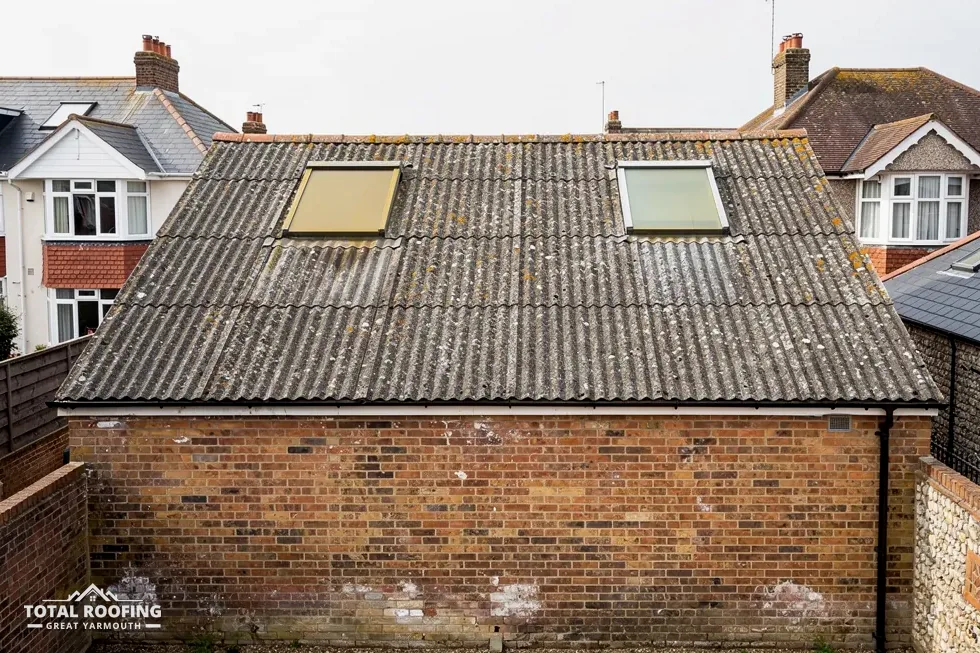
Fibre-cement sheets are a separate case, and a roof of them needs its material established before anything else is done. On a building built or refurbished before 2000, HSE says to assume asbestos is present, and it counts every asbestos cement roof as fragile, so nobody should walk on one to trace a leak. Our fragile roof safety guide explains how they are reached.
Roof lights, gutters and flashings
A roof light is an opening cut in the sheeting, and its upstand, seal and fixings are a joint that has to hold for as long as the roof does. Plastic roof lights also age, and a cracked or distorted one can leak at its edge or through its face.
Gutters are the second large group of causes. A gutter between two roof slopes, or one behind a parapet, can fill with debris and overflow back into the building. For falls, Brett Martin's installation guidance is "1mm for every 600mm" downward towards the rainwater outlet. A run that has sagged into a dip and holds a pool is no longer falling that way.
Flashings at the ridge, at an abutting wall or around a plant opening complete the list. A strip that has lifted, split or lost its sealant lets rain in at the junction. Our guide to industrial roof cladding describes the sheeting these details sit on.
Is it a leak or condensation?
Not every drip comes from rain. Warm, moist air inside the building reaches a cold metal sheet from below, and the moisture condenses into drops that fall. The giveaway is timing: condensation can drip on a cold, dry morning when no rain has fallen, and it spreads across a wide area instead of a single point.
A true leak follows the weather. It appears after rain, concentrates on one run of the roof and can leave a stain that traces back to a single feature. The two can occur together, and a roof with a small leak can also be condensing, so the survey looks at both.
If you can, note the date and time of each drip and whether it was raining, and send a photo on WhatsApp to 07880 284133. Our commercial roof surveys guide explains the inspection. The repair is priced after that survey and arrives as one written total, and the commercial roofing hub lists the other guides.
