
A roof over occupied bedrooms
A hotel or guest house roof does the same job as any other, but a failure costs differently. A leak into a warehouse stops stock moving. A leak into a bedroom takes a room out of use, and the owner may lose the booking and the cost of a ceiling repair as well. The roof is part of the business, and a hospitality owner is right to treat a stain on an upper-floor ceiling as a booking problem as well as a building problem. The sooner the source is known, the sooner the owner can decide which rooms to hold back and which to let.
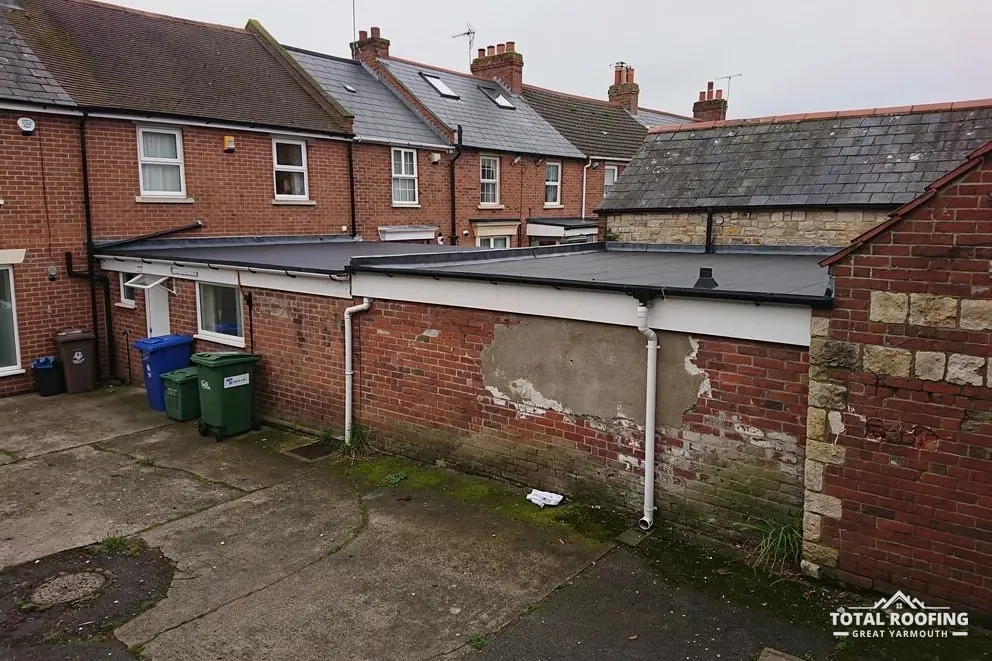
The building can have more than one roof type under one name. A guest house may have a pitched main roof, a flat roof over a rear extension or a kitchen, dormers, a roof terrace, chimney stacks and a run of rainwater gutters at the front and back. Each of these is a separate part with its own covering and its own way of failing. A survey looks at them as one roof, because a stain in a bedroom is not always below the fault that caused it. Water can travel a long way along a rafter or a membrane before it shows.
Our commercial flat roofing systems guide explains the coverings used on the flat sections, and the survey covers both flat and pitched parts in one visit. Afterwards the written price covers the whole job as a single total.
Questions about the age and make-up of the building are for the survey, not for assumptions. Great Yarmouth has hotels and guest houses of many ages, and a roof built or refurbished before 2000 is treated as possibly holding asbestos until a survey says otherwise.
Exposure on the seafront
How exposed a seafront hotel is depends on its own plot, its height and what stands around it, and that is a reason to look closely at how its roof is fixed. What the standard says about it is specific, and it names no wind figure for any address. Marley's guidance on BS 5534, the slating and tiling code of practice, says its minimums "will always be superseded by the generation of a Fixing Specification, which is site specific", and that location counts: the exposure of the roof and the local topography.
In practice, fixings are calculated for the site's exposure under BS 5534, so a roof on the front can call for a different fixing specification from one a street back. Marley also says ridge and hip tiles should have mechanical fixings to resist the calculated wind uplift force. Mortar alone is no longer relied on, because the 2015 amendments to the code made it clear that mortar "could no longer be relied upon as the only means of securing the roof covering".
BS 5534 is a code of practice, and Marley points out that installing to it "isn't required by law". It is the standard that designers and surveyors point to, and a roof fixed to it can be explained to all of them. On a hotel, where the roof is high and the pavement below carries guests and passers-by, loose tiles and ridge pieces are a risk to people as well as to the building.
BS 8612:2018 is a separate standard, for ridge, hip and verge systems fixed without mortar, so a survey records which kind a ridge has. Gutters and downpipes on a tall front elevation matter for the same reason: an overflowing or loose outlet drops water and weight onto the pavement.
What a survey checks on a hotel roof
- Ridge, hip and verge fixings against the specification
- Flat roof coverings, upstands and outlets
- Chimney stacks, flashings and pots
- Dormer cheeks, valleys and window surrounds
- Gutters, hoppers and downpipes at the front
- Ceilings below for signs of past leaks
Working around guests and the season
Timing is the owner's decision, because only the owner knows the booking pattern. The job needs weeks when scaffold and noise can be tolerated, and a roof that is leaking now cannot always wait for them. An owner who reports a leak in the middle of a busy period still has options: a make-safe repair can stop water coming in, and the larger work can be planned for a quieter stretch.
Noise, dust and access shape the plan. Stripping a covering sends vibration through the rooms below, and rooms directly under the work may need to stay empty while it happens. Guests who arrive to find scaffold on the front need to know about it in advance, and the entrance has to stay usable. These are matters for the owner and the roofer to settle together once the survey has shown what the roof needs. Deliveries of materials need a place to stand that does not block the kitchen entrance, and the skip or waste chute needs a route that avoids the guest door. A hotel with a car park at the back has more room to work with than one whose only frontage is the seafront, so the plan starts from the site and not from a template.
Once the survey is done we report what the roof showed, other faults included, and give one written total price for the job. Send a photo of the problem on WhatsApp on 07880 284133 if you want it looked at before a visit is booked.
Myth
A hotel roof job has to wait until the building is empty.
Fact
A make-safe repair can stop a leak now; the larger job is planned around the booking calendar.
Scaffold, the pavement and fire exits
A tall frontage can mean scaffold, and a seafront hotel's frontage sits on or beside a public pavement. Scaffolding on the pavement or road needs a highway licence from the county council; we arrange the licence with our scaffolder. For Great Yarmouth that authority is Norfolk County Council, which charges £178.33 for the first 28 days of a scaffold licence and the same for each further 28 days. The council's page asks applicants to allow 7 calendar days for processing and to apply afresh whenever a scaffold is put up.
Those figures show why the licence period sits in the programme from the outset. Scaffold left up for a long job needs a renewal for each further 28 days, and the owner of a hotel in the middle of the season does not want a licence lapsing while guests are arriving.
The scaffold also has to leave the building's escape routes clear. Fire exits, the main entrance and any external staircase that guests rely on must stay usable, and the fire risk assessment for the premises needs to account for the scaffold being there. Hot works are a further point: torching on a felt membrane puts a naked flame close to an occupied building, so a roofer may choose a covering or a method that needs no flame near the roof timbers. The survey and the fire risk assessment settle that choice together.
Planning, listed buildings and the council
Re-covering a house roof is normally permitted development under Class C, and that wording is about houses. A hotel or guest house can be a different planning case, because the building may be used as a business or may be divided into flats or rooms, and householder rights belong to a house used as a house. Check with Great Yarmouth Borough Council whether a planning route applies to your roof before you order materials.
Seafront buildings may sit in a conservation area or carry a listing. Check with the council whether a conservation area or an Article 4 direction applies to the address. A listed building needs listed building consent for anything that works "in any manner which would affect its character as a building of special architectural or historic interest", and that covers a change of roof covering as well as larger alterations. Great Yarmouth Borough Council's building control team is also the place to check whether Building Regulations apply to a re-roof. For a flat roof renewal on a hotel extension, the council may take an interest in insulation, which falls under the energy rules in Approved Document L; we check the route with the council before work starts.
A full re-roof is a whole-roof job. The Planning Portal says re-roofing does not normally need a building regulations application only if it affects "Less than 25 per cent of the total 'building envelope'" and less than 50 per cent of the roof, so a whole-roof job on a hotel belongs outside that test. Our CDM guide covers the separate duties that fall on a business commissioning the work.
Storm damage and insurance
Storm damage is the point where a hospitality owner deals with an insurer. The Financial Ombudsman Service says: "Rain, hail or snowfall by itself can constitute a storm", and that "a storm usually involves violent winds, usually with rain, hail or snow". It also says "we'll usually look at expert reports and photos". For a hotel, that means taking pictures of the damage as it stands untouched, then telling the insurer.
Keep records of what the damage looked like before a make-safe repair covers it. A tarpaulin or temporary fix stops further water, and the photographs show what it replaced. Keep the invoice and a note of the date the leak began as well, because an insurer may ask for both. Guests' complaints, a room taken out of use and any ceiling repair also belong in that record, since they show the scale of the damage. A survey after the make-safe shows the work the roof needs, and the written price for that work is one total.
Whether a claim succeeds is between the owner and the insurer: the policy, the evidence and the state of the roof decide it. A roofer's part is to inspect the roof and say plainly what is wrong with it.
