
The short answer
Gulls cause blocked gutters, outlets and damaged edges on a commercial roof, and wild bird nests are protected by law while in use or being built. Clear and repair the roof outside that window, then proof the places they settle. A roofer can survey the roof and fit the physical measures.
What gulls do to a roof
A roof with a parapet and a flat deck, a shallow sheet roof or a wide valley gutter gives gulls a ledge to stand, rest and nest on. The harm is practical rather than dramatic, and it builds. Nest material, feathers, food scraps and droppings wash or blow into outlets and gutters. When an outlet is blocked, water has nowhere to go, ponds on the roof and finds the weakest detail.
Droppings gather on sheeting and around rooflights, which dulls translucent panels and leaves a slippery film on a roof that someone may later need to cross. Birds pull at sealant, loosen loose chippings and scratch at soft coverings, so seams and edges can be damaged by constant use.
A building on the seafront, at the port or beside the river can attract them, and an inland unit can too. The roof's own features matter more than its postcode: a flat top, a ledge, a sheltered corner and a gutter with standing water all invite birds. Gutters need a fall towards the outlet, which Brett Martin gives as "1mm for every 600mm", so a gutter that holds water is already a place a bird will use.
Nests, the law and the timing of work
Under the Wildlife and Countryside Act 1981 section 1, a person commits an offence if they intentionally "takes, damages or destroys the nest of any wild bird while that nest is in use or being built". A gull is a wild bird, so a gull's nest is covered by the same rule. What the offence turns on is the state of the nest itself, in use or being built, and that is a matter of fact on the day.
GOV.UK adds a point owners should know: for wild birds, there are no licensing purposes to permit development or construction. Roof work is not a reason that makes disturbing a nest in use acceptable.
The result is that nest removal and clearing belong outside the period when a nest is in use or being built, and that proofing is most useful when it goes on before birds begin to build. Where a nest is occupied, work around it stops, and a doubt about whether a nest is in use goes to Natural England or an ecologist before anyone disturbs it. Surveying a gull-troubled roof starts from that rule.
No calendar dates are set for any season, so it is the condition of each nest on the day that governs.
Proofing, cleaning and repair
- Clearing outlets, gutters and valleys of nest material and debris, and checking that water runs freely to the downpipe.
- Cleaning droppings from rooflights and sheeting, using methods that suit the covering. Marley warns that high-powered jet washes are "not recommended as it can damage the surface of the slate or tile", which is a reminder that harsh cleaning harms a roof.
- Repairing the damage birds have done: lifted sealant, scratched seams and displaced fixings.
- Physical proofing on ledges, parapets and ridges, such as spikes, wires or netting chosen for the building.
Proofing is fitted to the roof's geometry, so the survey comes before the specification. A parapet, a ridge and a plant platform each need something different, and an unsuitable fitting can trap debris or add a new place for birds to rest.
Gutter work is closely connected, and our page on commercial roof maintenance explains what an upkeep visit covers.
Access, safety and how we price it
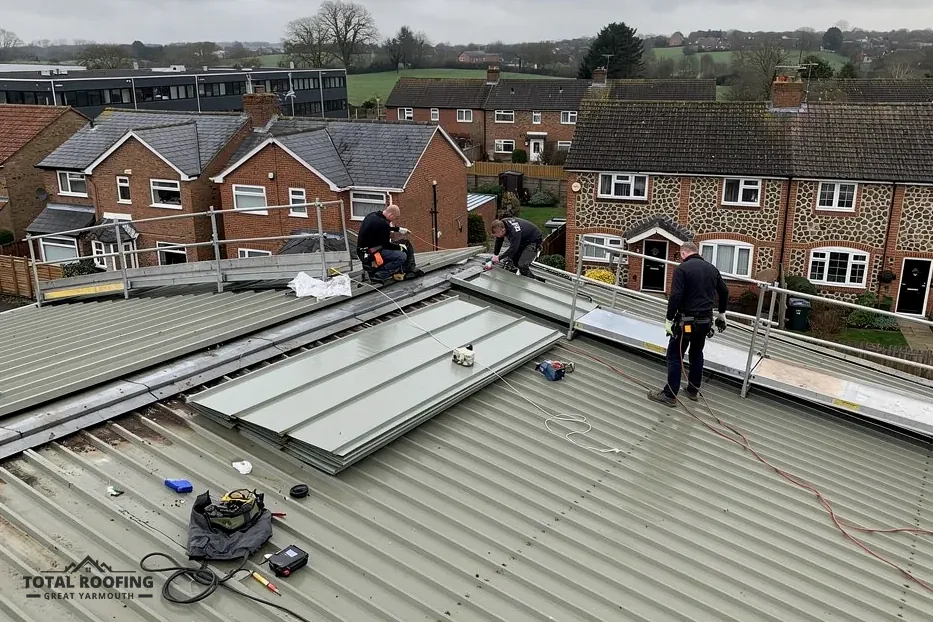
Gull problems sit on roofs that are hard to reach: parapets, valley gutters and flat decks with no edge protection. Our fragile roof safety page explains why a roof with brittle sheets or old rooflights needs a different access plan from a plain flat deck, and the same care applies when the job is gutter clearing.
At Total Roofing Great Yarmouth the starting point is a look at the roof in full, so blocked outlets, damaged seams and bird damage are read as parts of one picture, with anything else we notice reported plainly. The price arrives in writing as one total once that is done, because a business roof is priced from its own condition and access.
Where scaffolding has to stand on a pavement or road, a Highways Act s169 licence is needed from the county council, and we arrange the licence with our scaffolder. Other roofing for business buildings sits under commercial roofing.
