
The short answer
Fibre cement sheets are repaired or replaced bay by bay, but the first question is whether they contain asbestos. HSE's rule for a building built or refurbished before 2000 is to assume asbestos is in it, and HSE calls AC roofs always fragile, so the method depends on that answer.
Asbestos-free sheet or AC sheet
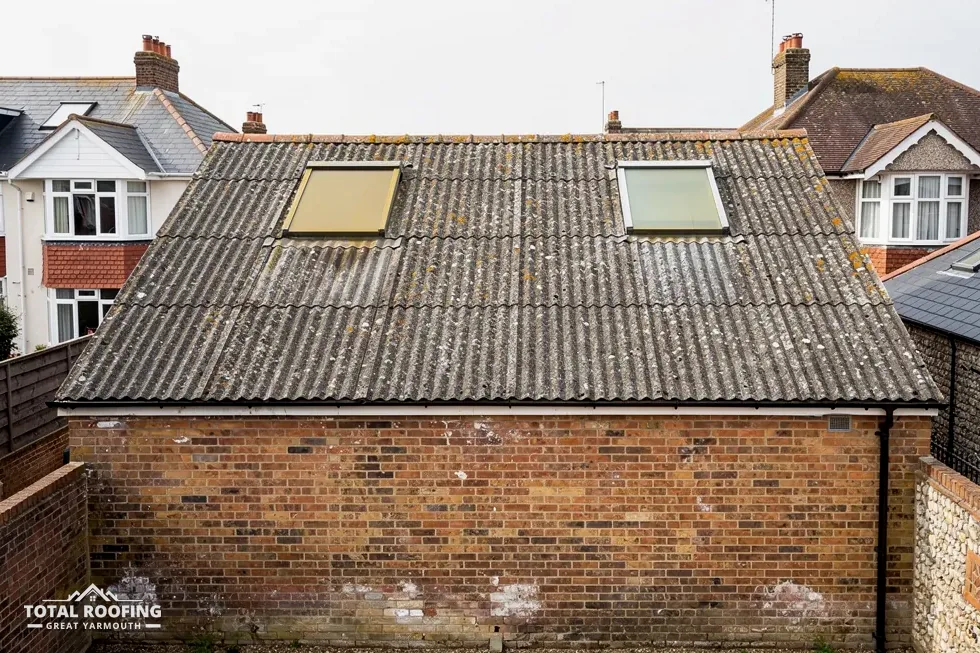
Corrugated fibre cement sheets cover industrial and agricultural buildings, and they look alike whether or not they contain asbestos. Asbestos cement, written AC, is the older material. A sheet made without asbestos can be indistinguishable from it on the roof, so colour, weathering and a clean snap prove nothing either way.
HSE's advice on whether asbestos is present reads: "If the building was built or refurbished before 2000, assume that there is asbestos in it." The rule is about the building's date, not a guess about a single sheet. A newer building is a different case, though a building refurbished in recent decades may still carry older sheets on one slope.
Where the date or the history is unclear, the careful route is to treat the sheets as AC until a laboratory test of a sample says otherwise. One building can hold both kinds, so a survey of the whole roof matters here: it marks which slopes and which sheets are in doubt.
How HSE groups the work
HSE sorts work on asbestos materials into groups, and the sheet's state decides which group a job falls in:
- Non-licensed work: asbestos cement roof sheeting, handled gently and taken off whole, including sheets weathered by age but not otherwise badly damaged.
- Notifiable non-licensed work: sheeting that has been cracked through, crushed or broken into pieces, with fire and flood damage as HSE's own examples.
- Licensed work: most jobs on asbestos insulating board, a different material that HSE lists in white soffit panels beneath roof eaves.
The dividing idea is breakage. A sheet unscrewed and lifted away intact is one thing, and a sheet that is drilled, cut or walked on and cracks is another. That is the reason a repair on AC is planned before anyone touches it, and why a quick fix from a ladder, with a drill or a hammer, is the wrong place to start. Waste follows the same care, and HSE's guidance says: "Use a lockable skip for asbestos".
Patch, replace a sheet or cover the roof
The options run from small to large. A localised repair deals with a split, a lifted corner or a hole where a fixing has failed. Replacing sheets removes the damaged units and fits new ones in the same bay. Over-cladding keeps the old sheets in place and fits a new covering above them, so the sheets are not taken off at all. Our page on over-cladding asbestos roofs explains that route.
Which one fits is settled by what the sheets and the structure can bear, not by preference. A roof with isolated cracks, sound fixings and sound purlins can be repaired. A roof whose sheets are crazed across a whole slope, or whose fixings have pulled through, is past patching, and each patch adds weight to a covering that is already struggling.
Translucent panels matter as well. They sit among the fibre cement sheets, and a rooflight that has gone brittle is as fragile as any AC sheet beside it, so it falls under the same access plan.
HSE guidance A14 states that "AC roofs are always fragile". A cracked sheet will not take a person's weight, and neither will its neighbours, which is why reaching the roof safely is the first job. Our fragile roof safety page covers it.
How a quote for sheet work comes together
The survey comes before any figure. We go over the roof as a whole and the structure carrying it, work out which sheets are in doubt, and report anything else that turns up on the way, such as gutters, ridge pieces and flashings, in plain words. The written price then covers the work in one total.
No price can be set for sheet work until the asbestos question has an answer, and business roofs are priced only after a survey. Our commercial roof surveys page sets out what is looked at, and the rest of the business roofing work is gathered under commercial roofing.
If a sheet has cracked and you want to show it to us, send a picture by WhatsApp from the ground. Keep off the roof, and do not move, drill or break the sheet in order to get the shot. A clear view of the damaged corrugation, the fixings and the sheets either side is all we need to decide what the survey should cover.
