
The short answer
A commercial roof condition report records what can be seen of the roof's covering, drainage, edges and fittings, with the faults found and what they imply. It is visual, so it cannot confirm what lies under insulation or cladding. A buyer, lender or landlord sets what form it must take.
Who asks for one and why
A condition report on a commercial roof is a record of the roof at a point in time. It is requested by a buyer who wants to see what the roof will demand in upkeep, by a lender weighing a loan against the building, by a landlord checking a tenant's care of the premises at the end of a term, or by an owner who is deciding whether to repair, recover or replace.
Each asks a slightly different question. A buyer asks what is coming. A lender asks about risk to the asset. A landlord asks whether the roof meets the lease. A tenant asks what will be demanded of them. The same roof can therefore be described in different ways for different readers, and the person who requires the report should say what it must answer and in what form it is to be produced.
Where the requirement is formal, such as a lender's condition or a sale, ask that party who may produce it. Some will name a chartered building surveyor. Our roof dilapidations at lease end page covers the lease-end angle, where the same roof is read against a repairing covenant.
What a good report covers
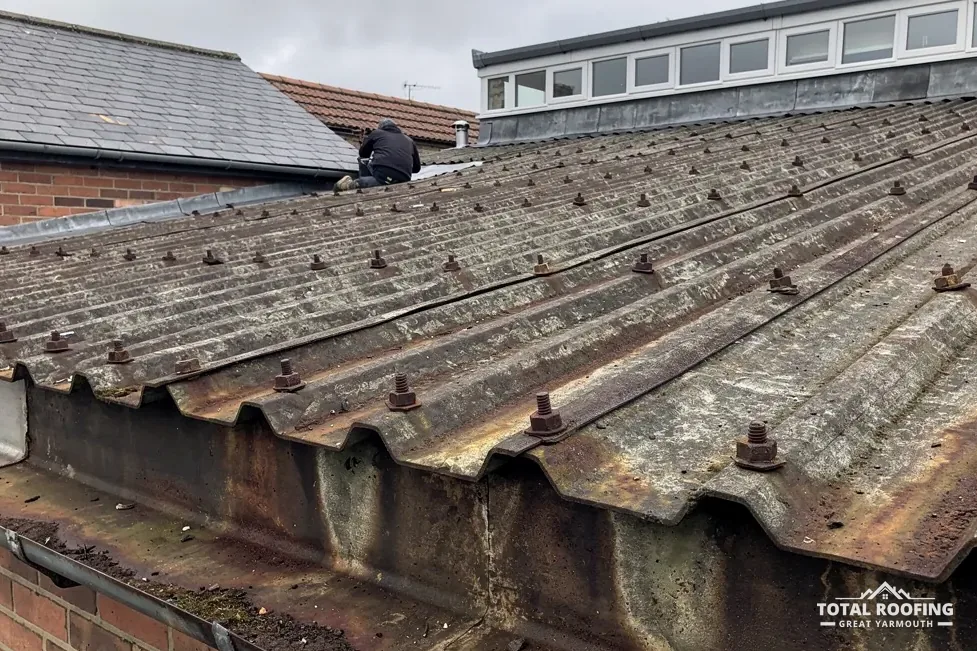
- The covering: profiled steel, fibre cement, single-ply or felt, its condition and any splits, laps, blisters or corrosion.
- The fixings and the structure that carries the covering, as far as they can be seen.
- Rooflights, vents, flues and other penetrations, with the seals around them.
- Gutters, downpipes and outlets, and whether water leaves the roof cleanly.
- Edges, parapets, flashings, copings and upstands.
- Evidence of earlier repairs, and whether they have held.
- The route onto the roof, and whether it is fragile.
- Any sign that the sheets may be asbestos cement.
On a flat roof the report also looks at falls and ponding. BS 6229:2025 sets a minimum finished fall of 1:80 for membrane flat roofs, so standing water on a membrane is worth noting against that figure.
A good report separates what was seen from what is assumed, and says which parts could not be reached or seen. It also ranks the faults, so that a split lap that is letting water in weighs more than a faded coating.
Where a visual look stops
A condition report is a visual inspection. It sees the outside of the roof, the underside where there is a way in, and any marks inside the building. It cannot see through insulation, behind cladding or into the core of an insulated panel, and it cannot test the strength of fixings that are hidden. Anything found to be uncertain is stated as uncertain.
That limit bites on two subjects. One is asbestos: HSE's guidance reads "If the building was built or refurbished before 2000, assume that there is asbestos in it." Only a laboratory test confirms a given sheet. The other is access: HSE's guidance A14 says "AC roofs are always fragile", so a report on one is written from the ground and from safe vantage points.
A report is also a snapshot. It states the roof's condition on the day it was seen, and a roof that reads sound now can still change after a gale or a long wet spell, which is why a buyer may want a fresh look close to completion. Our page on commercial roof maintenance covers keeping an eye on a roof between surveys.
A condition report beside a roofer's survey
A roofer's survey does a different job. Ours is a survey carried out ahead of a quote at Total Roofing Great Yarmouth. It takes in the entire roof, beyond the one spot that prompted the call, with the findings put to you in plain terms and a price in writing as a single total. It is a basis for repair work, not a formal report prepared for a third party to rely on.
If you are buying and the roof looks tired, a roofer's view of what the faults would cost to put right is useful beside the surveyor's report, because it turns findings into work. A business roof gets its own figure once it has been surveyed, set out as one written price.
Where a roof is in poor shape, the useful question for a buyer or landlord is what putting it right would involve, and that is a matter of repair work, recovering or replacement, each priced from the roof itself. The full range of business roof work is under commercial roofing.
