
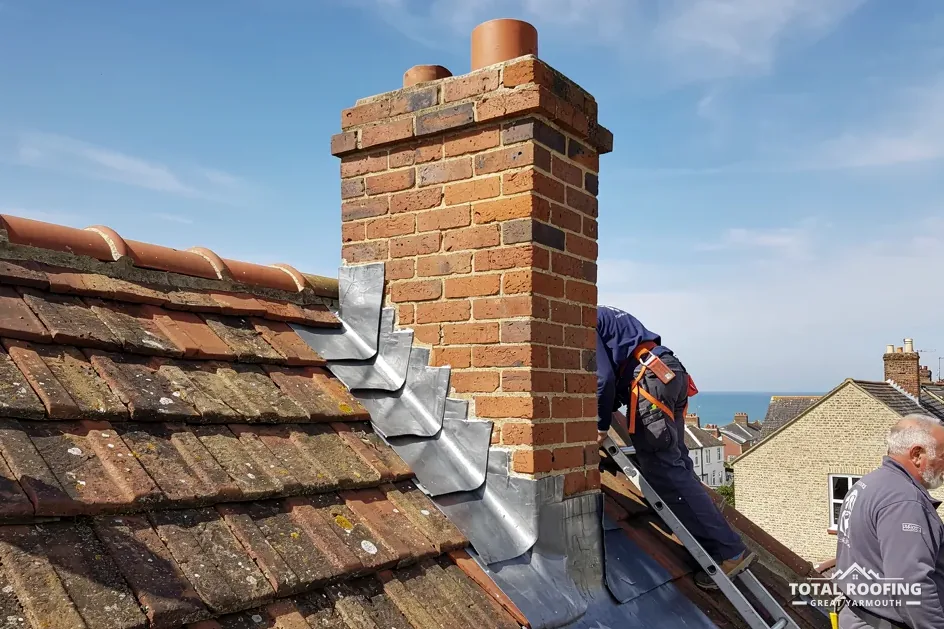
Who owns what on a shared stack
A shared stack is one block of brickwork that rises above the ridge and carries the flues of two houses, or sometimes more. Down in the loft the two chimney breasts stand back to back on the dividing wall. Above the roof they come together in a single stack with one set of pots, one flaunching and one run of flashing along each side. From the street it looks like one chimney, which is why people assume it belongs to one household.
Ownership is a legal question, not a roofing one, and the answer sits in the title deeds and the plans attached to them. Some deeds divide the stack down a centre line. Others say nothing at all. Nobody can read a property boundary off the brickwork, so if the deeds are unclear, ask a conveyancing solicitor or a party wall surveyor before a repair is planned.
What the roof does tell you is which parts are common. The stack itself, the flaunching on top and the pots are shared by their nature, because water that enters one flue can reach the other through the same masonry. The flashing is different: a run of lead on your side of the stack protects your slope, and the one on the neighbour's side protects theirs. A split in one does not leak into the other house, but both are fixed into the same brickwork.
That mix of shared masonry and separate roofs is why a shared stack needs a plan before anyone goes up a ladder. A survey of the whole roof, not only the slipped tile you rang about, looks at the stack from every side that can be reached, so the neighbour's slope and your own are both on the list. The plain finding goes to you, including what else we saw, and you decide what to raise with next door.
The Party Wall etc. Act 1996 and a shared stack
Work on a wall that two owners share is covered by the Party Wall etc. Act 1996. The Act lets the owner who wants the work, called the building owner, do certain jobs to a party structure, provided notice is served on the adjoining owner first. Two of the jobs it lists apply directly to chimneys. Section 2(2)(g) allows an owner "to cut away from a party wall … any footing or any projecting chimney breast, jamb or flue", and section 2(2)(j) allows an owner "to cut into the wall of an adjoining owner's building in order to insert a flashing or other weather-proofing".
Notice for that kind of work must "be served at least two months before the date on which the proposed work will begin", says section 3(2)(a). It is the building owner's job to serve it, not the roofer's and not building control's. The neighbour can agree in writing, and under section 3(3)(a) work can then start with "the consent in writing of the adjoining owners and of the adjoining occupiers", and an early start is possible that way.
If the neighbour does not consent "within the period of fourteen days", section 5 treats the neighbour as deemed to have dissented, and the Act says a dispute is then taken to exist. GOV.UK puts it plainly: "You cannot assume that no response means they agree to the works." Section 10 then sends the dispute to a surveyor procedure, where one agreed surveyor or one each settle how the work is done. This is not a veto: the neighbour cannot simply refuse and stop a lawful repair.
Whether a particular repair counts as work to a party structure depends on the wall and the work. Renewing the flaunching from above may not touch it. Cutting new lead into the neighbour's side of the brickwork may. A party wall surveyor is the right person to decide that, and questions about the Act do not go to building control.
A party wall notice, in order
- Decide what work the stack needs and where it touches the shared wall
- The building owner sends the neighbour a written notice
- Allow two months for work to a party structure
- Neighbour consents in writing, or has fourteen days to reply
- No consent means a dispute and a surveyor under section 10
Flaunching, flashing and pots at the join
Four parts of a shared stack let water in when they fail. The flaunching is the mortar slope that holds the pots in place and sheds rain off the top. The flashing is the strip of lead that seals the joint between the brickwork and the roof covering. The pointing is the mortar between the bricks. The pots and any cowls complete the head. Each has its own page in our guide to chimney flaunching and the other repair guides, but on a shared stack there is one extra problem: the parts on your side and the parts on the neighbour's side are exposed to the same weather and age together.
A cracked flaunching on the shared top is the clearest example. Rain that gets in does not stop at an invisible centre line. It runs down the flue and the masonry on both sides. Repairing only half of the head leaves the other half cracked, so a sensible plan treats the head as a single job, with the neighbour's agreement, even if the lead below it belongs to each roof separately.
Lead flashing is graded by code from 3 to 8 under BS EN 12588, and Leadworx, a lead flashing maker, says code 4 "has become the standard choice for general flashing work". The specification sets the code for each detail. MyJobQuote says correctly installed lead flashing "can last for over 80 years", though a stack that has moved or been repointed badly will fail well before that, at the joint and not in the sheet.
Where the flashing has to be cut into the brickwork on the neighbour's side, that is the section 2(2)(j) work described above, so the notice question comes back. It is worth raising early, because the lead may be a small part of the job and the notice period the longest.
Taking a stack down or removing a breast
Some shared stacks are no longer used. The fireplaces below have been closed and the owner wants the weight and the maintenance gone. That is a bigger decision on a shared stack than on a detached house, because the structure is carrying two flues and part of a wall.
Raking out a chimney breast always needs Building Regulations approval, because a breast is structural to the building, and one on a party wall brings the party wall notice in too. Cutting away a projecting breast is named in section 2(2)(g) of the 1996 Act. Our chimney repairs hub and the guide to removing a chimney stack explain the structural side; this page is about the shared wall.
Lowering the stack above the roofline raises a separate question. Chimney, flue and soil and vent pipe work is outside Class C of the General Permitted Development Order, which covers other alterations to a house roof, so the planning route is not settled by Class C. We check the planning or building-control route with the council, or with the Broads Authority if the address falls within its executive area, before work starts. A listed house needs listed building consent where the work would affect "its character as a building of special architectural or historic interest", and a conservation area or Article 4 direction is a question for the council as well.
When one household wants the stack down and the other does not, the stack cannot be removed from one side only. The neighbour's flue still needs a stack to vent through, and it needs to stay weathertight. Either the stack is rebuilt in a smaller form that still serves the remaining flue, or both owners agree to the change in writing.
Myth
One owner can take down the whole shared stack without asking next door.
Fact
The stack carries both flues and may be a party structure, so notice and agreement come first.
Scaffold, access and sharing the cost
A chimney stack above a terrace or semi is reached from the roof or from a scaffold. Scaffold reaching onto the pavement or road is subject to a highway licence, which the county council issues under section 169 of the Highways Act 1980. We arrange the licence with our scaffolder. The licence belongs to that job, so a scaffold put up for you is one scaffold, not two.
Because the stack is shared, one scaffold can serve both houses, and that is the obvious saving for neighbours who agree to work at the same time. Work on both sides of the stack can then be done in a single visit to the roof, without a second scaffold erected a month later. The arrangement between you and the neighbour about who contributes what is a private agreement. We cannot split a bill between two households, and we do not write a quote for a neighbour's half of a job that they have not asked us to price.
If your neighbour wants nothing done, your side can still be repaired. Your repair has to stay within your own property and your own side of any party structure, and any work that cuts into theirs needs the notice route above. If the stack head is cracked and both sides are exposed, the survey says so plainly, so you can show the neighbour what was found.
Our quote comes as a single total price in writing, set after a survey, for the work on your roof and your side of the stack. The same one price takes in any scaffold the job needs.
What sets the cost, and the figures published
Access is the first thing that sets the cost of chimney work: how high the stack stands, whether a scaffold is needed and how far the ridge is from the ground. After that comes the amount of masonry that has to be rebuilt, the lead that has to be renewed and whether the work touches the shared wall. A shared stack adds one more factor, the time taken to agree the work with next door.
MyJobQuote publishes averages for chimney removal. Its page, last updated 03/11/26, gives "around £2,500" for removing a chimney breast and "around £3,000 to £3,500" for taking the entire stack down together with the breast. For chimney leadwork only, its 22/09/26 page prices patching chimney lead flashing at around £200 and a full replacement at an average of around £570. Those figures are for chimney lead, not for other lead work. MyJobQuote states no VAT basis for these figures, and each is a national average rather than a price for one house.
Repointing a chimney is priced after the survey is done, since the published figures disagree with each other and the amount of loose joint cannot be judged from a table. A shared stack is priced on the same basis, using what the survey finds on your side and on the shared head. The surveyor looks at the pots, the flaunching, the pointing, the flashing on both slopes and the loft side of the breast where it can be reached, so the written total covers the whole stack that your roof carries and not just the one defect that prompted the call. If a neighbour agrees to work at the same time, that changes the access but not the principle: each household still receives its own written price for its own roof.
Published chimney averages
| Removing a chimney breast | around £2,500 |
|---|---|
| Whole stack taken down with its breast | around £3,000 to £3,500 |
| Chimney lead patch repair | around £200 for chimney lead |
| Chimney lead full replacement | around £570 for chimney lead |
MyJobQuote, pages last updated 03/11/26 and 22/09/26. National averages, no VAT basis stated.
