
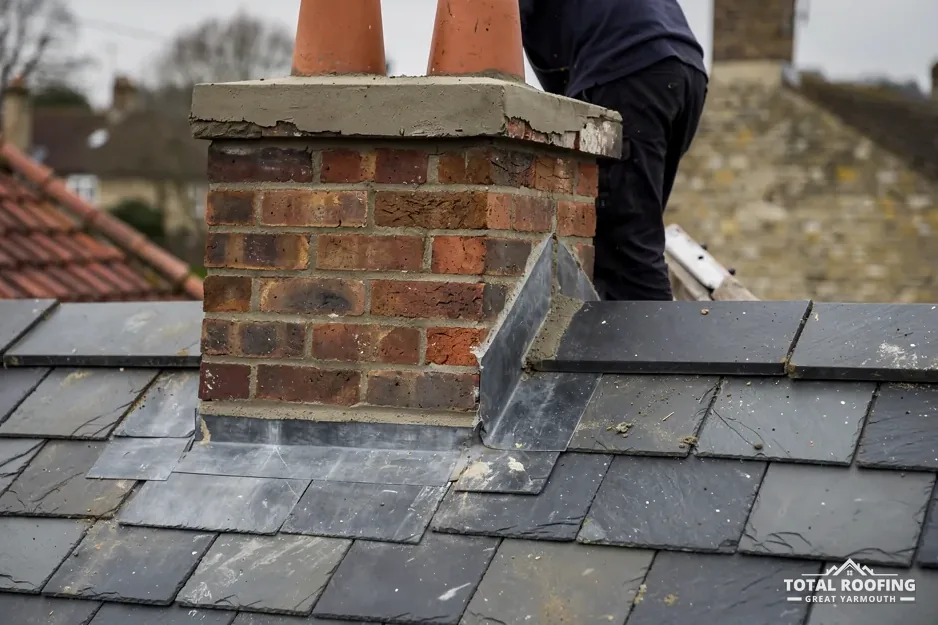
The short answer
A rendered stack stays dry only while the render is sound. Cracks and hollow patches let rain in and keep it there against the brick. The options are patching, stripping the render and repointing the brick, or re-rendering the whole stack once the cause is found.
What the render is doing on a stack
Render is a mortar coat spread over the face of the brickwork and finished smooth or textured. On a chimney stack it does two jobs. It gives the brick a continuous skin that sheds rain, and it covers brickwork that has weathered too far for repointing alone to rescue. Some stacks are rendered to match the walls of the house below, which means the finish sits across the whole of the chimney from the roofline to the pot.
That continuous skin is also the weakness. Rain runs off it as long as it is whole, but the skin is rigid, the brick behind it moves slightly with temperature and damp, and the coat depends on its grip on the surface under it. When it fails, it fails in patches, and a patch is enough to let water behind.
What lies under the render differs from stack to stack. The brick below can be sound or softened, which is why a survey looks before anyone decides between patching and replacing the coat.
How a rendered stack goes wrong
Water is the cause every time, and render hides the evidence. Look for these from the ground:
- Hairline cracks running across the face, or a map of fine cracks all over it.
- A patch that bulges or sounds hollow: the coat has come away from the brick.
- Pieces that have fallen to the roof or garden.
- Damp or staining on the breast wall or ceiling beside the chimney inside.
- Green growth or dark streaks running down from a cracked area.
Once rain enters behind the render, the coat holds it against the brick. In winter that water can freeze and push the coat further off, which enlarges the patch. The damage does not show on the surface until a piece falls, so a stack that looks acceptable from the street can still be taking water behind a skin that has lost its bond.
Cracks near the top of the stack sit beside the flaunching, the mortar bed that holds the pot. A split there lets water in from above, and the repair has to deal with both the render and the bed together.
Patch, strip or re-render
The choice turns on what is under the coat. Where the render is sound over most of the stack and only a small area has failed, the loose coat is cut back to a firm edge and the patch is made good. Where it has come away across a wide area, the coat is stripped, the brickwork behind it is examined, and the stack is either repointed bare, following our guide to chimney repointing, or given a new coat of render.
Stripping shows what the render was covering. Badly weathered brick may need cutting out and replacing, and a stack that has moved may point to a chimney stack rebuild instead. The reverse can happen too: a cracked coat over sound brick is a cheaper and smaller job than one over brick that has failed.
Repair prices turn on the area of render, the access and the state of the brick under it, so your own figure is fixed after the survey. For changes to the look of a stack on a listed building, in a conservation area or in the Broads, check with the council before the finish is altered. The permitted development class for roof alterations excludes a chimney, so any change beyond like-for-like repair should be raised with the council first.
Flashings, lead and the survey
Where the lead flashing meets a rendered stack, it is tucked into a groove cut in the coat. Renewing the render disturbs that line, so the lead is looked at in the same visit. MyJobQuote says correctly installed lead flashing can last for over 80 years, and a good flashing is worth keeping and re-dressing where the survey finds it sound.
At Total Roofing Great Yarmouth the survey looks over every slope, so the render, the flashings, the pot and the tiles beside the stack are looked at together, and whatever else shows up is described plainly. You then receive one written total price for the work.
A photograph of the stack sent to WhatsApp 07880 284133 gives a first view of the render. On a stack shared with a neighbour, cutting a flashing into the party wall is party structure work, and notice is due at least two months before the date on which the proposed work will begin. For the wider range of stack faults, return to chimney repairs.
