
The short answer
It depends on the job and the roof, and no honest figure can be given before a survey. A small repair is a different task from a full re-roof, a flat roof or a chimney stack. Notice periods for scaffold licences, consents and neighbours can add time before anyone goes up.
Why a repair, a re-roof and a chimney job differ
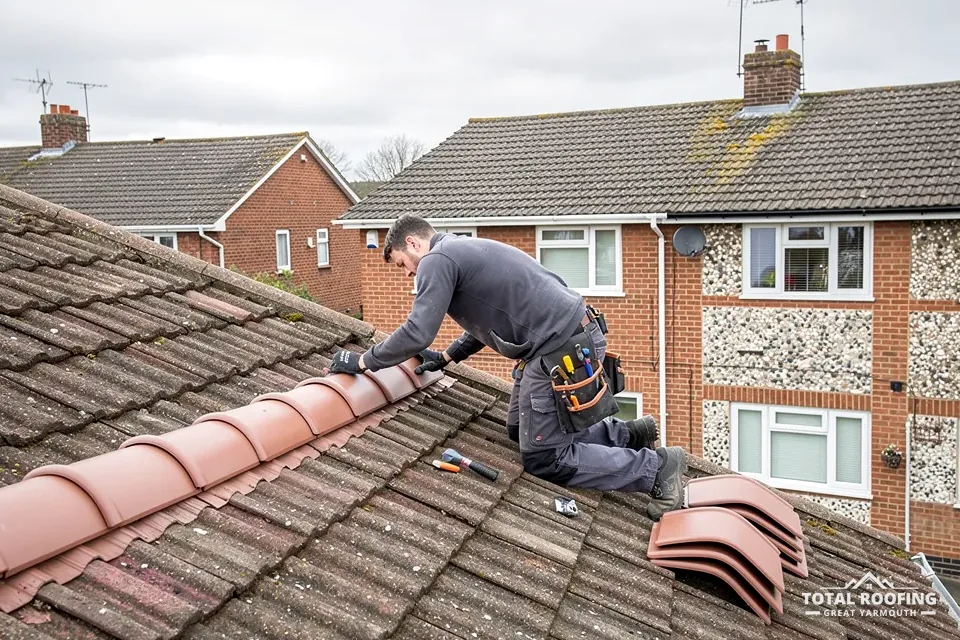
A repair to a few slipped tiles means reaching the spot, lifting the damaged pieces, checking the battens and underlay beneath them and laying sound ones back. The work is confined to one area of one slope, and the scaffold question may not arise at all.
A full re-roof is a different undertaking. The old covering comes off the whole roof, the battens and underlay are checked and may be renewed, and the new covering goes on slope by slope, with the ridge, verges and flashings finished last. Every edge and junction is a separate piece of work, and a larger or more complicated roof has more of them.
A flat roof depends on its deck and its membrane: the deck must be sound and laid to a fall, and a membrane over it has its own sequence of steps. A chimney job spans the stack, the pot, the flashing where it meets the roof and sometimes the brickwork, and the scaffold needs to reach all of it. Because every roof is built differently, a general day count would mislead you, and the plan for your own roof is set once the survey is done.
Waits that come before anyone goes up
Some of the longest delays are not on the roof at all. Any scaffold that obstructs the road or pavement needs county council permission, and at Total Roofing Great Yarmouth we arrange the licence with our scaffolder. Norfolk County Council's page says to allow 7 calendar days for an application to be processed, and Suffolk County Council's asks for 10 working days' notice, so the county matters.
Building control comes next where the job needs it, for instance a full re-roof, or a new covering that is 15 per cent or more heavier. A listed house brings a consent step of its own, and the council decides in its own time. Our guide to planning permission for roof work sets out when a planning route applies.
Neighbours can add weeks. Under the Party Wall etc. Act 1996, the notice for work to a party structure goes out "at least two months before the date on which the proposed work will begin", and a new boundary wall needs "at least one month before he intends the building work to start". The party wall guide explains which jobs are caught.
What can stretch the work once it is under way
Weather is the obvious one. A roof cannot be left open to rain, and wet or windy days can hold up a stripped slope until it is safe to carry on. A job that looks short on paper may therefore be spread over more days than you would count.
The roof can also reveal what no survey from outside could show. Rotten battens, damaged rafters or old nails that will not hold are found once the covering is lifted, and they need sorting before the new covering goes down. Matching tiles or slates to an existing roof can take longer than ordering new ones, as can a supplier's delivery date.
Wildlife can stop work altogether. Birds nesting under the eaves and bats roosting in the roof are both protected, so a discovery can pause the job while the rules are checked, and bat-affecting work may call for a Natural England licence. Asbestos also changes the plan: HSE's advice is "If the building was built or refurbished before 2000, assume that there is asbestos in it."
Planning around the uncertainty
- Ask for the start of the work to be given as a window, not a single date, and for what could move it to be written down.
- Check early whether your address needs a scaffold licence, building control or consent, because those waits come first, and ask the council which of them apply.
- Tell the roofer about any shared roof or party wall at the start.
- Keep the written quote: one total price covers the job, whether it runs long or short.
We survey the whole roof before we quote, and we report on anything else we notice, so the job you are quoted for is the one the roof needs. A quote that states one total price can be compared directly with another, whichever firm gives it and however many days the work finally takes. If the answers to the questions above are not yet clear, that is a good reason to wait for the survey before booking a date with anyone.
