
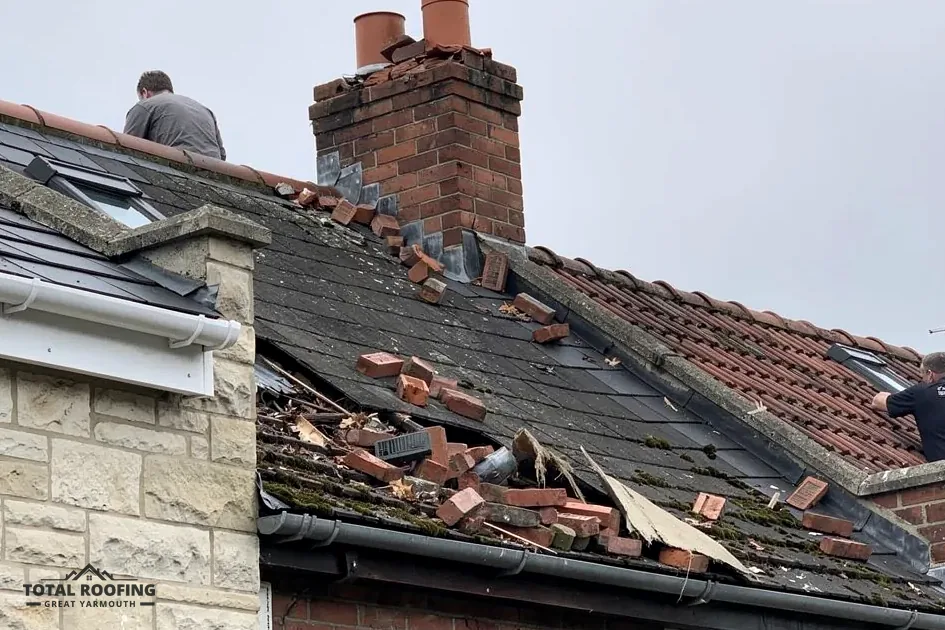
Why the chimney is the thatch question
Thatch is a dry, thick covering made of reed or straw, and it sits very close to a chimney stack at the point where the stack rises through the roof. In a tiled house the chimney meets slate or clay, which does not burn. In a thatched one it meets the covering itself, so the condition of the chimney matters to the whole roof.
Broads cottages and village homes across Norfolk and Suffolk can carry thatch, and the same fire safety guidance applies to all of them. The advice does not depend on how common thatch is. It applies to any home where a flue passes close to thatch.
The sources for this post are the fire and rescue services themselves. Six services, among them Norfolk and Suffolk, published a joint thatched properties booklet in 2017, and it is the clearest public statement of where chimney-related fires start. It is a guide for householders, written by the people who attend the fires.
We are a roofer, not a thatcher. We look at the chimney stack, its flaunching and its lead, and we leave the thatch to a master thatcher. That division of work is covered below, and it matters because the stack and the thatch need different skills.
What the fire services' guide says
The joint guide reports a finding that shapes everything else. In its words: "Recent research has identified that a major cause of chimney related thatch fires is attributable to heat transfer through the brickwork of the flue into the adjacent thatch." The fire does not start at the pot or in the open flame, but in heat moving through solid brick to the thatch beside it.
That is why the guide's advice centres on the flue itself. Its instruction on upkeep is short: "Have the chimney swept regularly by a qualified chimney sweep." It does not set a number of sweeps a year in the passage we are using, so the right interval for your appliance and fuel is a question for the sweep and for the guide itself, which you can read in full.
The guide also deals with spark arrestors, which are mesh caps fitted to a chimney top. The guide does not recommend them, and adds that where one is installed it "must be kept clean". So the advice is not to treat one as a cure-all, and to keep it clear if one is already there.
Our chimney repair service deals with the stack and the roofing beside it, and what the guide describes is the reason that work needs care.
Points from the fire services' guide
- Heat can pass through flue brickwork into the thatch
- Regular sweeping is a job for a qualified sweep
- Keep any spark arrestor clean
- The guide covers Norfolk and Suffolk services
What a roofer looks at on the stack
A stack is a column of brick with several layers of protection on top, and every layer does a different job and wears out in a different way. The brickwork carries the flue. Pointing fills the joints. Flaunching is the sloping mortar crown that beds the pot and throws rain clear. Lead flashing seals the junction between the stack and the roof. When any layer fails, rain gets into the brick and can cause trouble beneath.
On a thatched house, a survey of the stack looks at the parts a roofer deals with. Is the pointing sound, or are the joints open? Has the flaunching cracked? Is the pot secure? Is there lead at the base, and is it sound? These are the same checks for any chimney, and the extra stake with thatch next to the flue is a reason to take them seriously.
The inside of a flue is a different matter: a chimney sweep can inspect and sweep it, and the people who fit and service the appliance know its condition. A roofer's survey covers the stack's exterior and the roof around it.
Our guides on chimney flaunching and chimney repointing explain those two jobs in detail.
What the stack survey checks
- Look at the pointing between the bricks.
- Check the flaunching for cracks and gaps.
- Check that the pot is firm in its bed.
- Check the lead at the foot of the stack.
- Look at the junction between the stack and the thatch.
Who repairs what: the stack and the thatch
Thatch is repaired by a master thatcher. Reed and straw covering needs a different set of tools and a different knowledge of how the material sheds water. That work belongs to the thatcher. If your cottage needs the thatch patched, ridged or re-laid, the thatcher is the person to ring.
The stack is ours to look at. Work on the brickwork, the pointing, the flaunching and the lead is roofing and masonry, and it can be done alongside a thatcher's repair when both are needed on the same chimney. The order of work, and how the two trades share access, is worth settling before either starts. A thatcher may need to work round the stack, and a roofer needs to reach it, so a short conversation between the two firms, with you in the loop, avoids one trade undoing the other's work.
Access to a chimney on a thatched roof can need care. A scaffold that takes up pavement or carriageway has to be licensed by the county council as highway, and we arrange the licence with our scaffolder. On a cottage set back from the road the scaffold may stand on your own land, but the survey will say what the job needs.
If you want to choose a thatcher, ask to see recent work and speak to the owner of a roof they have done, as you would with any trade.
Consents on an older thatched home
A thatched cottage can be old, and it may be listed. A listed home keeps its permitted development rights for roof work, though any work that would affect the building "in any manner which would affect its character as a building of special architectural or historic interest" needs listed building consent. A chimney can be part of that character, so work on the stack starts with a conversation with the council.
Building Regulations can apply to repair work in some cases, and the right route is to check with your council's building control team before work starts. Before anything begins, we check the route with the council, or with the Broads Authority where a home sits inside its area. Planning for a home inside the Broads executive area goes to the Broads Authority, which says: "We are the local planning authority for all land and properties within our executive area".
Part of a town can sit inside that area and part outside, so check the address. If you are unsure whether a conservation area or an Article 4 direction covers the house, ask the council: our chimney stack rebuild guide covers what rebuilding a stack involves.
Removing a chimney breast always needs Building Regulations approval, as the breast is structural. That is a different job from repairing the stack above the roof, and on a thatched house it needs thought before anyone takes a tool to it.
Myth
A chimney on an old cottage can be repaired without asking anyone.
Fact
A listed home needs listed building consent where the work touches its character, and other routes may apply.
Signs on the stack worth a closer look
Between professional visits, you can look at the chimney from the garden or the lane. A pair of binoculars helps, and there is no need to climb anything. You are looking for change: something that was not there last time you looked, or something that has got worse.
Mortar lying on the roof or in the gutter suggests the pointing or the flaunching is breaking up. A pot that sits at an angle, or a stack that leans, needs a survey soon. A pale crust on the brick can be a sign of water working through the stack, and a brown stain on the chimney breast inside a bedroom or the loft points the same way. Water in a stack is a roofing problem, and it can sit alongside the fire question without being the same thing.
Where thatch meets the stack, notice any gap, any thatch that looks disturbed or any sign of wear around the junction. That junction is for the thatcher to judge, and a photograph of it is a good thing to hand them. Your photographs also give any roofer a clear starting point before the survey.
The fire and rescue services' guide puts the sweep first: a qualified chimney sweep is to sweep the chimney regularly. Alongside that, keep the outside of the stack in repair, so that the brick, the mortar and the lead are doing their jobs. Our guide to chimney stack rebuilds covers the point where repair stops being enough.
Questions to ask before work starts
Before any work on a chimney beside thatch, a few plain questions save trouble. Who is doing the stack, who is doing the thatch, and in what order? Has a sweep looked at the flue? Does the home's insurer need to be told about the work? That last question is for your policy and your insurer, and this post cannot answer it.
Ask for the work to be described in writing. Our quote, written after the survey, carries one total price and describes the stack work we would do. Compare that with what the thatcher plans, so the two descriptions meet at the same joint and neither leaves a gap for the other to assume.
If a chimney is in use, think about when it is lit. Work on the stack may mean the appliance has to stay cold for a while, and a thatched home that has just had mortar work needs the new mortar to set before the fire is used. Ask whoever does the work how long to wait.
To start, a picture of the stack sent to WhatsApp on 07880 284133 is welcome, and so is a call to 01493 277103 or the quote form. We look at what you send, and a survey follows.
