
What the published lifespans for slate actually say
Ask how long a slate roof lasts and you will hear big numbers, 150 years or 200 years among them. The published guide figures are smaller, and each is an estimate. HomeBuilding, last updated 30 September 2025, gives approximate lifespans: Welsh slate at "100+ years", Spanish natural slate at "75-100 years" and reclaimed Welsh slate at "50-80 years". Nothing in that table reaches 200.
Two details in that table matter. The figures are approximate, and "100+" is an open-ended entry that says a long time without naming an end. It is not a promise about any particular roof, and it is not the same as saying that the whole roof, slate and everything holding it up, will reach that age. A figure for a material is a figure for the material.
Compare it with other coverings from the same table: clay tiles at "60-80 years" and plain concrete tiles at "40-50 years". Marley, the tile maker, says: "Typically, roof tiles are expected to last for around 60 years", and adds: "This is not a guarantee or warranty of its longevity." Marley and HomeBuilding give different figures for concrete tiles.
So slate does sit at the long end of the published range. A roof that reaches 100 years is within what the published guide describes. A roof that reaches 200 would be a rarity, and no figure in the guide supports promising it.
Myth
A slate roof will last 200 years once it is laid.
Fact
Published guides give Welsh slate "100+ years", approximate, and promise nothing for a particular roof.
What wears out on a slate roof before the slate does
The slate is only one part of a slate roof. Each slate hangs from a fixing on a timber batten, over an underlay, with lead at the junctions and mortar or dry systems along the ridge and verges. The slate can outlast several of the parts around it, and a roof is judged by the parts that give out, not by the one that lasts.
Fixings are one place to look. Each slate is secured with a nail or a hook, and a nail that has rusted through or pulled loose lets the slate slip. This is called nail fatigue, and our guide to nail fatigue in slate roofs explains how it shows. A slipped slate on an otherwise sound roof can be a sign that the fixings across the slope need attention, not only the one you can see.
Battens and underlay sit out of sight, so their condition is hard to judge from the ground. Timber that has been damp for a long period can soften, and an old underlay can tear or perish. Both are things a survey looks at when the slates are lifted or the loft is inspected, and both can be wearing out while the slate looks perfect. A loft inspection and a look at the slate's underside, where it is possible, tell more than a view from the road.
Gutters, flashings and the ridge border the main field of slates and wear in their own ways. Until a worn part is replaced, it sets the limit for the whole roof.
Parts that can wear out before the slate
- Nails or hooks holding each slate
- Timber battens beneath the slate
- The underlay in the roof space
- Lead flashings at chimneys and abutments
- Ridge and hip bedding
- Gutters and the fascia behind them
Lead, zinc and the details around the slate
Lead flashings protect the junctions where slate meets a wall or chimney. MyJobQuote says correctly installed lead flashing can last for over 80 years, and gives a higher figure for higher codes. Lead sheet is graded by code from 3 to 8 under BS EN 12588, and Leadworx, a lead flashing maker, says code 4 has become the standard choice for general flashing work. The specification sets the code for each detail.
Zinc is used on some details and roofs. VMZinc, the maker, says: "When correctly designed and installed a zinc roof can last in excess of 100 years." Notice the conditional: correctly designed and installed. The same condition runs through every lifespan on this page, and it is a reminder that a long life for the material depends on the work done around it.
Ridge and hip tiles are a further point. Following the 2015 amendments to BS 5534, Marley says mortar "could no longer be relied upon as the only means of securing the roof covering", and adds: "In all cases, ridge or hip tiles should be mechanically fixed to resist the calculated wind uplift force." BS 8612:2018 is the specification for dry-fixed ridges, hips and verges.
None of these details is a reason to doubt the slate. They are the reason a roof inspection looks at the whole roof, flashings and ridge included, rather than just the slates you can count from the pavement. Where a flashing is worn out, replacing it on its own can add years to a roof whose slates are still sound, which is one reason a survey prices repairs as well as replacements.
Pitch, exposure and fixing: why the specification matters
How a slate roof is set out affects how long it lasts. Cupa, a slate supplier, reports that BS 5534 indicates a minimum roof pitch for natural slate of 20 degrees in a moderate-exposure area, using a slate 500mm long with a 115mm overlap. It also rules out hook fixings below 25 degrees. Those figures describe the conditions in which a slate is set out to perform as intended.
Exposure is part of the same picture. Marley says BS 5534's minimums "will always be superseded by the generation of a Fixing Specification, which is site specific", and the factors include how exposed the roof is. BS 5534 is a code of practice, not law, but it is the standard the fixing specification works from.
For a slate roof on the coast or beside open marsh, the exposure of the site is therefore one of the first questions at the survey. It is a site-specific matter, and the specification follows the roof it is written for, not a general rule for the area.
None of this changes with the product chosen. Welsh, Spanish and reclaimed slate all depend on a pitch that suits the product, a fixing that suits the site and a headlap that suits both, which is why the same slate can perform differently from one roof to the next.
Terms used on slate roofs
- HeadlapHow far each slate overlaps the course two below.
- BattenTimber strip that carries a course of slates.
- UnderlayA membrane laid under the battens.
- Nail fatigueSlate fixings that have rusted or loosened.
Welsh, Spanish and reclaimed slate compared
HomeBuilding's three slate entries are worth reading together. Welsh slate is "100+ years", Spanish natural slate "75-100 years" and reclaimed Welsh slate "50-80 years". Each is approximate. Our guide to Welsh versus Spanish slate sets the two side by side.
Reclaimed slate comes with its own question, because the slates have already had a first life. The range that HomeBuilding gives for reclaimed Welsh slate is lower than for new Welsh slate, which is a figure to hold alongside the cost of new. Price is part of the choice, and the survey says how many slates on a roof can be kept and how many would need replacing either way. Where slates are salvaged from another roof, how well they were fixed and stored is worth asking about, as well as where they came from.
On price, HomeBuilding says "a standard three-bedroom semi with a 65m2 roof and plain concrete tiles may cost between £10,000 and £15,000", and that a Welsh slate roof for the same property "might reach £18,000". MyJobQuote says: "The average cost of fitting a slate roof is around £7,800." The figures describe different houses and sources, so they are examples and not your quote. See slate roof cost for the rest.
When you read a lifespan, look for three things: whether it is described as approximate, whether it belongs to the material or to a whole roof, and who is giving it. A maker's figure and a magazine table are not the same kind of evidence, and neither is a quote for your house.
Published figures for a slate roof
| Welsh slate roof, 65m2 semi | might reach £18,000 (HomeBuilding) |
|---|---|
| Plain concrete tiles, same property | between £10,000 and £15,000 (HomeBuilding) |
| Fitting a slate roof, average | around £7,800 for the average slate roof (MyJobQuote) |
HomeBuilding last updated 30 September 2025. MyJobQuote slate roof page, 6 October 2026, no VAT basis stated. The three figures cover different houses, and the survey is what prices yours.
How to tell whether your slate roof has years left
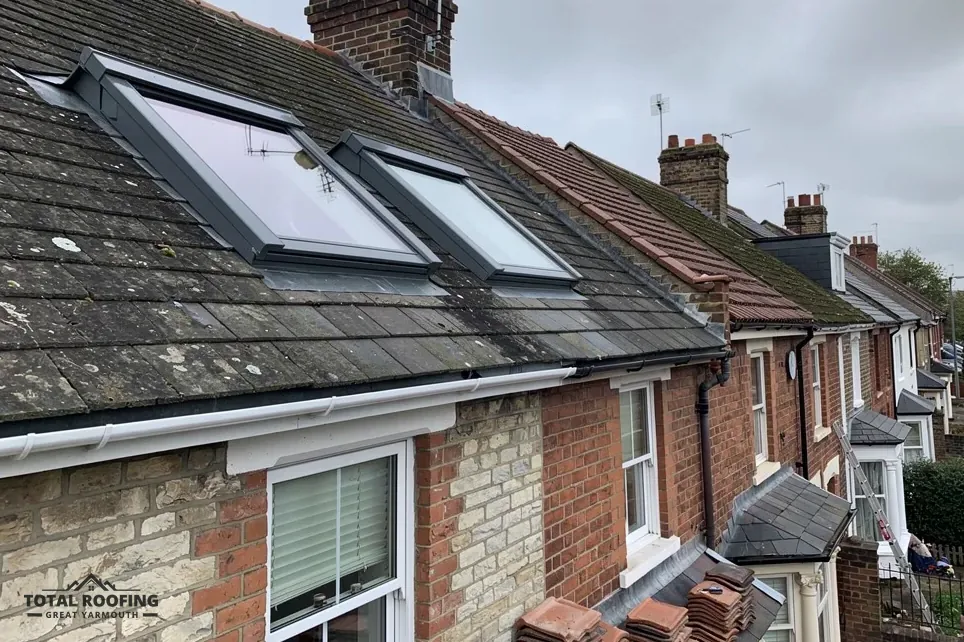
You can learn something from the ground. Look for slates that have slipped or dropped, patches where a slate is missing, and slates that are cracked, flaking or splitting along their layers. Look for rust staining below the slates, which can point to fixings that are failing. Check the gutters for fragments, and the loft for daylight or damp patches. Moss, lichen or algae on slate is a surface matter and says little about age.
None of that tells you the age of the roof or its remaining life. A roof with a few slipped slates may need only a repair, and a roof that looks even from the road may have fixings or battens near the end. The way to know is to have the whole roof surveyed, from the slate to the lead to the timber beneath, and to read what the survey finds in plain words.
That is how we approach it: survey first, the whole roof rather than the one slipped slate, and every finding reported to you, including anything else we noticed. You can start with a WhatsApp photo. If the slate is sound and the fixings are failing, the answer may be to re-fix and repair; if the fixings and battens are spent, re-slating is the other route, and the choice is yours to make on the evidence.
A roof that is looked after well can last a very long time. That is a different statement from promising 200 years, and it is the one that can be backed up. Start with slate roofing for the wider picture.
