
The short answer
The length is set on the roof, not on the phone. Size, the number of breaks in the roof, how many old slates can be reused and the weather all count, and the scaffold licence has its own notice period set by the county council.
Why each roof has its own timetable
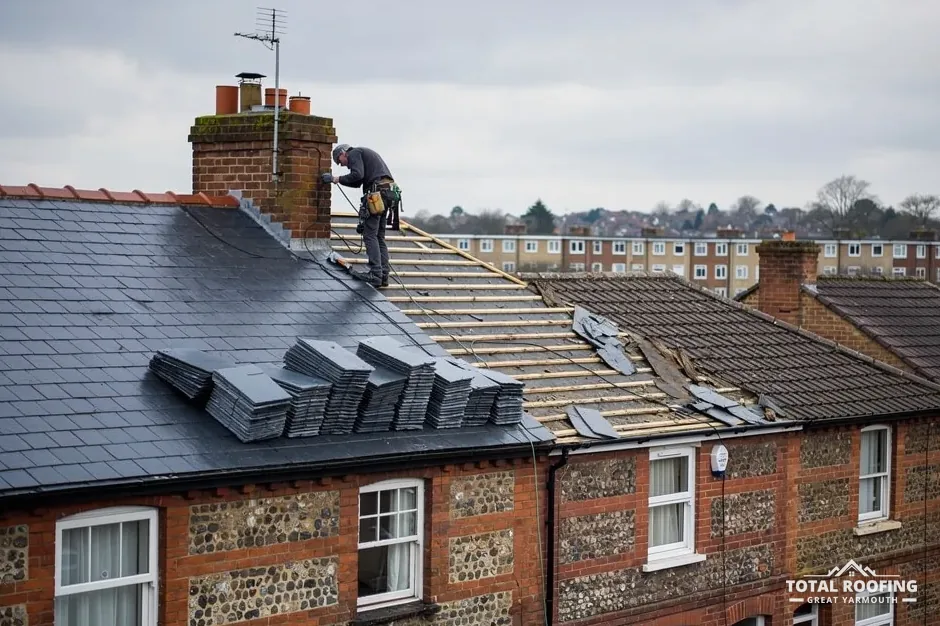
A re-slate is a sequence, and each step has to finish before the next begins. The scaffold goes up, the old slates come off, the battens and underlay are inspected and renewed where they have failed, the new covering is laid course by course, and the ridge, verges and flashings are finished last. Nothing in the sequence can be skipped, and the middle steps cannot be hurried without risking the fit of the roof.
The length therefore follows the roof. A plain slope with no breaks gives a long, steady run of courses. A roof cut up by chimneys, valleys, dormers, roof windows and returns needs each detail cut and dressed individually, and that takes longer per square metre than open slope. The condition under the slates matters as well: sound battens go back on, rotted ones are cut out, and every repair is added to the programme.
That is why a call that begins with a number of days is guesswork. After a survey of all the slopes, the loft and the abutments, the work can be described and the one written total price given.
What stretches or shortens the job
- Plain slopes against many breaks, valleys and dormers
- Sound battens against rotted timber to replace
- Slates fit to reuse against all new slate
- Dry spells against wet or windy days
Salvage and sorting the old slates
When the roof is stripped, each slate is looked at. A slate with a crack, flaking layers or a broken nail hole cannot go back on. A sound slate can, and sorting the good from the bad adds to the time on the ground, because the slates have to be lifted down, stacked by size and checked before the new courses are laid. The nail holes of an old slate also have to suit the new gauge.
HomeBuilding gives approximate lifespans of 100+ years for Welsh slate, 75-100 years for Spanish natural slate and 50-80 years for reclaimed Welsh slate, in a page dated 30 September 2025, which is part of why reuse is worth a look. Our guides to reclaimed roof slates and re-slating a roof explain how salvage works.
Where a roof cannot be re-covered with its own slates, new slates are brought in to make up the shortfall, and matching them in size and colour takes care.
Weather and an open roof
Part of a re-slate leaves the timber exposed to the weather, which is why the order of work is planned to keep each slope covered as far as the weather allows. Rain, wind and frost stop slating, because slates cannot be handled safely on a wet or icy slope and wind catches the sheets and the slates. A wet week therefore adds days that were not in the plan.
The underlay and the new battens are the cover during the work, and sections are stripped and re-covered in turn, not the whole roof at once. That order protects the house but lengthens the job a little. Ridge work, flashings and the lead around chimneys are also dressed in dry spells, since wet slate and wet lead are slippery and hard to bed down, and a slope left half finished before a forecast of bad weather is made weathertight with the underlay first.
The scaffold licence and its notice period
Where scaffolding occupies the footway or carriageway, section 169 of the Highways Act 1980 calls for a licence from the county council. We arrange the licence with our scaffolder, and the notice period is the council's own. Norfolk County Council's page says "Please allow 7 calendar days", and Suffolk County Council asks for 10 working days' notice, so the start can depend on which county the house is in.
That lead time is outside anyone's control on the roof, and it is one reason a start date cannot be promised before the survey. A full re-slate falls outside the Planning Portal test that covers work touching less than 50 per cent of the roof, so the building control route is checked with the council before work starts.
At Total Roofing Great Yarmouth the first step is surveying the roof, and one written total price comes after it. Our slate roofing hub lists the work, and the guide to slate roof cost gives dated published prices.
