
The short answer
Yes. A roof is made of slopes, and one can be stripped and re-covered while the other stays. For Building Regulations the share of the roof affected counts, and on a two-slope roof one side is half, which is not less than half, so the route is confirmed with building control.
Why one slope at a time works
A pitched roof is assembled from planes that meet along the ridge, the hips and the valleys. Every plane carries its own rafters, battens, underlay and covering, so working on one does not oblige you to touch the other. That is how a roof is repaired and extended in practice, and it is why a south slope that has taken the weather can be re-covered while the north one is left alone.
The join is where care is needed. The ridge runs between the slopes and shares its tiles, mortar or dry-fix fittings with both, so it has to come off and be refixed. Lead at a chimney or valley that straddles the slopes has to be dressed to suit both the new and the old. A survey looks at those junctions before saying that half a roof will do, and it also tells you whether the second slope is nearing the same point.
Doing one side now and the other in a few years has a cost: the scaffold goes up twice, and the second job meets the same junction again. If the other slope has similar tiles of a similar age, the survey will say so plainly, so that the decision is made with that in front of you.
Matching new tiles to old
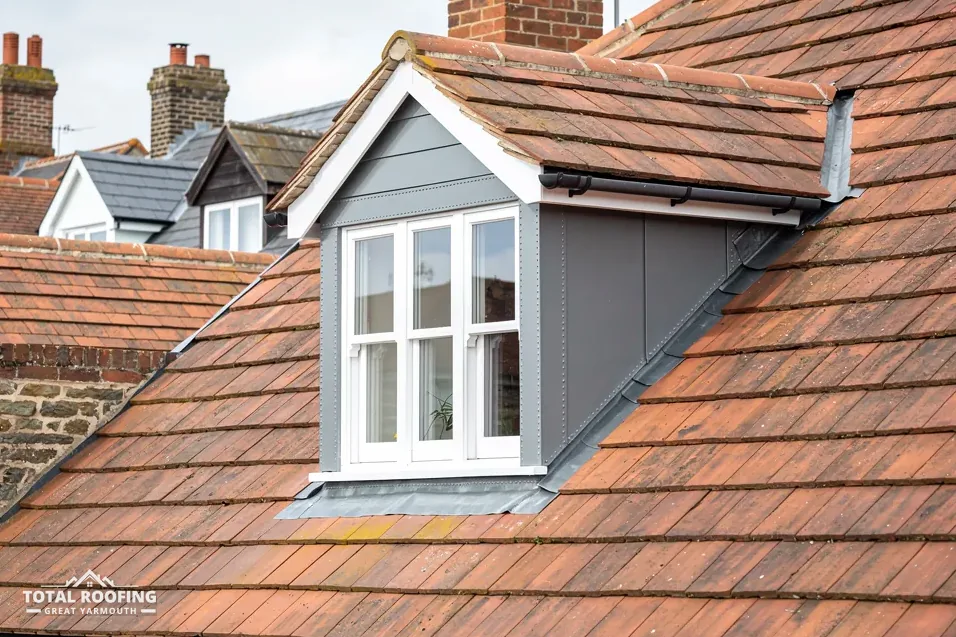
Old and new tiles do not always look alike. A covering exposed to decades of rain and sun differs in colour and surface from one that left the factory last month, and a tile that matched when new may not match now. Moss, lichen and fading all separate the two slopes, and the difference can show from the road.
A reclaimed tile has had the weathering already, which is one reason people look at them for a partial job. Our reclaimed roof tiles page explains what reclaimed stock involves. The new slope can also be covered in the same product as the old if it is still made, and the survey identifies the tile, its size and the gauge so that a supplier can be asked.
Pitch and fixing details come from the maker. On Marley's published list, the Lincoln clay pantile needs 15 degrees at the least and the concrete Anglia 25, so a replacement has to suit the existing slope's pitch as well as its appearance. A different product on one side of the house can be a deliberate choice, made with pitch, weight and appearance all weighed.
What the survey notes on a half-roof job
- Tile make, size and batten gauge
- Pitch of each slope
- Ridge and hip fixings at the join
- Condition of the slope you are keeping
- Lead where the slopes meet a chimney
Where half a roof falls against the rules
Say a roof has two equal slopes. The Planning Portal's re-roofing guide asks two questions: is less than 25 per cent of the total 'building envelope' affected, and is less than 50 per cent of the roof affected? Both answers have to be yes before no application is normally needed. One of two equal slopes is half the roof, and half is not less than half. A hip roof, a rear extension or a large dormer changes the sums, since the slope you replace may be more or less than half.
That marks a threshold to check, not a reason to avoid the work. Building control comes from the council's building control team or a registered building control approver, and the council is asked about the route ahead of any start. At Great Yarmouth Borough Council or East Suffolk Council addresses, ask that council's building control team directly.
Approved Document L adds an energy rule. Renovate more than 50% of a roof's surface and the whole roof gets improved where feasible, with a 15-year payback as the fallback limit. Weight is its own test: choose a covering 15 per cent or more heavier, on either side, and approval plus a structural check come into play. The Building Regulations for re-roofing page explains the 25 and 50 per cent tests.
What a half-roof job costs
Nothing is published for half a roof, so the third-party figures below cover the pieces. The Which? Trusted Traders survey of 11 traders (November 2025, excluding VAT) lists £75 to £400 for a handful of broken or missing tiles, and £7,000 to £21,000 for re-covering an average three-bedroom house entirely. Checkatrade's June 2026 table, exclusive of VAT, quotes £110 to £160 per m² for clay tile repairs on a pitch, and around £190 per m² for natural slate.
The Checkatrade numbers are rates per m², not totals, and multiplying one by a slope's area would give a figure nobody published. Scaffold, ridge and junction work come to much the same whether one slope or two are covered, so half a roof may not cost half the price.
At Total Roofing Great Yarmouth you get one written total once the whole roof has been surveyed, which lets you see what the second slope would involve before deciding. The new roof cost page lists the ranges, and the roof replacement hub covers the rest.
