
The short answer
Yes, if you can put up with noise and dust. The covering comes off in stages, the underlay and battens keep the weather out of the rooms below, and the garden and path become a work zone. A baby, a night-shift worker or a nervous pet may be easier to house elsewhere for a few days.
What the noise and dust are like
A re-roof is physical work done directly over your head, and the sound travels through the rafters into every room. Stripping the old covering is the loudest stage: tiles are lifted, stacked and sent down, and the whole roof structure carries the knocks. Fixing new battens brings hammering or a nail gun, and cutting tiles or slates adds a whine. The sound is steady on the working days and stops when the crew leaves.
| Stage | What you will notice |
|---|---|
| Scaffold going up | Metal clanging, a blocked path or drive |
| Stripping the old covering | The heaviest noise, shaking ceilings, dust in the loft |
| Battens and underlay | Hammering or nailing overhead |
| New covering | Steady tapping and the sound of cutting |
| Ridge and verges | Cutting and fixing at the roof edge |
Dust is the other cost of living under the work. Old mortar, grit and dried debris drop into the loft through gaps while the covering is lifted, so anything stored up there is better moved or covered beforehand, and the loft hatch kept closed.
Weather cover while the roof is open
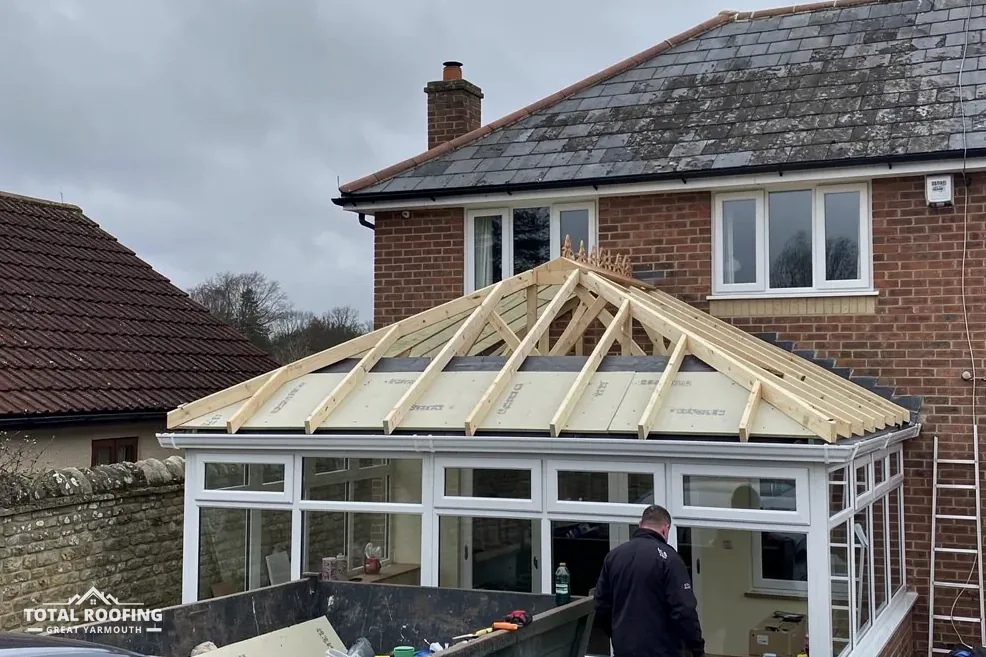
People worry most about waking up to rain on an open roof. When a slope has been stripped, the new underlay and battens are the barrier between the sky and your ceilings, so how much is opened at once, and whether it can be covered again before the weather turns, is worth asking about.
Hope is not a plan. Before you agree a start, ask the firm how it keeps an open slope covered if the forecast turns, and who will tell you if a day is lost. A clear answer is worth more than a smooth one.
Tell the firm about anything in the rooms directly below the roof that would suffer from a drip or a shake: a nursery, a computer desk, framed pictures on a chimney breast or a wardrobe full of clothes. Moving them for the duration costs an afternoon, and a stripped slope is not the moment to find out which room was the weak point.
Children, pets and the garden
Scaffold poles, ladders, falling debris and moving tiles make the ground around the house a work area. Keep children out of the garden and drive on the working days, and keep dogs inside or away from the sides of the house where the roofers are lifting and lowering material. Cats and rabbits are better in a different part of the house from the loft hatch, because the noise carries and frightens them.
- Move cars from the drive and the road outside before the first day.
- Keep windows shut on the days of stripping, as dust blows in.
- Take washing in and clear outdoor furniture from the working zone.
- Agree a gate or door that stays closed to children and pets.
- Ask where ladders and materials will stand, so a clear route to your front door is kept.
The Construction (Design and Management) Regulations 2015 move the client duties a householder would otherwise carry onto the contractor, and each project has a construction phase plan. That is why safe access and a site that is kept apart from the family are matters to raise with the firm before the scaffold goes up.
When moving out for a few days makes sense
Some households are better off elsewhere for the loudest stage. A baby that naps in the day, someone sleeping after a night shift, an adult working from home on calls, or a person for whom noise and dust are a health problem will all find stripping hard to live through. Staying with family for the loudest stage, or picking a week when the house will be empty anyway, can turn a trial into an inconvenience.
Check the age of the building too. HSE says "If the building was built or refurbished before 2000, assume that there is asbestos in it", and asbestos cement sheeting on a roof or garage needs careful handling by someone who knows what it is. If a survey finds it, that is a reason to plan where the family will be while it is dealt with.
At Total Roofing Great Yarmouth our survey covers the entire roof, and what it finds is put to you in plain words, so you can plan around the real job. For the sequence of stages see the re-roofing process guide, under our roof replacement page.
