
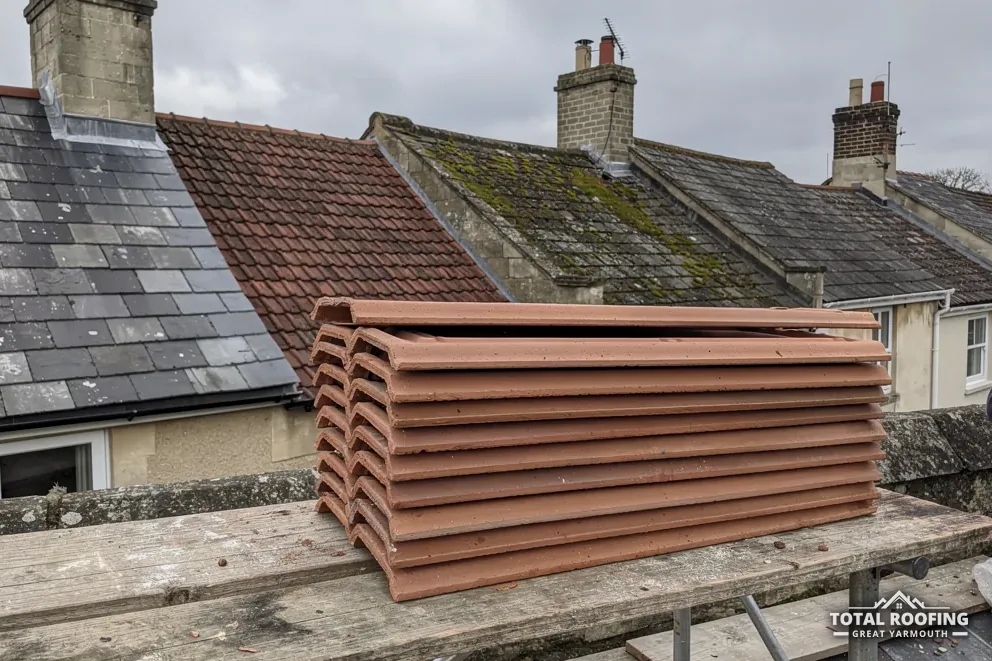
The short answer
It means the mortar bedding under the ridge, hip or verge tiles is breaking down, so those tiles are losing their hold. Re-bedding replaces the mortar, and a dry-fix system replaces it altogether. A survey decides which suits the roof you have.
Where the mortar sits and what its loss shows
Mortar appears in three places on a typical tiled roof. A ridge is capped with tiles bedded along the apex, where the two slopes meet. Hips run down the outside corners of a hipped roof and carry their own bedded tiles. Verges are the sloping edges at a gable end, where the last tiles are finished against the wall with mortar pointing.
Each of those joints is exposed to rain from above and to the wind that tries to lift the cap tiles. When mortar falls away, the cause is the bed itself: it has cracked, shrunk away from the tile or lost its bond. The loose pieces on the ground are the visible part of a larger loss, because a bed that sheds fragments may be thin or cracked along its length, which only a closer look can confirm.
Do not read the debris as a purely cosmetic matter. A cap tile with little holding it is a tile that can shift in a gust. Keep clear of the foot of that wall, and have the roof looked at. The wider range of roof faults is gathered on our roof repairs hub.
Re-bedding and what the standard says
Re-bedding means raking out or removing the failed mortar, lifting the cap tiles, and relaying them on fresh bedding. It is a repair to the joint, and it is a sound answer where the tiles beneath are in good order and the ridge line is true.
The rules around fixing have changed. BS 5534 sets out how slating and tiling are fixed. Marley adds that installing to it isn't required by law. Marley also says that since the 2015 amendments mortar "could no longer be relied upon as the only means of securing the roof covering". On ridge and hip tiles, Marley adds, the fixing has to be mechanical so that it resists the wind uplift force calculated for the roof.
In practice that points to a bed plus a fixing, such as a clip or a screw into a batten or a ridge board, not mortar alone. Tile fixings are set by a site-specific fixing specification under BS 5534, which allows for how exposed the roof is. If your ridge was bedded before those amendments, a survey can tell you whether it relies on mortar by itself.
Dry-fix as the alternative to mortar
A dry-fix system replaces the mortar bed with mechanical parts. BS 8612:2018 is current and is the standard written for systems that fix ridges, hips and verges dry. Instead of a mortar bed, ridge and hip tiles are held by clips, brackets and fixings that locate on the battens or on a ridge support.
The comparison can be put simply, and it is a general one. Mortar relies on a bond that weathers and cracks, while a dry system relies on parts that hold the tile in position whatever the state of any bedding. A dry verge replaces the mortar finish at a gable end with a unit that is fixed to the roof structure and grips the edge tiles.
- Ridge: re-bed with fixings, or fit a dry-fix ridge system.
- Hip: the same choices, with the hip end and hip iron checked as part of the job.
- Verge: re-point and fix the edge tiles, or fit a dry verge. Our page on verge tiles falling off deals with that edge.
Published prices and next steps
Prices come from third parties, not from us. For one new ridge tile, Which? Trusted Traders gave £80 to £300, excluding VAT (November 2025). MyJobQuote shows ridge tile replacement averaging £225 to £550 (1 October 2026), and says dry verge work "usually falls between £500 and £2,000" (8 October 2026). Checkatrade's June 2026 table lists ridge tile repairs at £50 to £70 per metre, exclusive of VAT, which is a per-metre rate, so it does not give a job total. Hips are not priced in those guides; for a hip, the figure follows the survey.
While you wait for a survey, stay off the roof and away from the wall below, and photograph the debris and any gaps you can see from the ground. A photograph sent to 07880 284133 on WhatsApp helps us see what the survey needs to cover. The roof repair cost page has the full published ranges, and hip tile repairs covers the corners.
