
What a slipped tile is, and why it matters
A roof tile is not stuck down. Each one hangs from a batten by a small nib on its back edge and is held in place by its own weight, overlapped by the courses above, and secured by nails or clips as well. A slipped tile is one that has moved out of its row. It may sit a few centimetres lower than its neighbours, leave a gap at the top edge, or hang by one corner above a doorway.
The gap is what counts. Tiles shed rain because they overlap, and a tile that has dropped leaves the row beneath it exposed to the weather. Rain can then reach the underlay and the battens, and over time the timber. A slipped tile that is spotted early is a small job. One that is left through a few winters can turn into a damp batten, a stained ceiling and a larger repair.
Slipping is also a signal. Tiles stay put when the fixings hold and the timber under them is sound, so a tile that has moved is telling you one of those has failed. The useful question is why it moved, not only how to push it back. Our guide to finding a roof leak explains how a gap like this shows up inside the house.
Why tiles slip: nails, battens and wind
Nail failure is one cause. A nail holding a tile to its batten can rust through, work loose as the timber moves, or snap at the head. Once the nail has gone, the tile depends only on its nib and its weight, and a gust or the weight of a snowfall can shift it. Neighbouring tiles that share the same age and fixings may be close to the same state, which is why one slipped tile is a reason to check the rest of the slope.
Batten rot is another. Timber battens that have been wet for long periods soften, and a soft batten no longer grips a nail. The nail pulls out, the tile slides, and the cycle repeats. You cannot see this from the ground, and you may not see it from the top of a ladder either, because the batten is hidden under the tile it supports. A roofer lifts the tiles beside the slipped one to see the timber properly.
Wind is the third. Gusts can lift the edge of a tile and slide it, and the effect is greatest at the edges and ridge of the roof, where the air pressure differs most. Marley's fixing guidance says the minimums in BS 5534 "will always be superseded by the generation of a Fixing Specification, which is site specific and takes into account factors such as" the exposure of the roof. How hard the weather hits one house is a matter of its own site.
Age, movement in the roof structure and earlier poor repairs also loosen tiles. A repair done years ago with too few nails, or with a tile of the wrong profile, can sit quietly until the first hard gust and then give way. Whichever cause applies, the cure has to deal with it, not only with the tile, and that is why the lifted batten is the first thing a roofer looks at.
Myth
A slipped tile only needs pushing back into place.
Fact
It has moved because a nail, a batten or a clip has failed, and that has to be fixed too.
How a slipped tile is refixed
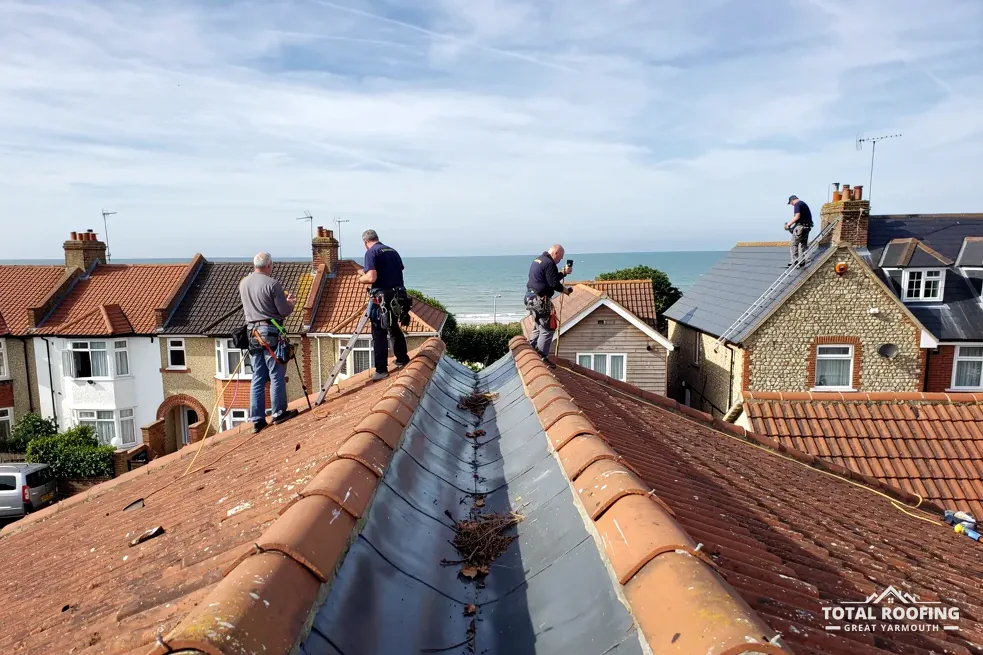
Refixing starts with lifting the tiles around the slipped one, so that the batten, the underlay and the old nail holes can all be seen. Nothing is assumed from the pavement, and nothing is pressed back into a row until the timber beneath it has been judged sound. If the batten is sound, the tile goes back into its course and is fixed with a nail or clip. If the batten has gone soft, the damaged length is cut out and replaced with new treated timber before any tile is laid on it. If the underlay has torn, that is repaired too. Each fix is made to the part that failed, so the tile that slipped is refixed on timber that will hold a nail, with a fixing that matches the courses around it.
Matching matters as well. A replacement tile has to suit the ones around it in profile and size, or the overlap will not seat properly, and older tiles are not always still made. Where a matching tile is hard to find, the choice is between a near match that sits slightly differently and re-covering a larger area, and the quote spells out which one is proposed.
The job is described to you as work on the roof, not as a service extra. You hear what was found under the tile, what has been replaced and what has been left alone, and the written quote covers the whole job as one total.
How a refix is carried out
- Lift the tiles either side of the slipped one.
- Check the batten, underlay and nail positions.
- Replace soft batten and torn underlay.
- Refix with new nails or clips.
- Check the overlap and neighbouring courses.
Clips, nails and what BS 5534 says
The BSI catalogue lists BS 5534:2014+A2:2018 as the current edition of this code for tiled and slated pitched roofs. Marley, the tile maker, points out that "Installing to BS 5534 isn't required by law". It is a code of practice that roofers follow as the recognised way to fix a covering, not a statute.
The standard changed how roof tiles are secured. Marley says: "The 2015 amendments made it clear that mortar could no longer be relied upon as the only means of securing the roof covering." A tile bedded on mortar alone no longer meets that expectation, so a mechanical fixing, either a nail or a clip, goes in as well. A clip is a small metal retainer that holds the tile to its batten against the lifting force of the wind.
Ridge, hip and verge tiles are the edges where the wind pulls hardest. Marley's wind guidance reads: "In all cases, ridge or hip tiles should be mechanically fixed to resist the calculated wind uplift force." A separate standard, BS 8612:2018, deals with the dry-fixed systems used in place of mortar bedding along ridges, hips and verges. Whether a given roof needs clips on every tile or only at the edges is set by its fixing specification, which allows for how exposed the roof is.
What holds a tile in place
- Its nib hooking over the batten
- Its weight and the overlap of courses above
- Nails through the tile into the batten
- Clips that resist wind lift
- Fixings on ridge, hip and verge tiles
When slipping points to a new roof
One slipped tile is a repair. Slipping across a whole slope is different: it suggests the fixings or battens right across that slope are worn out. If lifting the neighbouring tiles shows soft timber and failed nails in each, replacing tile after tile solves nothing, because the next failure is waiting beside the last. A survey of every slope shows how far the fault extends, and then the decision is yours.
Coverings do not last for ever, but the sources give a range, not a deadline. Marley says: "Typically, roof tiles are expected to last for around 60 years", followed by "This is not a guarantee or warranty of its longevity." Marley also reports that the BRE set a minimum life expectancy of 60 years for clay tiles. HomeBuilding, updated in September 2025, gives approximate lifespans of 60 to 80 years for clay tiles and 40 to 50 years for plain concrete tiles. The two sources give different figures for concrete, so read both as guidance.
If a re-roof does follow, check the building control route. The Planning Portal says no application is normally needed if "Less than 25 per cent of the total 'building envelope'" is affected and "Less than 50 per cent of the roof is affected". Stripping and recovering a whole roof goes beyond that second limit, so the test does not cover it. Weight is a separate trigger: swapping to a covering 15 per cent or more heavier needs approval, after a structural check. The council's building control team or a registered approver can confirm the route.
What to do about a slipped tile today
Look from the ground. A pair of binoculars is enough to see whether a tile has slid, whether others nearby have moved, and whether the ridge line is still straight. Check the gutter below as well, because a fragment of tile can end up there and block the outlet. Do not climb to take a closer look: wet tiles are slippery and a loose tile can slide out under a foot.
If a tile has fallen into the garden or onto the pavement, move it somewhere safe and take a photograph of where it was. A WhatsApp message with the photo, to 07880 284133, lets us see the fault before a visit. If a tile is hanging over a door or a path, keep people away from that spot until it has been dealt with, and do not stand a ladder beneath it. If it is only slightly displaced and there is no sign of rain getting in, the repair can be planned for a dry spell; if the loft shows damp below it, the visit should not wait.
Bats are a further point. GOV.UK lists "repairing or replacing a roof" among the jobs that can call for a Natural England bat licence, and damaging or destroying a bat roost is an offence whatever the intent. If you have seen bats near the slipped tile, mention it when you ring.
Our guide to what roof repairs cost sets published ranges against what moves a price, and the roof repairs page covers the other faults we are asked about.
