
The short answer
A loose or cracked hip tile is repaired by lifting the cap tiles, replacing what has failed and re-bedding them with mechanical fixings, or by fitting a dry hip system. The published figures cover ridges and not hips, so the price of a hip follows a survey.
The parts of a hip and how each fails
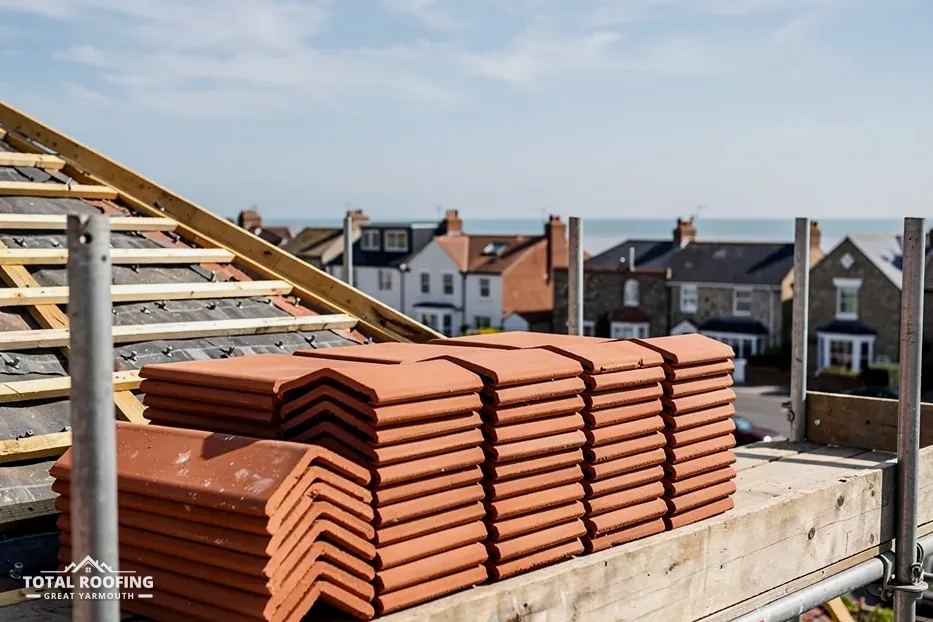
On a hipped roof the outer corners run downhill from the top of the roof to the gutter line, and the joint where two slopes meet is covered by a run of hip tiles. Each is bedded on mortar and set over the cut edges of the tiles below on either side. At the bottom end, where the hip meets the eaves, the lowest tile has to resist the pull of gravity along the slope. At the top, the hip tiles meet the ridge.
Three parts can fail. The mortar bed can crack and drop away, leaving tiles that sit loose and can be seen to rock. A hip tile can crack across its curve or its end. And the metal bracket, if the roof has one, can corrode or loosen so the bottom tile starts to slide. All three are general observations from roofing practice rather than a surveyed figure.
You can see most of this from the ground. Look for a gap along the line of the hip, mortar on the ground at the foot of the corner, or a tile at an angle. Do not climb to check. Our page on mortar falling off the roof explains what the debris means at ridge, hip and verge.
Re-bedding hip tiles with fixings
Re-bedding means lifting the loose hip tiles, clearing out the failed mortar, replacing any cracked tile and relaying the run on fresh bedding. The tiles are bedded to the profile of the slopes on both sides, so the cut tiles beneath have to be checked before the cap goes back, since a damaged one lets rain in below the hip.
Mortar alone is not what the current guidance relies on. Marley says that since the 2015 amendments mortar "could no longer be relied upon as the only means of securing the roof covering". For hip and ridge tiles it asks for mechanical fixing, set against the calculated wind uplift force. BS 5534 is the code behind this, and Marley points out that working to it isn't required by law.
A re-bed done properly therefore has a fixing for each tile or at set intervals, not just a bed. Tile fixings are set by a site-specific fixing specification under BS 5534, which allows for how exposed the roof is. That specification belongs with the survey, and the roof is not guessed at from the ground.
Hip irons and dry hip systems
A hip iron is a metal strap or bracket fixed at the foot of a hip, so the lowest tile is held against sliding down the slope. Where one is missing or has corroded, the loosest part of the run is at the bottom, and replacing it is part of the repair. Whether a particular roof needs one is a point for the survey.
A dry hip system replaces the mortar bed with fittings. BS 8612:2018, which is current, is the standard for fitting ridges, hips and verges dry, with parts and no mortar bed. The cap tiles are held by clips and a hip start, and no mortar is relied on to hold them.
- Re-bed with fixings: keeps the mortar look, adds a mechanical hold.
- Dry hip system: no mortar bed to crack or drop out.
- Hip iron at the foot: checked or renewed either way.
Our page on verge tiles falling off deals with the same choice at a gable edge.
Why the survey comes before a hip price
The price of a hip is set by the survey. The figures that exist for ridge tiles, from Which?, MyJobQuote and Checkatrade, are ridge figures and do not carry across to a hip, so none appears here. A hip's cost turns on its length, its pitch, how many hips the roof has, the state of the tiles beneath and how the corner is reached. After the survey you receive one written total.
Access matters at a hip because the slope drops away on both sides. A corner at first-floor height is reached with scaffold. Scaffold standing on the pavement or road needs a highway licence from the county council (Highways Act 1980 s169), and we arrange the licence with our scaffolder.
A photograph of the hip taken from the ground, sent on WhatsApp to 07880 284133, lets us see how many tiles are affected before the survey. Related repair questions are on the roof repairs hub, and the roof repair cost page holds the published prices that do exist.
