
The short answer
Verge tiles fall because the mortar bedding and pointing holding them at the gable edge has cracked or crumbled, and wind can then lift the loosened tiles. Re-bedding restores a mortar verge, while a dry verge holds the edge with fixed parts instead.
What a verge is and what holds it
A gable end is a wall that rises to a point under the roof slope, and the verge is the line where the tiles stop at that wall. An edge tile has no neighbour on its outer side to brace it, unlike a tile set mid-slope. Their hold comes from the fixing to the roof structure and from the mortar bed and pointing along the edge.
That edge is where the roof meets open air on two faces. Rain runs across it, and a gust can reach it from the gable side as well as from the front. Mortar is stiff and does not flex as the structure moves with temperature, so over time it can crack, shrink away from the tile and drop out in pieces, a process that happens at the bed before it shows at the surface.
Pieces of mortar on a path beside the gable wall are the plainest sign. A tile hanging at an angle along the edge, or a gap showing where one has gone, means the hold has failed. Our guide to slipped roof tiles separates a tile that has slid from one that has lost its bedding.
Why wind turns a small gap into a lost tile
Once the bed is cracked, an edge tile has little to resist air getting under it. A gust moving across the gable can lift a loose tile, and a tile that lifts and drops will chip its neighbours. The tile that finally comes away may fall into the garden or onto the drive, which is why the ground below a gable end is worth keeping clear.
Marley says that since the 2015 amendments to the standard, mortar "could no longer be relied upon as the only means of securing the roof covering". It also notes that installing to BS 5534 isn't required by law. Together these show why a verge that depends on mortar alone is a weaker design than one with a mechanical fixing.
The fault sits in the bed, and a survey shows how far it runs along the edge. Our mortar falling off the roof page covers the same failure at the ridge and hips.
Re-bedding a mortar verge or retro-fitting a dry verge
There are two routes. The first is re-bedding. Old mortar comes out, the edge tiles are lifted, and they are relaid on fresh bedding and pointed. It keeps the look of the original and is a sound answer where the edge tiles and the structure beneath are in good order.
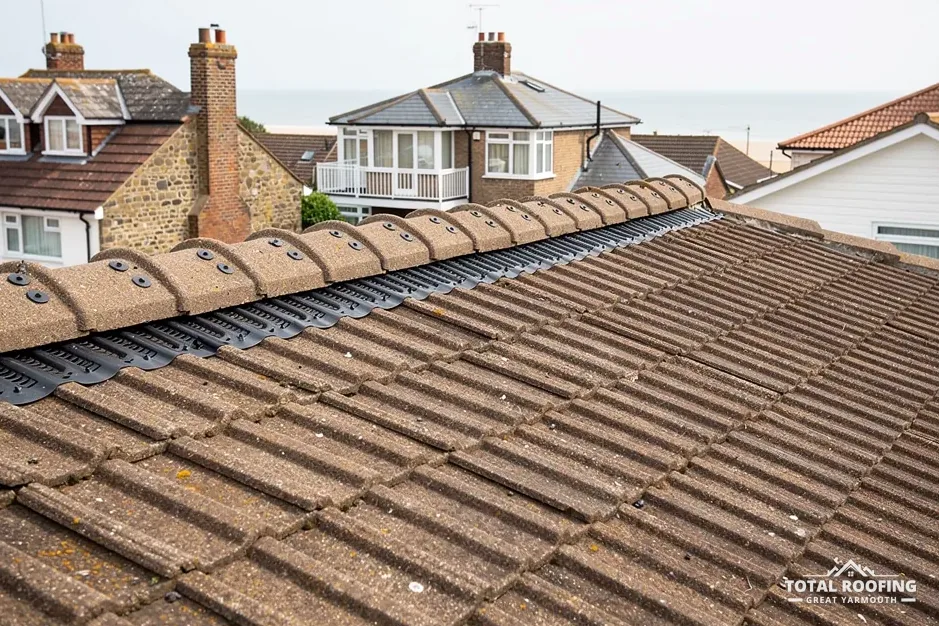
The second is a retro-fit dry verge. BS 8612:2018 sets the specification for dry-fixed systems used at ridges, hips and verges. A dry verge trades the mortar finish for a unit screwed to the roof structure, which grips the outer edge of the covering. It is added to the existing roof and does not need the whole slope to be re-covered.
- Re-bed and point: suits sound edge tiles and a straight, firm verge line.
- Retro-fit a dry verge: suits a verge where mortar has failed more than once, or where a mechanical fixing is wanted.
- Check the structure at the edge: whichever route is chosen, the battens and the rafter at the edge decide what the fixings can bite into.
While the edge is open, the pointing against the wall and the nearest tiles can be looked at too, because the survey looks across the entire roof, beyond the single gap. If the wall has a lead flashing, its condition is part of that look, since water that gets behind a verge can run down the inside of the wall.
Published prices and what to do now
MyJobQuote says dry verge installation "usually falls between £500 and £2,000" (8 October 2026), a range that reflects a published guide and not our price. Which? Trusted Traders have a figure for a ridge tile, £80 to £300 (November 2025, excluding VAT), but no verge-tile figure, so the figure for a mortar verge repair follows the survey, and the two routes can land at quite different figures. The wider roof repair cost page sets out the published ranges by job.
Before anyone has surveyed the roof, steer children, pets and visitors away from the foot of the gable wall, and resist the urge to climb up to it. A verge sits at the edge of the roof, so a fall from here goes straight to the ground. Photograph the edge from the garden and send the picture on WhatsApp to 07880 284133, taking in the whole gable so the gap can be placed against the wall and the ridge above it. The topic list is on the roof repairs hub.
