
The short answer
Not as a routine, no. Tiles rest on battens and are made to turn rain away, with no allowance for a person standing on them, so a step can crack one and a slip can end in a fall. Roofers spread their weight with roof ladders or crawling boards, and HSE calls asbestos cement roofs fragile.
What happens to tiles under a foot
A tile is supported at two points: where its upper edge hooks over a batten, and where its lower end rests on the tile below. Between those points it spans a gap. Rain loads it evenly and lightly, while a boot concentrates a person's whole weight on a few square centimetres.
Clay and concrete tiles both crack under that, and a hairline crack made on a dry day stays invisible until the next downpour reaches it. Pressing on the middle of a tile is worse than stepping where it is supported, and the damage can lie underneath one tile while the next looks perfect.
Old tiles are less forgiving. Age, frost and moss weaken the body of a tile, and an ageing roof can have battens that no longer grip a nail well. A slip on a wet or mossy slope also leaves almost nothing to catch the fall, even on a low roof over a garden or a drive, because the covering is smooth and steep. That, more than the cracked tile, is the reason the roof is left to people equipped for it.
How roofers move about on a pitched roof
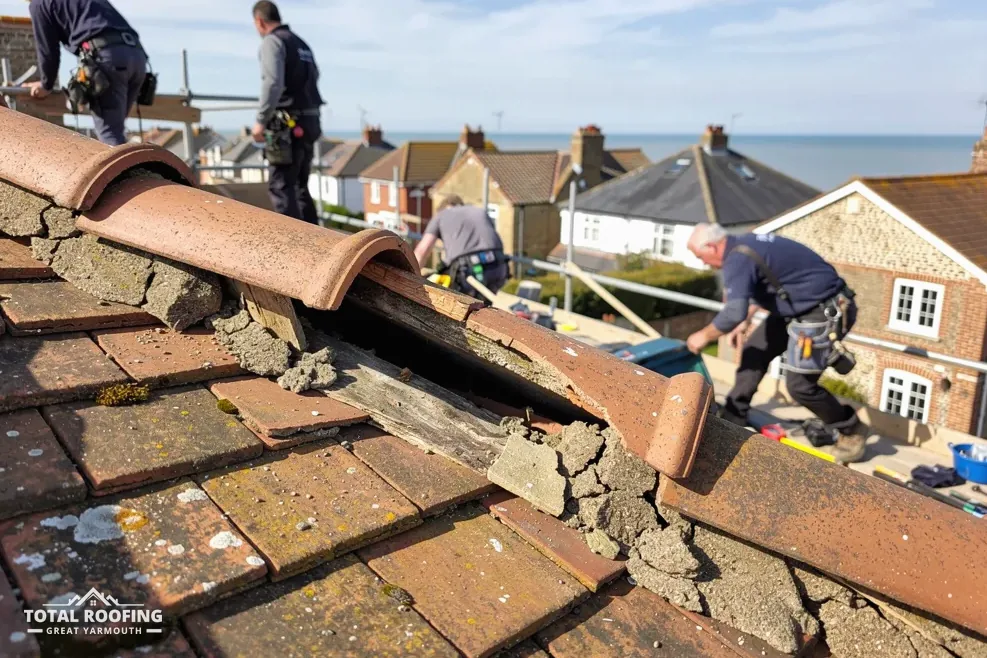
Where a roof has to be worked on, the aim is to put weight onto the structure rather than the covering and to stop a fall. The methods are ordinary parts of the trade:
- A scaffold at the eaves, which gives a platform and an edge to catch a slip.
- A roof ladder that hooks over the ridge and lies on the tiles, spreading weight across several courses.
- Crawling boards for the same purpose on a repair away from the ladder.
- Working from a cherry picker or tower where the slope is awkward.
Which of these suits a roof depends on its pitch, its height and what is below it. Pitch matters because a steep slope gives a boot less grip, and the page on minimum pitch for roof tiles shows how pitch is described. Putting scaffold on the pavement needs a Highways Act 1980 s169 licence from the county council, and we arrange the licence with our scaffolder.
Roofs you should never step on
Some roofs are fragile in a different sense, because the covering gives way beneath a person without warning. HSE's asbestos guidance describes AC roofs as always fragile, and its advice on age is: If the building was built or refurbished before 2000, assume that there is asbestos in it. An asbestos cement sheet looks like a solid grey slab and breaks without a sound, so a garage or outbuilding roof of that kind is not a place to test.
Rooflights are another hazard on any type of roof. A plastic panel set in a tiled or sheeted slope can be weaker than the covering beside it and can be hidden by moss or dirt. Wet moss, ice and fallen leaves make any slope slippery.
The safe rule for anyone who is not a roofer is to look from the ground and from the inside, and to treat a step onto the slope as the last resort rather than the first. A pair of binoculars, a phone with a zoom lens and a torch in the loft will find a good deal. Our page on pantile roof leaks lists what the loft can show.
Aerial and satellite fitters, and what to ask
Fitters of aerials, satellite dishes and solar equipment can need to reach a roof, and the question is who pays for any cracked or displaced tile afterwards. A cracked tile may not leak on the day and then does so later, when the work has long finished.
If someone has been on the roof, a look afterwards is worth having, because a tile that was stepped on may be cracked and a bracket that was fixed through a tile may not be sealed. Photos of the roof from before the visit make any later conversation simpler.
At Total Roofing Great Yarmouth our survey looks at the entire slope, so a cracked tile is named next to anything else we saw up there. The figure you get is one written total, and a photo from WhatsApp lets us judge what to look for. The pitched roofing service has the rest of the tiled-roof jobs.
