
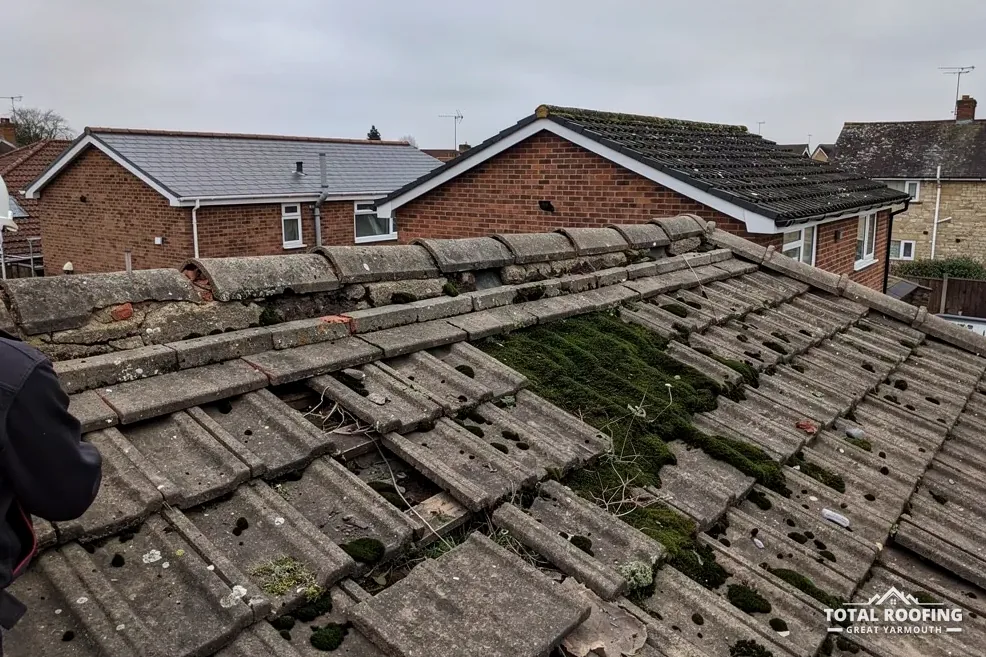
Pitch, headlap and gauge in plain terms
A pantile is an S-shaped tile that laps sideways into its neighbour and downwards over the course below it. Three measurements decide whether that arrangement keeps the rain out. Pitch is how steeply the roof falls, counted in degrees up from flat. Headlap is the distance one course of tiles reaches down over the head, the top edge, of the course beneath. Gauge is the spacing of the battens the tiles hang from, and it fixes how much of each tile shows and how much is covered.
The three are tied together. A tile maker publishes a minimum pitch for each product, and, with it, the matching headlap and batten spacing for that product. Alter one figure on site and the others stop agreeing with the sheet. A roof laid to the wrong gauge has less overlap than the tile was designed for, or tiles that sit on their battens in a way the maker never intended. That is why this page keeps returning to the product sheet: the figures belong to a named tile, not to pantiles as a whole.
Pantiles come in clay and concrete versions, and the two carry different figures. Even inside one material, products differ. A roof that reads as pantile from the pavement could be covered in either, and the numbers for one cannot be borrowed for the other. Our guide to what a pantile roof is covers the tile itself, and the pitched roofing hub lists every guide in this series.
Four terms used on this page
- PitchThe slope of the roof, counted in degrees
- HeadlapHow far one course laps over the next one down
- GaugeSpacing between battens, set by the tile maker
- Minimum pitchShallowest slope the maker allows for that tile
Minimum pitch on the product sheets
The clearest numbers come from manufacturers. Sandtoft, part of Wienerberger, sets a minimum roof pitch of 30°, a 75 mm headlap and a fixed batten gauge of 290 mm for its clay Old English Pantile. That sheet, version 1.1 dated 2 April 2025, puts the weight as laid at 41.6 kg per m². Those four figures describe one clay pantile from one maker.
Marley's published minimum pitches show how far products can sit apart. Its sheet gives 15° for the Lincoln clay pantile and 25° for the concrete Anglia tile. They are different products from the same maker, 10° apart, and the gap makes the point: a minimum pitch belongs to a product, and a roof that passes for one tile can fail for another.
| Product | Material | Minimum pitch | Headlap |
|---|---|---|---|
| Sandtoft Old English Pantile | Clay | 30° | 75 mm |
| Marley Lincoln | Clay pantile | 15° | Check the sheet |
| Marley Anglia | Concrete | 25° | Check the sheet |
A minimum is the lowest slope the maker allows, not a target. A roof laid right at the minimum has the least margin for a gust, a blocked gutter or a tile that has shifted. Where a roof is only a little steeper than the figure, the surveyor looks harder at the laps, because there is little room for error. Weight is on the sheet as well, and the structure carries it, so swapping the covering brings in the structure along with the weather. Makers revise their sheets, so the one that applies is the sheet for the tile actually being laid, at its current version.
Why a shallow pantile roof lets rain in
On a steep roof, water runs off the tile surface quickly and drains down the channel of each pan before it can go anywhere else. On a shallow one it moves slowly. It sits in the channel for longer, it spreads sideways across the lap and a gust can drive it up the slope against gravity. The overlap between courses is the barrier, and headlap is how much barrier there is.
That is general roofing mechanics, not a figure from a data sheet, but it explains why each maker ties its minimum pitch to a headlap. As the slope falls, the water spends longer on the roof and the wind has more chance to push it past the lap, so the lap has to do more of the work. When the pitch is below what the tile was made for, no amount of extra effort at the lap fully makes up for it.
The leaks that follow can look random. A stain appears on a ceiling in one corner after a spell of driving rain, then dries out and stays quiet through a fortnight of dry weather. The tile directly above the stain may be perfectly sound. The cause is the combination of slope, overlap and weather, which is why re-bedding one tile does not cure it. Look at the slope and the laps before the cracked tile.
Myth
A leaking pantile roof just needs the cracked tile swapped.
Fact
If the pitch or headlap is wrong for the tile, a swapped tile leaves the cause in place.
Headlap and batten gauge on site
Headlap cannot be seen from the ground and it is hard to measure on a finished roof without lifting tiles, so the check is made at the battens. The batten gauge is the spacing between batten centres, and on a roof covered in a fixed-gauge tile the figure comes straight from the sheet. The maker's fixed gauge for that clay pantile is 290 mm. If the battens were set wider than that, the courses reach down less far than designed and the headlap shrinks to match.
Gauge errors can creep in through repairs. A section re-battened in a hurry, a run of tiles taken off and put back one batten out, or an old roof whose battens have sagged between rafters can all leave a stretch with the wrong overlap. Such a stretch may have held for years, and then let go in the one storm that pushed rain a little further up the slope than usual.
A fixed gauge is different from an adjustable one. Some tiles are made to be laid across a range of gauges, with the headlap changing as the gauge changes. Where a sheet gives a fixed figure, as Sandtoft's does for its clay pantile, there is no adjusting it. The sheet for the tile on your roof says which kind you have.
How the laps are checked
- Find which tile is on the roof and match it to a data sheet
- Measure the slope of the roof in degrees
- Compare the pitch with the minimum on the sheet
- Check batten spacing against the gauge the maker gives
- Look at how far each course laps the one below
- Check for slipped, cracked or loose tiles along the laps
Re-roofing in pantiles: when the pitch decides the tile
Pitch also settles what can go back on. If a roof is being stripped and re-covered, the new tile has to be one whose published minimum is at or below the slope of the roof, and the headlap and gauge go with it. That is a reason to ask what tile is proposed and to read its sheet. Our guide to re-roofing in clay pantiles goes through the job, and clay against concrete pantiles covers the choice between the two materials.
A re-roof also raises the regulation question. Under the Planning Portal's guide, re-roofing does not normally need a building regulations application if it affects "Less than 25 per cent of the total 'building envelope'" and "Less than 50 per cent of the roof is affected." A full re-roof is over that line, so the building control route is part of the job. The Portal also says approval is needed if a new covering increases the weight by "15 per cent or more", and it says to speak to a structural engineer or surveyor beforehand. Planning for a straight re-roof is a separate matter: re-roofing a house is normally permitted development under Class C.
Building control is carried out by the council's building control team or by a registered building control approver. On a Great Yarmouth address the council to ask is the borough's own team, so check there before any work is booked. The planning and building control route is confirmed with the council before the work starts, and the single written total price follows the survey.
What the survey checks on a pantile roof
A survey of a pantile roof covers the whole roof, not just the one tile you rang about, and you are told plainly what turned up, anything else seen included. For pitch and headlap it starts with the slope, because that figure limits everything else. It then moves to the battens and the laps, the ridge and the verges, and the underlay wherever tiles are lifted. Each of these can fail independently of the pitch, so each gets its own look.
If a roof sits at a lower pitch than the sheet for its tile allows, repair is the wrong word for the options on offer. The choice is between living with the risk, changing the covering to a product made for that slope, or altering the roof structure, and each carries a different cost. A written quote follows the survey and sets out the one total price for the route chosen.
A photo over WhatsApp can come first. A photo taken at the gable end or along the eaves shows the tile profile and gives a rough idea of the slope, which is enough to say what is likely to be on the roof before anyone climbs up. If you would rather talk it through, the phone and the quote form are always one click away.
Checked on a pantile roof
- Slope of the roof against the maker's minimum pitch
- Batten spacing against the published gauge
- Headlap along each course
- Cracked, slipped or missing pantiles
- Ridge and verge fixings
- Underlay and battens beneath any lifted tiles
