
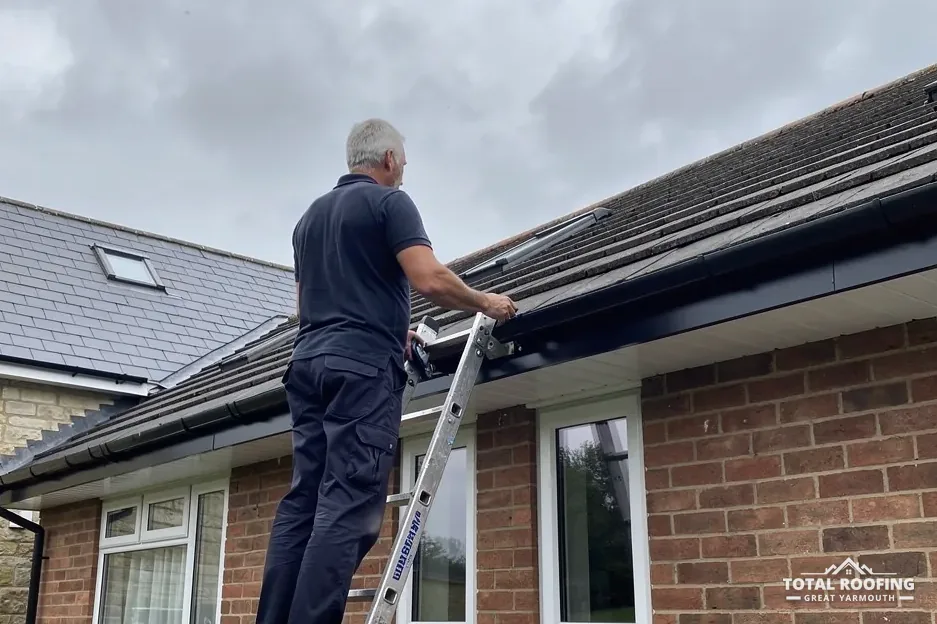
Where a gutter leaks: the joints on a run
A gutter is not one long channel. It is a set of lengths clipped to the fascia board, and every place where two pieces meet is a joint. On a plastic system the lengths are joined by a union bracket, a small clip-on piece with a rubber seal inside it. A stop end closes the far end of a run, an outlet drops water into the downpipe, and an angle turns a corner. Each of those fittings carries its own seal, so a house with a few corners and two outlets has plenty of places for a drip to start. Every run has at least a stop end and an outlet, plus a union wherever one length is not enough, and the roof above sends all its rain through the lot.
While the fittings are sound, the channel itself is not what leaks. Water that drips from the underside of a joint during rain is telling you the seal or the clip has let go. Water that spills over the front lip is a different fault, a blockage or a fall problem, and we cover that further down.
Cast iron and aluminium run on different details. Cast iron lengths are bolted together through a flange with a sealing compound in between, and aluminium lengths are riveted or clipped and sealed. The principle matches the plastic version, and so does the way the leak shows up as a drip or a wet streak below the joint: a joint stays watertight only while the seal between the two faces is intact and the pieces stay put.
Joints on a typical gutter run
- Union bracket between two lengths
- Stop end closing a run
- Outlet feeding the downpipe
- Internal or external corner angle
- Bolted flange on a cast iron length
Perished rubber seals
The rubber seal inside a union is the part that wears out. Rubber exposed to sunlight, frost and damp for years loses its give: it hardens, shrinks away from the channel and cracks. A seal in that state no longer presses against both lengths, and water slips through the gap, wetting the fascia face or dripping onto the wall below. From the ground the gutter can look perfectly sound, because the leak is on the underside of the joint.
A perished seal on a plastic system is a small part with a large effect. The union can be unclipped, the old seal lifted out and a new one fitted, or the whole union swapped for a fresh one. Swapping the union is the cleaner repair because the clip arms that grip the gutter lip are also tired by then.
A leak at a seal also hides a second question: whether the clip itself is still gripping. The union is held by arms that clasp the front and back lips of the gutter. If those arms have spread or snapped, a new seal sits loosely in a joint that cannot hold it tight, and the drip returns within weeks. Looking at the clip and the seal together is what makes the repair last.
On cast iron the equivalent fault is a dried-out sealing compound between the bolted flanges. The bolts are undone, the faces cleaned back and the joint remade with new compound and bolts. Old bolts can be rusted solid, which turns a ten-minute job into a longer one and is a good reason to look at the whole run while the access is in place.
Thermal movement in plastic gutters
Plastic expands as the day warms and contracts again as it cools. A length of uPVC gutter several metres long moves by a visible amount between a hot afternoon and a frosty night, so the union brackets are built to let each length slide a little. Fitters leave a small gap at each end of a length for exactly that reason, and the brackets carry a mark showing how far the gutter should be pushed in.
Trouble starts when a length has been pushed hard against its neighbour, or clipped so tightly that it cannot slide. The movement then goes somewhere else. It can pull a union open, lift a stop end or squeeze the seal out of its channel. A joint that leaks in cold weather and sits tight in warm weather is a strong hint that movement is involved.
Re-seating the length with the right gap, and refitting the union with a new seal, deals with the cause. The fitter checks the bracket spacing at the same time, because brackets set too far apart let a length bow and push on its joints. Tight clips, uneven spacing and a run fixed hard against a wall all stop a length moving freely, so they are looked at together. Smearing silicone along the outside of a joint does not. It can hold a joint still for a short while, but it stops the gutter sliding as designed and sets up the next leak.
Myth
A bead of silicone along the outside stops a dripping union for good.
Fact
It covers the leak at the surface while the perished seal and any movement problem stay inside.
Falls, sagging and standing water
A gutter needs a slight slope towards the outlet. Brett Martin, a gutter maker, says a run should fall "1mm for every 600mm" towards the outlet. That is a gentle slope, easy to lose if a bracket drops or a fascia board has softened and let the screws pull.
When a section sags, water collects there instead of draining away. A pool of standing water sits against the joint, which pushes against a seal that was fine while the water ran through. A joint under a low spot can leak even when the seal itself is in decent condition, and replacing the seal alone will not cure it. The brackets have to be adjusted or replaced and the fall put back first.
A run that has sagged between brackets also holds leaves and silt in the dip, which adds weight and pulls the sag further. Where the dip sits over a joint, the joint carries the load and is the first place to give way under it. The fascia board behind the gutter matters here too. Gutter brackets screw into the fascia, and a board that has rotted behind the gutter cannot hold them. Where that is the case the board needs attention before any gutter work is worth doing. That is why a leaking joint on a sagging run is worth reading together with the state of the board: the board is part of the same roofline.
Telling a joint leak from a blocked gutter
Not every drip is a joint failure. A gutter packed with leaves, moss or silt holds water back and sends it over the front lip or out through the nearest weak point, which can be a joint. Clearing the run is a sensible first check, and it also shows where the water was pooling. Silt that has built up in one stretch is itself a clue to a fall problem, since water that drained properly would have carried it to the outlet. Our guide to gutter cleaning covers how that is done.
The pattern of the drip tells you something. Water running only at a joint while the rest of the gutter is dry points to the joint. Water overflowing along the whole front suggests a blockage or a blocked outlet. Water running down the wall below a downpipe suggests a joint at the shoe or the pipe connection rather than the gutter. A cracked length shows as a line of drips along its underside, and a split in the back of an old plastic run can send water behind the gutter into the fascia without ever appearing at the front. That hidden route is worth ruling out, because the damage builds quietly. If a ladder is not for you, you can send us a photo of the joint on WhatsApp.
A simple order for checking a leak
- Clear the run and look for standing water
- Watch which joint drips during rain
- Check the seal for cracks and gaps
- Check bracket spacing and the fall
- Look behind the gutter at the fascia board
Replacing a union or the whole run
If one union has failed and the rest of the run is sound, a new union and seal is a proportionate repair. If every joint is tired, the brackets are loose and the channel is cracked or sagging, repairing joint by joint spends money on a system that has run out its working life. A neighbour on the same street may have had a joint repaired years ago and a gutter that has since failed in a new place, so one house is no guide to another. One retailer says uPVC roofline products "can typically maintain reliable performance for between 20 and 40 years" when installed correctly, so the age of the run helps decide between a repair and a renewal.
For the cost of renewing the whole run, The average gutter replacement cost in the UK is around £1,000 to £1,600 according to MyJobQuote (page updated 20 October 2026). Access drives a good part of what a house actually costs, especially a two-storey run where a scaffold may be needed. Where the job needs scaffold, it sits inside our one written total price, and scaffolding on the pavement or road needs a highway licence from the county council: we arrange the licence with our scaffolder.
The guttering, soffits and fascias hub covers the whole roofline, our guide to gutter replacement cost sets out what moves the price, and our comparison of uPVC and aluminium guttering helps if you are choosing a new material. We survey the whole roofline, not only the joint you rang about, and note anything else that looks wrong along the roofline.
Third-party gutter figures
| Average gutter replacement cost, UK | average of around £1,000 to £1,600 |
|---|---|
| Fascia and soffit capping | average of around £800 |
MyJobQuote, gutter replacement page updated 20 October 2026 and capping page updated 17 September 2026. The written quote after a survey is one total price.
