
What a downpipe is made of
A downpipe looks like one long tube, but it is a set of parts. At the top, an outlet in the gutter feeds a hopper or a funnel, and from there the pipe drops down the wall. Where the wall steps in, an offset or a pair of bends carries the pipe sideways around a projection such as a bay, a string course or a deep eaves overhang. Near the bottom, a shoe turns the flow outwards, and below that a gully or a soakaway takes the water into the drain.
Brackets hold the pipe off the wall. A bracket is a clip or a collar fixed into the brickwork or the mortar joint, and a run of pipe needs enough of them to keep it straight and stop it working loose. Between the brackets, the pipe is in sections, pushed together with a socket at each joint. In plastic the socket carries a seal, and in cast iron it is packed and sealed.
Each part has its own way of going wrong. The outlet and hopper catch debris. The bends are where a blockage lodges. The joints leak. The brackets loosen, and the shoe gets knocked or goes missing. Looking at the pipe as a set of parts makes it easier to say where the fault is, which is the first step in deciding what to do about it.
Blocked downpipes: how to tell, and what clears them
A blocked downpipe has one signature: the gutter above it overflows while the rest of the run is clear. Water pours over the front lip at the outlet end, or backs up along the gutter, and in heavy rain it can run down the face of the wall. If the pipe is blocked low down, the water can instead stand inside the pipe and force its way out at a joint, which looks like a leak from the middle of the pipe and can fool you into replacing a section that was sound.
What blocks a pipe is whatever the gutter lets through. Moss washed off the roof, leaves, grit and sludge arrive at the outlet and settle in the bends. A ball, a bird's nest or a wedge of compacted debris can lodge at an offset, and a pipe that has narrowed with plant roots or silt at its foot can back up from the bottom.
Clearing a blockage starts at the top. The hopper and outlet are checked and cleared by hand, and the pipe is then flushed with water to see whether it runs freely. A pipe that does not pass water is cleared with a drain rod or a flexible rod from the top or, where it can be unclipped, from the shoe end. A blockage low in the pipe or in the gully at its foot may be a drain matter, not a roofing one, so water that still backs up after the pipe is clear needs the drain looking at.
As in a gutter clear-out, check for a nest before clearing the hopper. A nest in use or being built is protected, and our guide to gutter cleaning explains what the Wildlife and Countryside Act says. Moss and debris tipped into an open pipe also send the blockage further down, so it is lifted out and bagged, not pushed through.
Signs of a blocked downpipe
- Gutter overflowing at the outlet end only
- Water backing up along the gutter
- A wet streak from a joint mid-pipe
- Pipe wet at the top, dry at the foot
- Gully at the foot standing full
Cracked pipes and leaking joints
Plastic downpipes crack. A sharp knock from a ladder, a ball or a mower can split a section, and ageing can leave the material brittle so that a crack opens along the seam. A crack lets water out as a thin jet or a steady drip, and the stain below it on the wall shows where it is. A leak at a socket shows up the same way, with water running down the outside of the pipe from the joint.
A joint seal can fail without the pipe being damaged. A dry or displaced seal at a socket leaks in rain and holds when the pipe is quiet, so the leak only shows when the gutter is flowing hard. Pushing the joint back together and re-seating the seal can cure it, but a socket that has split will not hold, and that section is replaced.
Cast iron downpipes can rust from the inside. The outside looks sound while the inner wall thins, and a pipe that rings dull when tapped can have a thin section. Cast iron is also made in sockets that are packed with sealant, and that sealant can fail at the joint. Our page on cast iron guttering covers the repair and repainting route for iron runs.
One more check applies to older houses. HSE lists asbestos cement products, including rainwater goods, among materials that can contain asbestos, and its advice is "If the building was built or refurbished before 2000, assume that there is asbestos in it." A downpipe that cannot be identified is not drilled, snapped or scraped until it is known.
Brackets, offsets and the shoe
A downpipe that has come away from the wall at the top is a bracket fault. Brackets are fixed into the brickwork, and a fixing that has worked loose, a bracket that has rusted or a mortar joint that has crumbled lets the pipe swing. A swinging pipe strains its joints and can pull out of its socket, so tightening or renewing the brackets is a repair worth doing before a joint fails.
Offsets are where strain builds up. The pipe changes direction there, the flow slows and debris settles, and an offset that has been cut short or bent out of line can hold water. If a replacement is needed, the offset is a reason to look at the pipe as a whole run and not as a single length.
The shoe at the foot does a plain job: it turns the water outwards, away from the wall, so that it lands on a drain or a hard surface instead of splashing against the brickwork. A shoe that has gone missing, been knocked off or been blocked lets water run down the wall base and bounce back onto it. The wall at the bottom of a downpipe is the first place to look for green staining.
Where the pipe discharges into a gully, check that the gully itself is clear. A pipe that is working and a gully that is full gives the same wet wall as a pipe that is blocked. Leaves and silt settle in a gully grid, and the water that cannot drain away backs up the pipe and splashes the foot of the wall. A gully is cleared by lifting the grid and taking out what has gathered, and if it stays full after that, the drain beyond it is the next thing to look at.
Checking a downpipe from top to foot
- Look at the hopper and outlet for debris
- Run water down and watch each joint
- Check brackets for movement along the pipe
- Look at offsets for blockage and strain
- Check the shoe and the gully at the foot
Damp walls from a failing downpipe
A downpipe that leaks or overflows puts water onto one patch of wall. Brick, render and mortar soak it up, and the patch stays wet for long after the rain stops. The signs are a green or black stain running down the wall from a joint, a patch of darker brickwork at the foot, peeling paint on a window reveal near the pipe and, in time, a damp patch inside the room on the other side.
Because the water takes the same route every time, the damage is concentrated. Mortar softens, render blows or cracks, and in winter wet masonry can be damaged by frost. Plant growth, algae and mould follow the damp. A wall that is wet from a downpipe dries out when the pipe is mended, and staining that remains is cosmetic once the damp has stopped.
The mistake to avoid is treating the wall and leaving the pipe. A damp-proofing treatment inside a room does nothing if rain is still running down the outside, and a patch of new render over a stained wall hides the evidence without curing it. The survey looks at the whole roofline above a damp patch, because the gutter, the hopper and the pipe all feed the same wall.
Water can also reach the inside of a house through a wall that has been wet for long. A damp internal patch that appears below a window or beside a chimney breast can have a roof or gutter cause, which is why a damp wall is a reason to look up as well as down.
Repair or replace, and what is priced
A repair suits a fault that stays in one place while the remainder of the pipe is sound: a single cracked section, a leaking joint, a loose bracket or a missing shoe. A replacement is the right answer when the pipe is brittle throughout, when several sections have failed or when the run has been damaged so often that patching is a cycle. The survey says which, and the written quote gives one total price for the work found. When a downpipe is renewed, the new pipe should be sized and positioned to suit the outlet in the gutter above it, and the shoe and gully fixed or checked at the same time, so the run is sound from top to foot and not only in the length that failed.
A single downpipe repair is priced after the survey. The nearest published figure is for a bigger job: MyJobQuote's average gutter replacement cost in the UK is around £1,000 to £1,600 (its page of 20 October 2026, with no VAT basis stated), and it does not split that average by part. What moves a downpipe quote is the height, the number of sections, the access and whether the pipe and gutter are replaced together.
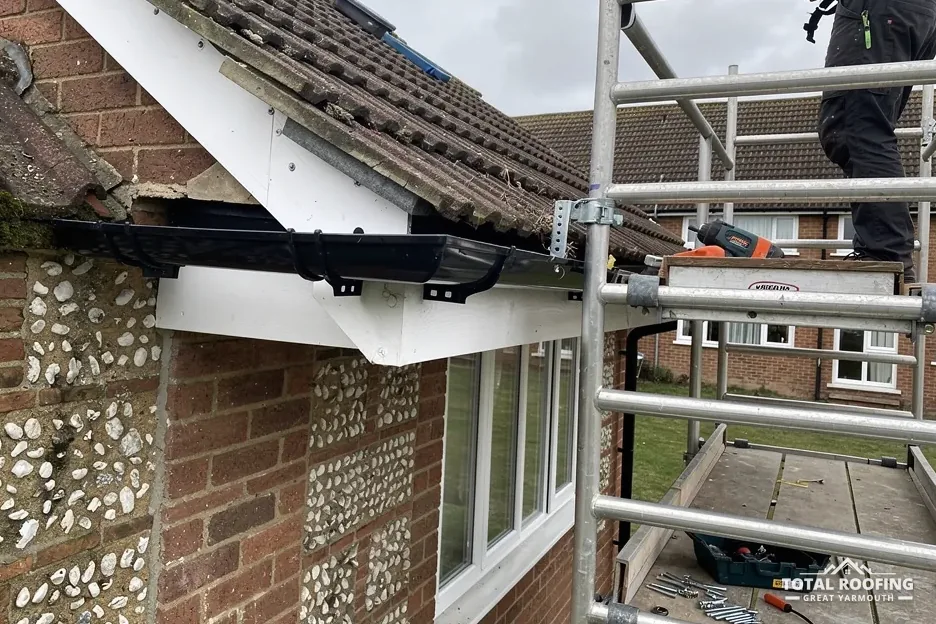
A downpipe that sits on a high gable or behind a bay can need a tower or scaffold. Scaffolding on the pavement or road needs a highway licence from the county council; we arrange the licence with our scaffolder. See our gutter replacement cost guide for the published figures, and the guttering, soffits and fascias page for the whole roofline.
