
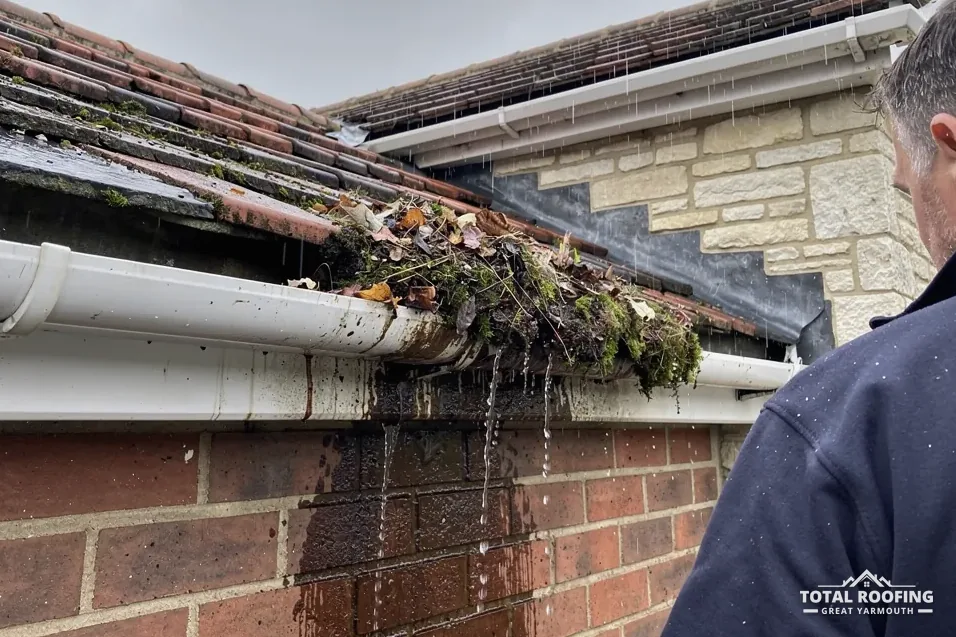
The short answer
A leaking gutter soaks the wall below it, so a damp patch, green staining or peeling paint under the gutter line points to it. Trace where the water escapes, repair that joint, length or outlet, and the wall then dries slowly by itself. Which? Trusted Traders put clearing all gutters at £75 to £350 (November 2025, excluding VAT).
How a gutter leak ends up inside the wall
A gutter is meant to carry roof water sideways to a downpipe. When it leaks, that water takes the shortest way down instead, which is the face of the wall. Brick and render soak it up, and a wall that is wetted again every time it rains never gets the chance to dry.
The marks are easy to read once you know where to look. A dark, damp band under one stretch of the eaves, green algae streaks below a joint, a bubbling or flaking patch of paint, and a damp stain on the inside of the same wall all point back to the gutter above. On a house with the damp inside a bedroom or a stairwell, the outside wall nearest the damp is the place to start, looking up at the gutter along that stretch.
The water can escape in several ways: a joint whose seal has failed, a crack in the channel, an end cap that has come loose, a gutter that has sagged so water misses the outlet, or a blocked run that fills and spills over the front or back. Each one wets a different part of the wall, which is why the pattern of the marks helps to find the cause.
Tracing the leak before anything is repaired
A good time to trace a gutter leak is while it is raining. Standing in the garden, you can see where the water leaves the gutter and where it runs down the wall. In dry weather, a survey from access equipment can check each part in turn:
- Joints and end caps, for gaps, dry seals and drips along the underside.
- Outlets and the downpipe head, for silt, leaves and moss holding water back.
- The fall along the run, so the flow runs on to the outlet instead of standing.
- The brackets and the fascia board behind, for movement and rot.
- The downpipe joints, where a leak can wet the wall low down.
It also needs ruling out that the gutter is the cause at all. A cracked render, failed pointing, a leaking pipe or condensation can all leave a damp patch on a wall, and a damp wall is not proof of a leaking gutter. Tracing means finding the gutter fault and, where there isn't one, saying so plainly.
Repair, then drying out
Once the source is found, the repair is matched to it. A choked outlet is cleared, a failed joint is resealed or the length is replaced, a sagging run is rehung to a proper fall, and a gutter on a rotten board is refixed once the board is repaired or replaced. Our guide to gutter cleaning covers the blockages, and the page on fascias and soffits covers the board.
The wall dries after the leak stops, and it dries slowly. The time depends on how thick the wall is, how long it was wet and the weather, so a patch that looks the same a week later is not a sign the repair failed. It is worth leaving the wall to dry rather than painting or sealing a wet surface, because the paint blisters and the damp stays behind it. If a damp patch inside the house is still spreading well after the gutter has been repaired, a damp specialist can look at the wall itself.
Published prices for gutter work
| Work | Figure | Source and date |
|---|---|---|
| Clearing all gutters, front and back | £75 to £350 | Which?, November 2025, ex VAT. |
| Average gutter replacement | around £1,000 to £1,600 | MyJobQuote, 20 October 2026. |
A repair to a single joint is priced after a survey, because the access and what the survey finds decide the figure, and a published average for a whole replacement says little about one leaking joint. Our page on gutter replacement cost explains the factors behind a price, and the guttering, soffits and fascias hub lists the other roofline pages.
The Which? figure is for clearing out the gutters, which suits a leak caused by a blocked run, while the MyJobQuote average covers fitting new guttering. Neither is a price for tracing a leak. The written quote is one total price once the roof and gutters have been surveyed, and it covers the roofline as a whole, so a leak found at one joint is looked at alongside the brackets and board next to it.
