
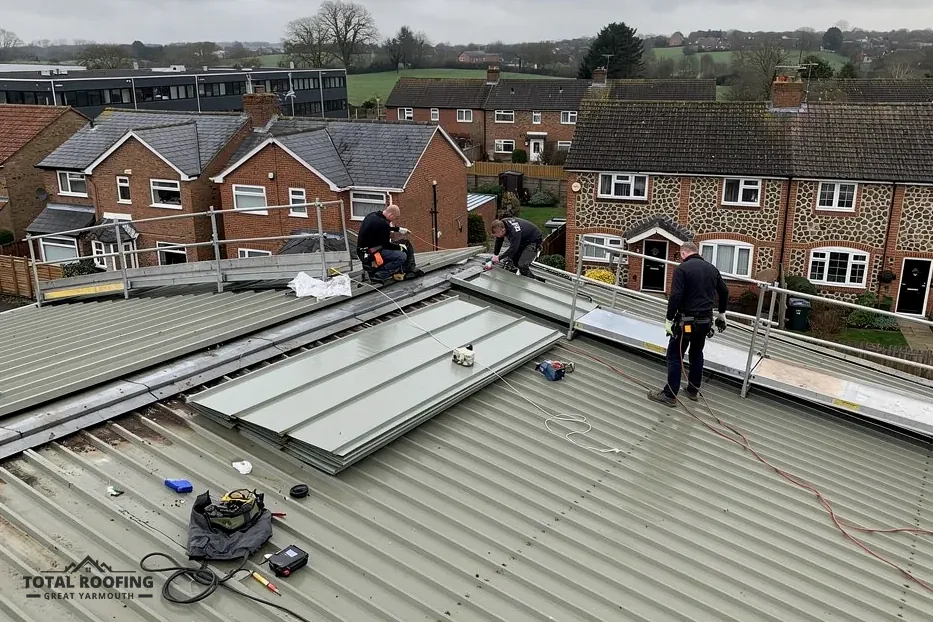
Where water gets into a sheeted roof
A warehouse or industrial unit roof is built from large sheets, either profiled metal or fibre cement, fixed to rails called purlins that span between the main frames. The water-shedding surface is made of overlaps: sheets lap over one another at their sides and ends, and the joints are sealed. A roof with many sheets has many joints, and a leak is a fault at one of them, or at a hole cut through the sheets for something else.
The short list of places is the same for any building of this kind. Side laps and end laps, where the sealant has aged or the sheets have been pulled out of line. Fixings, where a screw has backed out, corroded or been over-driven through its washer. Roof lights, where the panel or its surround has failed. Gutters at the eaves and the valleys between roof slopes, where an outlet blocks and water backs up under the sheets. Flashings, where the sheets finish against a parapet, wall or the ridge. And penetrations, the openings for flues, vents, extract fans and cables.
The difficulty is that the place a drip lands on the floor is not always the place the water came in. Water runs down the underside of a sheet, along a purlin or down a gutter bracket and drops some metres away. A repair that seals the spot above the drip can miss the fault entirely. That is why a survey follows the water uphill, checking the whole slope rather than the single patch the occupier pointed at.
The sections below take the causes one at a time, then look at how to tell a leak from condensation and how a repair can be organised without stopping the unit.
Places a unit roof leaks
- Side laps and end laps between sheets
- Fixings that are loose, rusted or over-driven
- Roof lights and the sheets around them
- Gutters, box gutters and valley outlets
- Ridge, wall and eaves flashings
- Openings cut for flues, vents and fans
Laps and sealants
Each lap relies on two things: the sheets overlapping by enough distance, and a sealant strip between them that closes the gap. Sealants age. A mastic bead that was soft and sticky when the roof went on can harden, crack or pull away as the sheets expand and contract through the day and the seasons. Where a lap has opened, rain driven across the roof can run inside the joint instead of over it.
Sheets can also be out of line. If a sheet was laid slightly twisted, or a fixing has pulled it sideways, the lap opens along part of its length. Looking at the lap from above shows a gap, and from below a thin line of daylight or a stain on the purlin. Neither is easy to see from the floor of the unit.
The repair depends on what the survey shows. A lap with sound sheets and a failed seal can be cleaned and resealed, with the new sealant matched to the sheet material. A lap where the sheet itself is cracked or corroded needs the sheet replaced. A whole slope with failing laps points towards a bigger decision, the choice between patching and covering the old roof. Our industrial roof cladding guide explains the alternative of overlaying the roof with a new system.
No sealant is permanent, and a sealed lap is a repair, not a new roof. The survey says whether the sheets around it are sound enough to hold a repair.
Fixings and fasteners
A sheet is held to the purlin by screws or bolts with a sealing washer under the head. The washer is a small piece of rubber bonded to metal, and it carries a lot of the weather protection of the whole roof. Over time it can perish, flatten or split, and the screw itself can rust at the head. A screw driven in too hard crushes the washer, and one not driven in far enough leaves a gap beside it.
Movement works on them all the while. Profiled metal sheets expand with heat and contract with cold, and the screws holding them move in their holes. A fixing that has worked loose lets the sheet lift in wind, and a sheet lifted by wind opens the lap beside it. In that way a failed fixing can cause damage some distance from itself.
Corrosion is the main reason fixings fail in older roofs. Once the head has rusted through or the screw has snapped, the sheet is held by its neighbours and the water gets in at the hole. A survey checks a sample across the roof and looks closely at any line of fixings that shows rust staining or lifted sheets.
Replacing a fixing means choosing one that suits the sheet and the purlin. A longer screw may be needed where the old hole has been enlarged, and the new one needs a washer that matches the profile. It is a small repair, but it has to be carried across enough of the roof to make a difference, because one new screw in a line of tired ones leaves the line as weak as before.
Roof lights and gutters in the leak count
Roof lights are in the leak count for two reasons. The panel is made of a different material from the sheets around it and moves differently, so the seal at its edge works harder. And panels crack, craze and yellow over the years, so water can come through the panel itself. Replacement panels have to match the profile of the sheets beside them, and they have to be fixed in a way that bears weight where the roof is walked on. A roof light is also a fall risk on a roof that gets walked on.
Gutters on a unit are large, and many sit between two roof slopes in a valley or run along a parapet as a box gutter. A blocked outlet fills the gutter, and when the water has nowhere to go, it rises up the underside of the sheets and comes in at the laps. Leaves, litter and debris from the roof itself are enough to do it. A valley gutter that has corroded or developed a split leaks into the unit directly below.
Brett Martin's figure for a gutter's fall is "1mm for every 600mm" towards the outlet, which means a gutter that has sagged or been laid flat holds standing water. A survey checks the gutter's fall, its joints, its brackets and its outlets, and it looks at how much load the gutter has to carry when it fills. A box gutter holding standing water adds weight to the structure under it, and water can seep through a weathered lining into the unit below. Our commercial roof maintenance guide sets out what keeps gutters and outlets clear.
Leak or condensation
Not every drip is a leak. Moist air inside a unit touches the cold underside of a metal roof, condenses and drips from it, and the drops look the same as rain coming in. A unit with a wet process, unflued heaters, a big team breathing inside it or stock that gives off moisture can produce condensation that falls on racking, stock and floors without a single failed lap.
The pattern tells the two apart. A leak appears after rain and follows the weather, so the first drips come when the rain starts, with drips concentrated near a lap, a fixing line or a roof light. Condensation follows temperature and activity: it appears on cold mornings, in the same places across a wide area of the roof, and can dry off by midday. A roof that was sealed but still drips needs the building's moisture looked at, not another coat of mastic.
Getting this wrong wastes money in both directions, and the stock below pays for it. Resealing a roof that is only suffering condensation does not stop the drips, and treating a genuine leak as condensation leaves stock getting wet. The survey checks the roof from above and from below and reads the pattern against the weather. Looking at the underside shows where moisture collects on the sheets, and a damp insulation layer between the sheets and the liner is a sign that the problem is above the line, not below it.
Myth
Every drip from a metal roof means a hole in it.
Fact
Condensation also falls from cold sheets; the pattern against the weather separates the two.
Keeping the unit working during repairs
A unit that stops trading to have its roof repaired loses money, so the work is planned to fit around the occupier. Repairs can be done in sections, taking one bay or slope at a time so the rest of the building stays in use. The occupier knows which bays hold stock that must not get wet, where forklifts run and when deliveries arrive, and the plan is built from that information.
Protection comes first in the sequence. Where sheets are taken off, the area below can be covered or cleared before the roof is opened, with the opening closed or covered before the crew leaves the roof. Access for the work needs thought as well: a mobile platform or scaffold, set where it does not block loading doors, and edge protection along the eaves. Asbestos has to be considered before anything is disturbed. HSE says: "If the building was built or refurbished before 2000, assume that there is asbestos in it." Our over-cladding guide covers the choice between covering and removing asbestos cement sheets.
Price follows from all of this. The price is set after the survey, from the size of the roof, how it is reached and what turns up, and it is written as a single total. Send a photo of the leak or the stain on WhatsApp on 07880 284133 and we will look at it first.
How a staged repair runs
- The survey finds the leak paths across the whole roof.
- The occupier marks bays to keep dry and routes to keep open.
- Stock below the first section is covered or moved.
- One section is opened, repaired and closed before the next.
- Gutters and outlets are cleared as each section finishes.
- The roof is checked after rain for any remaining drips.
