
The short answer
Spalling is the face of a brick breaking away, leaving a rough, softer surface behind. Frost and salts moving through damp brick are the causes. Badly spalled bricks are cut out and replaced, and whatever feeds moisture into the brick must be found and stopped too.
What spalling looks like
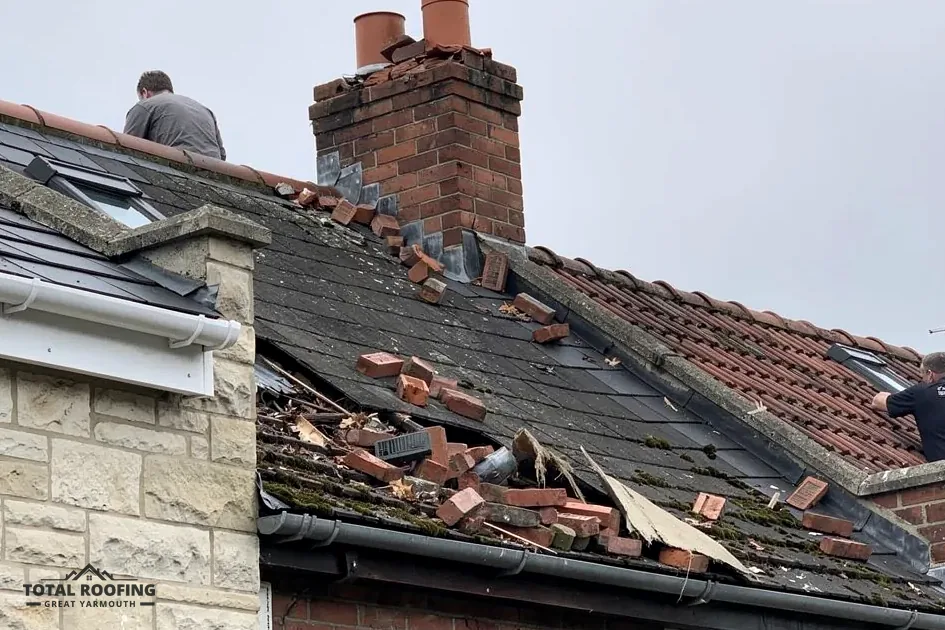
A sound brick has a hard, smooth fired skin. When that skin fails, flakes or thin sheets come away, or a shallow pit opens and grows, and the softer brick under it is exposed. You may find orange or red flakes in the gutter or on the roof tiles below the stack, or see bricks with a rough, scaly face compared with their neighbours.
On a chimney it can show on the windward and upper faces, and on the courses just under the pot, because those are the surfaces that stay wet longest and take the harshest weather. The damage can be patchy: one brick can be ruined while the next one is fine.
Spalling is not the same as worn mortar. Joints failing is a repointing matter, covered in our page on chimney repointing, while a spalled brick has lost part of itself and no amount of new mortar will put the face back.
What causes it
Brick is porous and takes up water, even when it looks dry, and the water is held in tiny pores right under the face. In a freezing spell, water inside the brick turns to ice and expands, and the pressure pushes the face off. A stack stands in the open and is wet from rain on every side, so it is exposed to repeated cycles of soaking and freezing.
Soluble salts do similar damage. When salts carried in the water reach the surface and the water dries out, the salts crystallise just under the face, and their growth pushes the skin of the brick away. Salts can come from the bricks and mortar themselves and, in a stack, from combustion products in the flue.
Other things make it worse: a hard cement mortar that traps moisture in the bricks instead of letting it escape through the joints, a failed bed under the pot that lets water pour down one face, and open joints that let rain soak in behind the brick. The cause has to be found, or fresh bricks will spall in their turn.
Terms on this page
- SpallingThe face of a brick flaking or breaking off
- CourseOne horizontal row of bricks
- FlaunchingMortar bed holding the pot at the top
- EfflorescenceWhite salt bloom left on brick as water dries
Cutting out and replacing bricks
A spalled brick that has lost only a thin layer can be kept under watch, but one that has lost its face keeps absorbing water and keeps getting worse, because the softer core underneath was never meant to face the weather. The repair is to chisel the damaged brick out, clean the opening and bed in a replacement. Where a whole patch of bricks is affected, the top courses of the stack may be taken down and laid again instead.
Matching matters on an older stack. Colour, size and texture vary between houses, and a modern brick set into old work can look out of place. Reclaimed or matching bricks are chosen where the look of the stack counts, and the size and bond of the old bricks are measured first so the new ones sit in the same pattern.
On a listed house, anything done "in any manner which would affect its character as a building of special architectural or historic interest" needs listed building consent, so a brick swap on a listed stack goes through the council first. A conservation area may add rules of its own, and the council is asked before work starts.
Dealing with the cause, and the price
Replacing bricks without fixing the water source only repeats the fault. The survey covers the mortar bed beneath the pot (see chimney flaunching), the joints, the lead and the pots, so the moisture is traced and not just the damage.
Work at the top of a stack needs a platform. Any frame on the footway needs county council sign-off, and we arrange the licence with our scaffolder. The number of bricks, the height and the access all move the figure, and so does any other repair the survey finds. You receive a single written price once the stack has been looked at, and nothing is priced from a distance.
Dated third-party ranges are collected under chimney repair costs, and the full range of stack work is listed on the chimney repairs hub. If you have a photograph of the spalled bricks, WhatsApp it to 07880 284133 and it will help show how far the damage has spread.
