
The short answer
The stack sets the length, not a standard figure. Its height, the amount of failed mortar, the scaffold needed to reach it and a dry spell of weather all count. The survey measures each of those, and the written figure for your job comes out of it as one sum.
What sets the length of the job
Repointing a chimney stack is slow, close work because every failed joint is cut back by hand and refilled one at a time. A short stack with a few open joints on one face is a smaller job than a tall stack with several flues, four weathered faces and mortar that has gone on every course.
Three features of the stack drive the workload. The first is its size: the height, the number of faces and the number of pots all add joints to deal with. The second is how deep the damage runs, because mortar that has only receded a little is quicker to rake out than mortar that has turned to sand to the depth of the brick. The third is what else the survey turns up, since a stack may need more than joint work.
That last point explains why a time cannot be given from a photo. A crack that runs through bricks, a pot that is rocking in its bed or lead that has lifted at the roof junction each add repairs to the list, and each one has to be dealt with before the stack is finished.
Scaffold and access come first
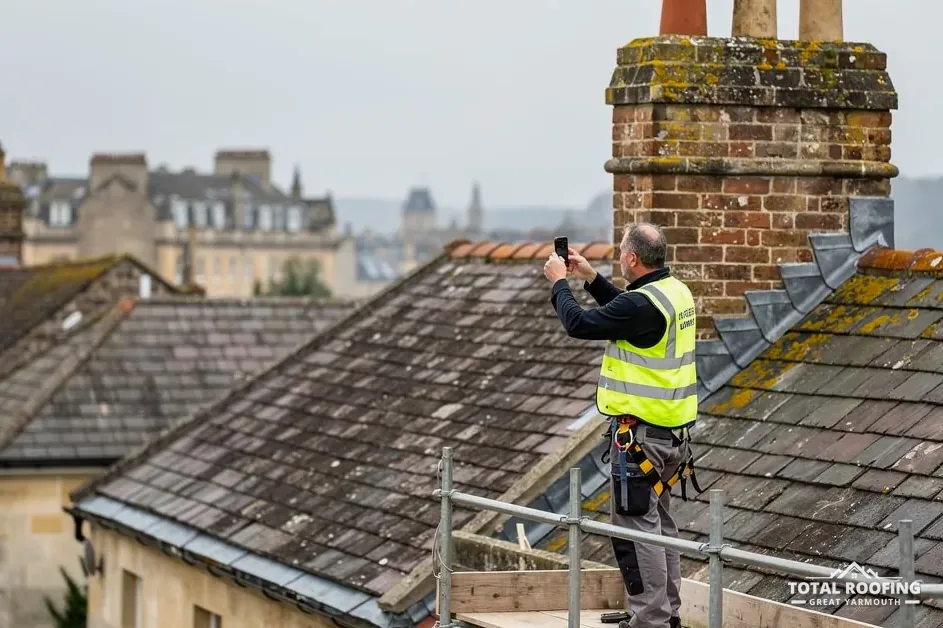
Nobody repoints a stack from a ladder. The work needs a safe platform around the stack, and that can mean a scaffold tower or a chimney scaffold, a smaller frame built to reach the stack and not the whole house. A tall house, a steep roof or a stack set well back from the eaves can call for a full scaffold with more boards and more ties.
Under the Highways Act 1980, a scaffold that blocks part of the public highway has to be licensed by the county council, and we arrange the licence with our scaffolder. Any scaffold the stack needs sits within the one price you are given.
Putting the scaffold up and taking it down has its own duration before and after the brickwork itself, which is a further reason the length of a repointing job cannot be read off the stack alone. Our page on what chimney repairs cost covers how access moves the price.
Weather and drying
Fresh mortar needs time to set before rain or frost reaches it. A heavy shower can wash soft new joints out, and frost can break up mortar that has not firmed. A day that is too wet, too cold or too windy for safe work at height can therefore stop the job and push the finish date back, however small the stack is.
Fresh mortar needs dry weather to set, so a dry forecast is worth waiting for, on the coast or inland. The order of work stays the same whatever the sky does, and it is set out below.
That is why repointing runs as a series of dry-weather stages, and why the scaffold stays in place until the last joint has been finished and has had time to firm. A forecast with a settled dry spell is the one that lets the brickwork move along without stopping and starting.
The order of work on a stack
- Scaffold goes up and the stack is checked at close range
- Loose, crumbling mortar is raked out of each joint
- Joints are cleaned and refilled with new mortar
- Any extra repairs found, such as pot beds or lead
- Scaffold comes down once the joints have been finished
Why the survey comes before any figure on length
Nothing is priced until a survey has been done, and the survey covers the whole stack as well as the joints that prompted your call. Whatever else is spotted gets named in plain words. The written quote then sets out one total price for the work, and the survey is also where the access and any extra repairs become clear.
If you want an early view, a clear photo of the stack from the garden is enough to show how many faces are weathered, and it can go to our WhatsApp number, 07880 284133. The chimney repairs hub lists the other faults that can turn up beside worn joints, and the page on chimney repointing explains the repair itself in more detail.
Where several jobs on the same stack are needed, the scaffold serves all of them, which is one reason to have them looked at together and not one visit at a time.
