
The short answer
Call a sweep for the flue and a roofer for the stack. A sweep cleans and inspects the passage the smoke travels up, from inside the house; a roofer repairs what stands on the roof, such as pointing, flaunching, flashings, pot and cap.
Two halves of one chimney
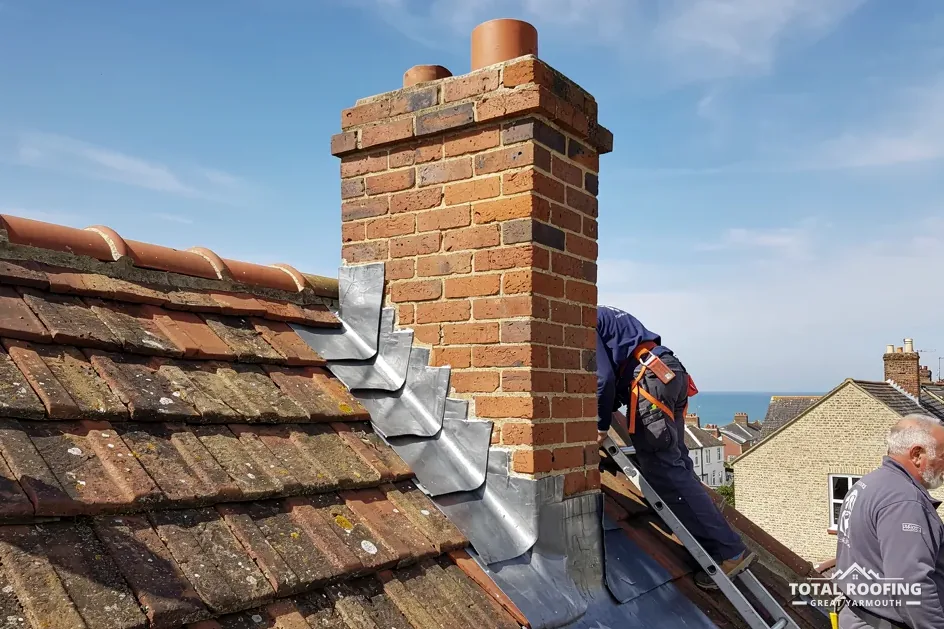
A chimney has an inside and an outside. The inside is the flue, the passage that carries smoke and gases from the fireplace or appliance up to the pot. It is reached from the fireplace, and it is cleaned from there. The outside is the stack: the brickwork that rises above the roofline, with its pointing, the flaunching, the sloping mortar under the pot, the lead flashings at its foot, and the pot or cap on top.
A sweep works on the first half. Soot and debris in the flue, a blocked pot and a flue that will not draw are in their field, and so is looking up the flue to see how it stands. A roofer works on the second half, from the roof or a scaffold, and deals with the weather side of the chimney.
The job you have decides the call. Smoke in the room or soot falling into the grate points to the flue. Damp on the chimney breast, a mark across the ceiling near the stack, crumbling joints or a leaning pot point to the stack.
Where the two overlap
The pot is where they meet. A pot choked with nesting material or fallen debris stops the flue working, and a pot that has come loose from a cracked flaunching is a roofing fault. Either trade may be the one who spots it, so the right call depends on what the fault turns out to be.
Sort the symptoms by where they appear:
- Soot in the grate, smoke blowing back, a flue that does not draw: a sweep.
- A damp patch on the breast or ceiling after rain: a roofer, starting with the guide on why a chimney leaks.
- Loose or cracked bricks, open joints, a cracked bed under the pot: a roofer.
- A flue that is clear but a pot that has shifted: a roofer for the pot and its bed.
- Debris in the flue after a storm: a sweep to clear it, and a roofer if the stack above was damaged.
A sweeping brush cannot repair brickwork, and a roofer's survey from the roof does not clean a flue. Each can see the other's problem, which is why a sweep who spots a damaged pot or a roofer who finds a blocked one will say so.
Thatched homes and regular sweeping
Sweeping has particular weight where a house is thatched. The 2017 thatch guide from the fire and rescue services of Bedfordshire, Cambridgeshire, Essex, Hertfordshire, Norfolk and Suffolk says: "Recent research has identified that a major cause of chimney related thatch fires is attributable to heat transfer through the brickwork of the flue into the adjacent thatch." Its advice includes: "Have the chimney swept regularly by a qualified chimney sweep."
On spark arrestors, the same guide says that if they are installed they "must be kept clean". A sweep is the person to ask about the flue and any arrestor. The condition of the brickwork around the flue is a stack matter, so a sound stack and a swept flue go together. That is the one place where both trades touch a fire-safety question, and each should know what the other has found. Say so when you book either of them, and pass on anything written down.
The guide is written for thatched properties, whereas the split of flue and stack described above holds for any home.
Handing over between the two
If a sweep reports a broken pot, loose brickwork or signs of water at the top of the flue, the roofing half starts from there. A photo of the stack, or of anything the sweep has written down, can be sent to WhatsApp 07880 284133 as a first look. The photo is a starting point, and the price follows the survey as a single written total.
Total Roofing Great Yarmouth surveys the whole roof before quoting. On a chimney that means the pot, the stack, its lead and the slopes beside it, with whatever else turns up described in plain words. Where the cause turns out to lie inside the flue, the job belongs to a sweep or a flue specialist, and the survey sends you to the right trade.
The main page on chimney repairs lists the stack faults, and the guide to chimney flaunching covers the bed under the pot, which is a point where the two trades meet.
