
The short answer
A chimney back gutter is a channel of lead set into the roof against the upslope face of a stack. It catches the rain running down the slope and carries it round both sides of the chimney. When it splits or clogs, water gets into the roof.
Where the back gutter sits and what it does
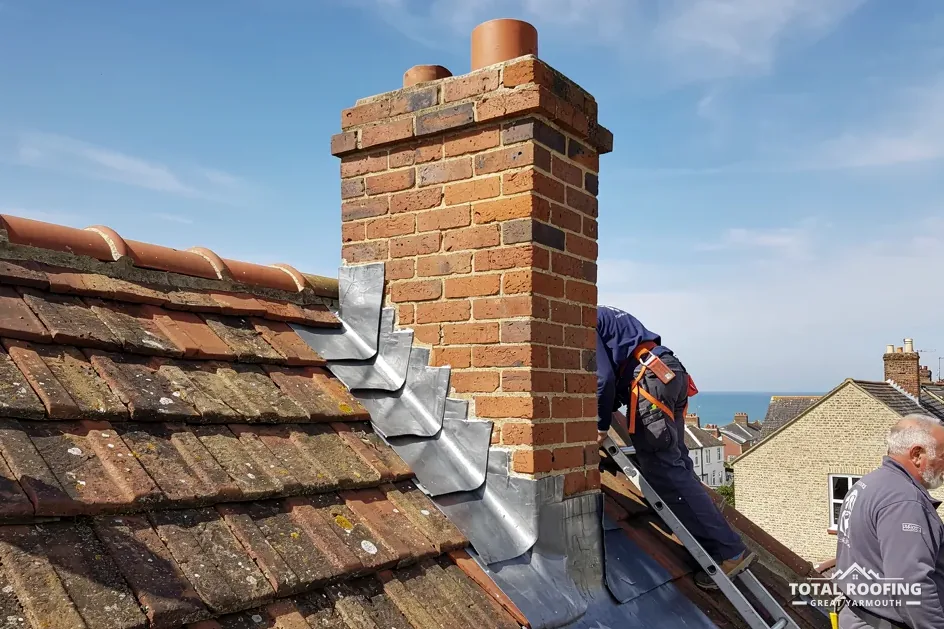
Think of a chimney as a wall standing across the slope of the roof. Rain running down from the ridge meets the uphill face of the stack and has nowhere to go, so the roof needs a way to steer it round. That job belongs to the back gutter, sometimes called a back tray: a shallow channel of lead sitting against the stack on its upper side, tilted so that water drains to the left and right and then onto the roof covering beside the chimney.
The channel is not a stand-alone part. Its upper edge is lapped under the roof covering above it, its sides link to the flashings that run up each side of the chimney, and its back edge rises up the brickwork and is tucked into a mortar joint. A fault in any of those links can let water pass behind the lead instead of along it.
Because it sits in the angle between slope and chimney, the back gutter is also the part where leaves, moss and grit settle. A blocked channel holds a pool against the stack, and a pool sits over any small split in the lead for as long as it stays there.
Why a back gutter lets water in
Lead is a soft metal that moves with temperature, and a long, wide sheet is pulled each time it warms and cools. Over the years that movement can open a split along a fold, and a hole the size of a pinhead is enough to start a damp patch on the ceiling beside the chimney. Other causes are on the list too:
- Lead that has lifted at its upper edge, so rain blows in behind it.
- A turned-up edge at the brickwork that has come out of its mortar joint, which leaves a gap on the face of the stack.
- Debris holding water in the channel, so it spills over the back edge.
- A channel laid too flat, or a roof covering above it that has slipped and now sheds water onto the lead in the wrong place.
Damp near a chimney has several possible sources, and the back gutter is one of them alongside the flaunching, flashings, pointing and cap. Our guide on why a chimney leaks takes you through how a survey separates them. Insurance can come into it as well: the Financial Ombudsman Service says it will usually look at expert reports and photos, so photograph any damage before anything is moved.
Lead codes, lifespan and published prices
Lead sheet is graded by code from 3 to 8 under BS EN 12588. The code for each detail comes from the job specification, so a wide back gutter and a short side flashing need not share one. Leadworx, a lead flashing maker, says code 4 has become the standard choice for general flashing work.
On lifespan, MyJobQuote says correctly installed lead flashing can last for over 80 years. The word is "can": it describes lead fitted correctly, and says nothing certain about any single roof.
MyJobQuote also publishes chimney leadwork figures (22 September 2026): around £200 for a lead flashing patch repair, an average of around £570 for a full replacement, and between £350 and £920 for a full leadwork replacement, depending largely on whether scaffolding is required. Those numbers cover chimney leadwork only and are not a price for your roof. Our quote is worked out after the survey and written as one total.
Repair, replacement and the work around it
A small split can be patched, but a back gutter that has lifted, stretched or lost its fixings is replaced with a new piece, which means the old lead comes out and new lead is dressed into the channel and tucked into the chimney. The side flashings and the roof covering beside the stack may be disturbed at the same time, so the survey covers them and the flaunching and pointing too, then reports in plain words anything else it finds. The result is one written total price.
Working at a chimney needs access that the ground cannot give. Lead work at a stack needs safe access. A scaffold on the pavement or road needs a highway licence from the county council; we arrange the licence with our scaffolder, and the cost sits in the written quote.
A stack shared with a neighbour brings in the Party Wall etc. Act 1996: tucking a flashing into their side of the wall is party structure work, so the owner of the building must give notice at least two months before the date on which the proposed work will begin. For wider stack repairs, see chimney flashing repair, or return to chimney repairs.
