
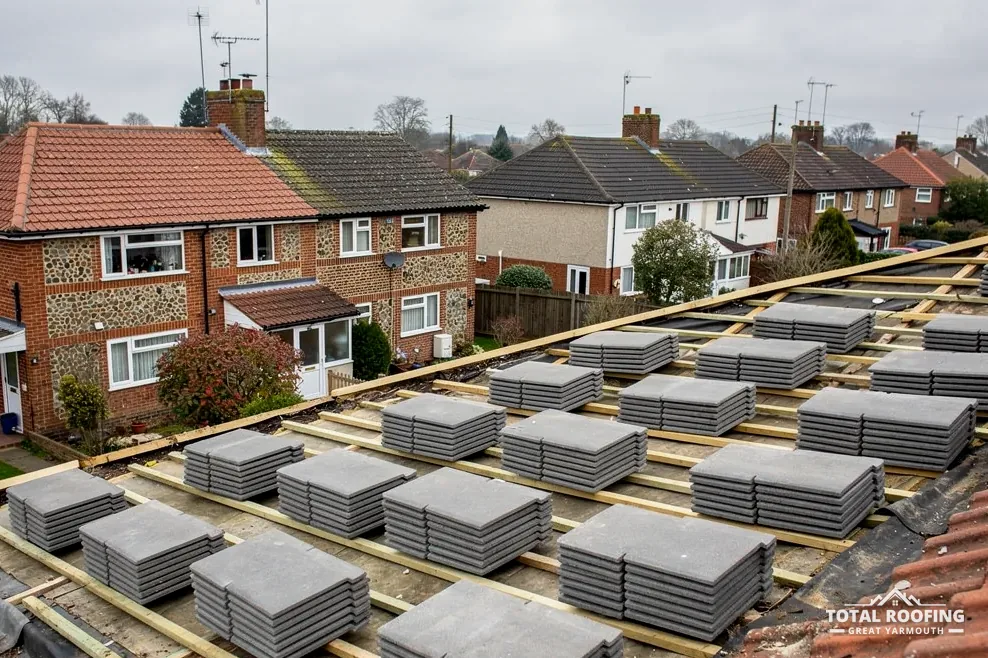
The short answer
Walk round the house on a dry, bright day with binoculars and look along each slope for slipped or missing tiles, gaps at the ridge and verge, loose flashings, sagging lines and gutters that hang or overflow. Add a torch check from the loft boards. Never climb onto the roof.
Stay on the ground, and pick the day
A roof inspection from below needs no ladder, and a ladder is not a safe way to extend it. Choose a dry day with good light, ideally with the sun low enough to throw a shadow along the slope, because a slipped tile shows as a ragged edge in that kind of light, and a missing one as a dark hole.
Take binoculars if you have them, or use your phone camera at full zoom and enlarge the photograph afterwards. Walk all the way round, including the side that is hard to see from the road. A neighbour's drive or garden gives the clearest view of a gable end, and a quick knock to ask permission is sensible.
Never step onto the roof to get a closer look. HSE's guidance A14 states "AC roofs are always fragile", and a rooflight or an old sheet can give way underfoot. HSE also tells householders: "If the building was built or refurbished before 2000, assume that there is asbestos in it."
What to look at, part by part
Run your eye along each slope in the same order every time, so nothing is skipped: the eaves and gutters at the bottom, the field of the roof, then the ridge and any chimney at the top.
- Tiles or slates: slipped, cracked, missing or sitting proud of their row.
- The ridge line: gaps in the mortar, tiles that have shifted or a line that dips.
- Verges at the gable end: loose edge tiles or cement falling away.
- Flashings: lead or metal at the chimney and wall junctions lifting or splitting.
- The chimney stack: crumbling mortar, a leaning pot or cracked flaunching.
- Gutters and downpipes: sagging, loose, full of moss or overflowing after rain.
- The overall shape: a slope that bows, or a ridge that is no longer straight.
A sag matters more than a single tile. It points to something under the covering, such as a timber or its support, and it is a matter for a survey rather than a guess from the pavement. Note where on the slope it sits and photograph it from two positions.
Gutters, flashings and flat sections
Watch the gutters when it rains, if you can. Brett Martin's installation guidance has a gutter falling towards its outlet, so a run where water stands in puddles or spills over the front edge has lost its fall or its support. Sagging brackets, a joint that drips and a downpipe that is blocked at the shoe are all visible from the path.
Lead flashing can last for over 80 years when correctly installed, according to MyJobQuote, but it moves with the weather and can lift or crack at a joint. Look for a gap you can see daylight through, or a bright, clean line where an edge has curled up.
On a flat section such as a rear extension or a porch, look for standing water a day after rain, splits in the covering and a membrane that has lifted at an edge. BS 6229:2025 sets a minimum finished fall of 1:80 for membrane flat roofs, so some water on the surface is not unusual but a deep pool is.
The loft check, and what to do with it
From the loft hatch, stand on a joist or a board and shine a torch at the underside of the roof. You are looking for pinpoints of daylight, dark or wet-looking timber, stained underlay, dripping around the chimney and insulation that is damp or flattened. Stay on boards or joists, never on the ceiling between them, and keep clear of anything that might be asbestos.
Take dated photographs of anything you find, whether from the pavement or from the loft. Message us a picture on WhatsApp, 07880 284133, and we will have something to look at, though only a survey shows what lies beneath the covering. At Total Roofing Great Yarmouth that survey covers all of the roof, and what you are handed afterwards is a single written total.
Our roof maintenance checklist gives a longer list for keeping watch, and Great Yarmouth roofs by house type explains how the parts differ between house types. Leave moss and cleaning to a roofer too, because scraping at a tile or soaking a slate from a ladder can do more harm than the growth ever did.
