
The short answer
It depends on the covering. HomeBuilding gives approximate lifespans of 100+ years for Welsh slate, 60-80 years for clay tiles and 40-50 years for plain concrete tiles, and flat roof membranes run to a few decades. Every figure is a published approximation, and what a survey finds on your own roof matters more.
Slate, clay and concrete tiles
HomeBuilding, last updated 30 September 2025, tabulates approximate lifespans by covering. Its figures are in the table below, and where a second source speaks to the same covering, that source is named in the text under it.
| Covering | Approximate lifespan | Source |
|---|---|---|
| Welsh slate | 100+ years | HomeBuilding |
| Spanish natural slate | 75-100 years | HomeBuilding |
| Reclaimed Welsh slate | 50-80 years | HomeBuilding |
| Clay tiles | 60-80 years | HomeBuilding |
| Plain concrete tiles | 40-50 years | HomeBuilding |
Marley, a tile maker, adds two statements. On clay: "For clay roof tiles, the BRE determined a minimum life expectancy of 60 years". On tiles in general, it puts the typical expectation for roof tiles at around 60 years, then adds in its own words: "This is not a guarantee or warranty of its longevity." The BRE figure belongs to clay alone. For concrete tiles, HomeBuilding's 40-50 years and Marley's general figure of around 60 for roof tiles do not match.
Flat roofs: EPDM, GRP and felt
Two sources give flat roof figures, and they do not agree. HomeBuilding's approximations sit in one column below. Less, a home-improvement site updated on 9 November 2026, writes "EPDM rubber membrane typically lasts 30 to 50 years", "GRP fibreglass lasts 25 to 40 years with minimal maintenance" and "Torch-on felt lasts 10 to 20 years depending on quality and installation".
| Membrane | HomeBuilding | Less |
|---|---|---|
| EPDM | 25-30 years | 30 to 50 years |
| GRP | 25-30 years | 25 to 40 years |
| Felt | 10-15 years | 10 to 20 years |
Read both columns together. Felt sits at the short end in each source and EPDM at the long end, but the ranges overlap only in part, and neither is a promise. A flat roof is judged as a membrane plus the deck beneath it, and the fall matters too: BS 6229:2025 sets a minimum finished fall of 1:80 for membrane flat roofs. Our roof maintenance checklist lists what you can check from the ground between surveys.
Lead, zinc and the parts around the covering
MyJobQuote, last updated 22 September 2026, says "Lead flashing that is correctly installed can last for over 80 years", adding "(over 100 years for higher codes)". For a lead flat roof, HomeBuilding's range is 60-100 years, and Less calls lead "the longest-lasting option at 50 to 100 years". For zinc, the maker VMZinc says: "When correctly designed and installed a zinc roof can last in excess of 100 years."
A roof is more than its covering. A retailer of uPVC roofline products writes that, "When installed correctly, they can typically maintain reliable performance for between 20 and 40 years". On conservatory roofs, HomeBuilding gives polycarbonate as "They have a typical lifespan of 10 years." HomeBuilding also quotes the managing director of Roofing Megastore: "A glass conservatory roof will likely last in excess of 30 years", and a tiled one "will typically last in excess of 50 years".
Each is a published statement about a product, from the party that wrote it, and none is a measurement of a particular roof. A glass conservatory roof and a plain concrete tile roof are different products with different ageing, so the figures are kept apart above.
What a lifespan figure means for your own roof
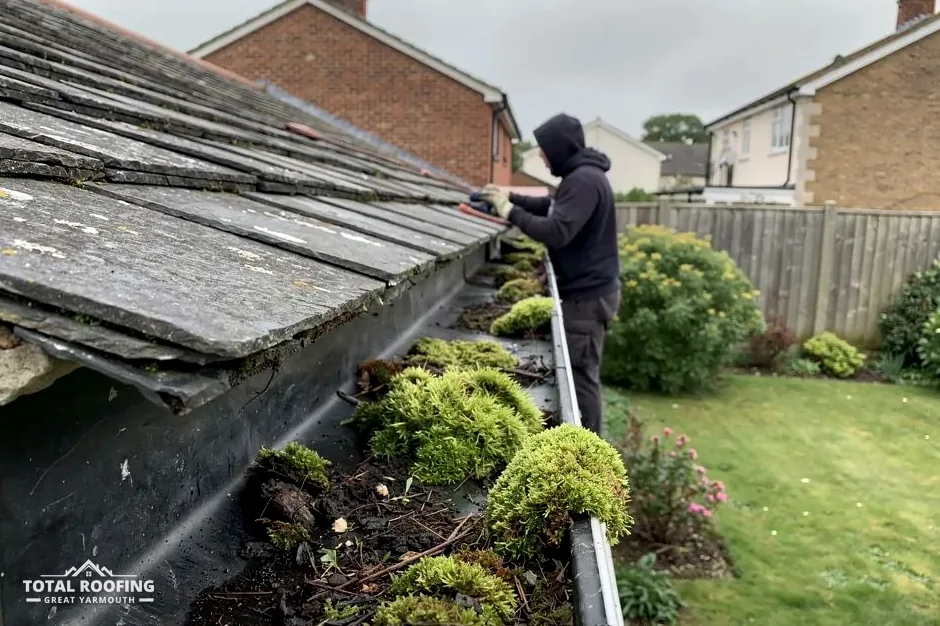
A lifespan is a range, and the covering is only one part of a roof. Battens, underlay, lead and ridge each age at their own pace behind it, so a slate roof inside a published range can still be failing at a flashing, while a tiled roof beyond that range can still be sound. Treat the age of a roof as a reason to inspect it, not as a verdict.
This is the reason a survey covers each part of the roof, from the ridge down to the gutter line, and not only the visible covering. At Total Roofing Great Yarmouth we report plainly on the roof in front of us, and anything else we see while we are up there, and give one written total price. Comparing that figure with a number from elsewhere is easier with our guide on reading a roofing quote.
Treat any single lifespan quoted to you, in an advert or a sales visit, as the start of a conversation. Ask which source it comes from, which covering it refers to and what it assumes about installation, because the published figures above carry exactly those qualifiers.
