
Twenty years: old, middle-aged or finished?
No single number answers this, because gutters are made from different materials and fail in different ways. The published figure for plastic guttering and roofline products comes from a retailer of uPVC fascia boards and related products, which says that when installed correctly they "can typically maintain reliable performance for between 20 and 40 years". Treat it as one seller's estimate for uPVC, not a promise, and note that it describes a range. A gutter at 20 years sits at the start of that range, not at the end of it.
That is the reassuring half. The other half is that the range assumes correct installation, and correct installation includes a fall towards the outlet and brackets at the right spacing. Brett Martin, a guttering manufacturer, gives the fall as 1mm for every 600mm, sloping towards the outlet. A run that was set level or backwards in the first place will hold water and wear faster, however good the plastic.
So the age is a prompt to look, not a verdict. A gutter that is 20 years old, still straight, still tight at the joints and still carrying water to the downpipes can stay where it is. One that leaks at several joints, has dropped away from the fascia or has gone brittle in its brackets is telling you something, whatever its birth date. The rest of this post is about reading those signs and deciding what to do about them.
Signs the gutters have done their time
Start from the ground in rain, because a gutter shows its faults when it is working. Watch where the water goes. Drips from a joint, spray over the front lip, water running down the wall behind a downpipe and a trickle where there should be none are all signs that the run is not carrying everything it should.
On a dry day look for the marks that rain leaves behind. Green or black staining down the wall under a joint shows long-term leakage. A damp patch on the brickwork or a darker stripe under the eaves can mean an overflowing or blocked run. Peeling paint on the fascia board points the same way. Sagging is easy to see against the line of the roof: the gutter should run in a clean slope, and a belly in the middle means a bracket has failed or the fascia behind is soft.
Plastic that has aged shows it in the surface. A chalky, faded or cracked finish, and brackets that snap when touched, are signs that the material has become brittle. Brittle plastic does not take a repair well, because every touch risks another crack. Our guide to gutter cleaning separates a blocked run, which a clear-out fixes, from a failed one, which it does not.
Warning signs on a gutter run
- Drips or staining at the joints between sections
- A visible sag or belly between brackets
- Brackets that are cracked, loose or brittle
- Overflow down the wall in ordinary rain
- Paint peeling or boards soft behind the gutter
Repair or replace: how to decide
A repair suits a run with one or two defects and sound sections either side of them. A single leaking joint can be resealed or the union replaced. A cracked length can be replaced with a new one of the same profile, as long as the profile can still be matched. Loose or missing brackets can be refitted or added. A clear-out of leaves, moss and silt deals with a blocked run, and a blockage is a different problem from a failed gutter.
Replacement makes sense when faults are widespread or when the cause is the system itself. If joints leak in many places, if brackets break as soon as they are touched, if the run has sagged because the fascia is soft or if the old profile is no longer made, then patching one part simply moves the failure to the next. Replacement is also the moment to correct the fall, add brackets where the spacing was too wide and resize the downpipes if the roof has changed.
The decision belongs with someone who has looked at the whole roofline, and not at one corner of it. A survey looks at the gutters, but also at the fascia boards behind them, the soffits under the eaves and the edge of the roof covering above, because a new gutter fixed to a rotten board will fail again. The price is written once that survey is done. If cost is the main question, our page on gutter replacement cost sets out what moves the figure.
Repair or replace
Repair
- One or two faults
- Rest of run is sound
- Profile can be matched
Replace
- Faults along the run
- Brittle brackets and sections
- Fascia or fall needs correcting
What sits behind the gutter: fascias, soffits and the fall
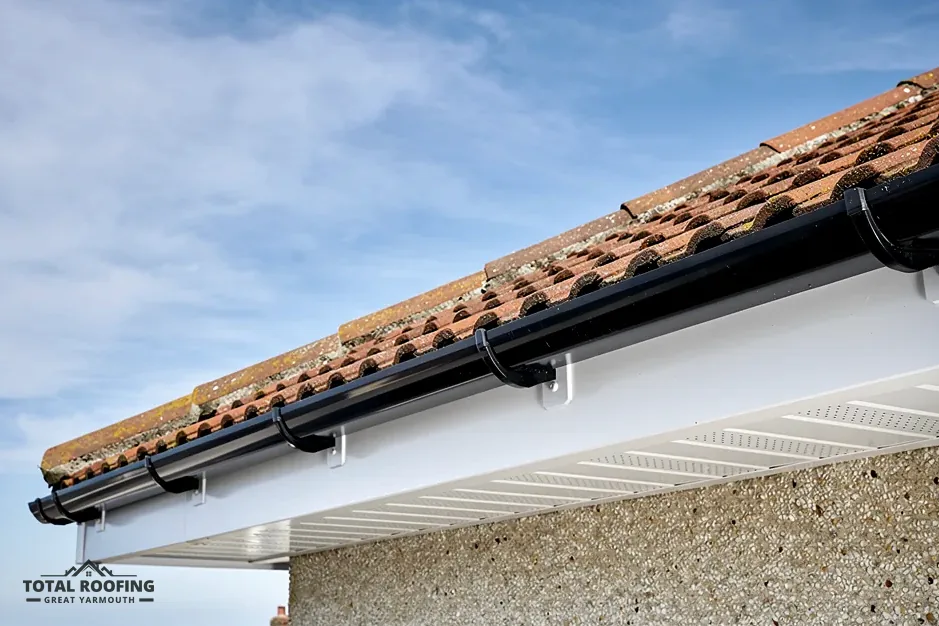
The gutter is the visible part of a system. It hangs from the fascia board, the board that runs along the ends of the rafters, and above it sits the edge of the roof covering, with the first course of tiles or the edge of the felt dropping into it. Below the fascia, the soffit closes the space between the board and the wall. If any of these is damp or rotten, the gutter is held on a weak base.
A replacement job is a sensible moment to look at all of them. Fascia boards that are soft to a screwdriver, with flaking paint and dark patches, need attention before new brackets go on. Where boards are sound but tired, capping over them is an alternative to replacement; our page on guttering, soffits and fascias covers the options. Soffit boards are worth a look as well, for ventilation openings that have been blocked and for staining from old leaks.
There is one more point for houses built or refurbished before 2000. HSE's advice is: "If the building was built or refurbished before 2000, assume that there is asbestos in it." Asbestos cement rainwater goods are on HSE's non-licensed list, and boarded soffits can be asbestos insulating board, so ask for an older gutter or soffit board of unknown type to be identified. A uPVC gutter is plastic and not part of that concern, but an older cement gutter, or a board whose type nobody knows, should be identified before it is cut, drilled or broken.
What replacement costs, from published sources
A clear-out is a different job from a replacement, and it is priced differently. Blocked gutters can be cleared without any new fittings, so what clearing them costs tells you little about the price of a new run. The figures for replacement are the ones that matter when you are deciding whether to renew, and they come from a national cost guide.
For replacement, MyJobQuote's page on replacing guttering (last updated 20/10/26) says: "The average gutter replacement cost in the UK is around £1,000 to £1,600." The same site's page on capping fascias and soffits (last updated 17/09/26) says the average cost of capping them is around £800. The MyJobQuote pages state no VAT basis, and neither figure is a price for your house, whose size, height and access change the work.
A firm's written price comes after its survey, as a single total for the described work. Where the work needs scaffold, it sits inside that total. Scaffolding on the pavement or road needs a highway licence from the county council, and we arrange the licence with our scaffolder. A long run of gutter at first-floor height is a different job from a single-storey lean-to, and the two should be priced on that basis.
Third-party figures for gutter work
| Average gutter replacement, UK | UK average, around £1,000 to £1,600 |
|---|---|
| Capping fascias and soffits, average | around £800 |
MyJobQuote, replace guttering (20/10/26) and capping fascias and soffits (17/09/26); the pages state no VAT basis.
Picking the material for the new run
Of the three, uPVC is a plastic, light to fit and available in a range of profiles and colours. Aluminium is a metal system that can be formed as a continuous run on site, which removes joints from the length of a gutter, and in the trade the result is called seamless guttering. Cast iron is heavy and traditional and suits period properties, though it needs painting and is heavier on the brackets and the fascia.
Material choice depends on the house, the budget and what is already there. A period house with iron gutters sits differently from a 2000s estate house with plastic ones, and a listed or conservation-area property may have a say from the council on the material. Our page on uPVC versus aluminium guttering compares the two in more detail.
Whatever the material, the outlets, joints and brackets need the same care as the choice. The run should fall towards the outlet, the brackets should be spaced to support a full gutter in heavy rain and the downpipes should be sized for the area of roof they drain. If you are weighing up an old gutter, a photo of the roofline sent on WhatsApp to 07880 284133 can be looked at before a survey is arranged.
How a gutter replacement is carried out
Replacing a run starts with access. A house gutter sits at eaves height, so a tower or scaffold is part of the job, and a ladder alone is not a safe way to hold a long length of gutter at arm's length. The old sections are unclipped, the brackets come off and the fascia behind is looked at again with the gutter out of the way, because that is the first time the whole board can be seen.
Any board that is soft is cut back or replaced before anything new is fixed to it. The new brackets go on at a spacing that supports the gutter when it is full, the fall is set towards the outlet and the sections are joined with their seals and clips. Downpipes are connected to the outlets, and the run is checked with water to see that it drains to the outlet and does not hold a puddle at any joint.
Where the roof covering drops into the gutter, the lowest course is checked so that water runs from the roof into the channel and not behind it. This is the same whole-roof look, not just the part you rang about. Any other fault seen from the scaffold is told to you plainly, alongside the price for the work described.
- Erect access at eaves height
- Remove the old gutters and brackets
- Check and repair the fascia behind
- Fix new brackets and set the fall
- Join the sections and connect the downpipes
- Test with water and check each joint
