
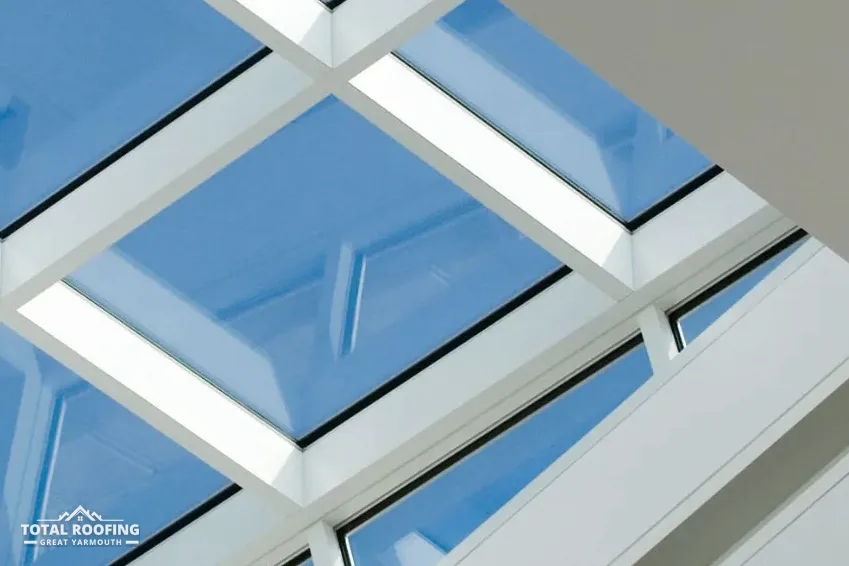
Roof windows and conservation areas: what Class C allows
For a house, the usual starting point is Class C of the General Permitted Development Order. GOV.UK's technical guidance says: "Class C covers other alterations to roofs such as re-roofing or the installation of roof lights/windows." Re-roofing a house is normally permitted development under Class C, and the same class reaches a roof window, so a house in a conservation area does not need planning permission for one just because of the designation, as long as the limits are met.
That point surprises people, because the same designation does remove other rights. Class B, which covers roof enlargements such as dormers, is not available on what the guidance calls article 2(3) land, a term that takes in conservation areas, the Broads and National Landscapes. Class C has no such exclusion. A dormer in a conservation area needs permission, and a roof window within the Class C limits does not, unless something further takes the right away.
Two things can do that: an Article 4 direction, and the way the home itself is classed. Flats sit outside the householder rights altogether, so a flat's roof window needs a different route. Listed homes are covered further down.
The limits themselves are specific, and they are listed below. Check the window against each one, and where you are unsure, ask the council before you order.
Limits for a Class C roof window
- It must not protrude more than 0.15 metres beyond the roof plane
- It must not rise above the highest part of the original roof
- Windows on side slopes need obscure glass
- A side-slope window must not open, unless the opening part is high
- Chimneys, flues and soil pipes are outside Class C
The side-slope rule: obscure glazing and opening parts
Class C comes with a condition about side slopes. Condition C.2 applies to "any window located on a roof slope forming a side elevation of the dwellinghouse". Such a window must be obscure-glazed and non-opening, with one relaxation: if its openable parts are "more than 1.7 metres above the floor of the room in which the window is installed", it may open. The guidance adds that side windows should be obscure glazed to a minimum of level 3.
The wording is easy to misread. Obscure glazing applies in every case. The 1.7 metre figure relaxes only the non-opening condition: a side-slope window can have an opening part if that part is higher than 1.7 metres above the floor, but the glass is still obscure. A quote that treats it differently is worth questioning.
Work out which slope is which before you choose a window. The condition reaches a slope that forms a side elevation of the house, as opposed to the front or rear slope. If a loft room has only a side slope to put a window in, the obscure glass and the fixed or high opening are part of the design, not an afterthought, and they affect how the room feels and how it is ventilated. A window in a rear slope that looks onto your own garden does not raise the side-slope condition at all.
If the layout does not allow a Class C window, an application for planning permission may be the route instead. The council, or the Broads Authority inside its area, tells you which.
Myth
A side-slope roof window only needs obscure glass if it opens below 1.7 metres.
Fact
The window is obscure-glazed in every case. The 1.7 metre height only relaxes the non-opening condition.
Article 4 directions: when the council has removed the right
GOV.UK describes an Article 4 direction as one that "enables the Secretary of State or the local planning authority to withdraw specified permitted development rights across a defined area." Where one applies, a change that would otherwise be permitted can need a planning application, and this is the point at which a conservation area becomes a real obstacle for a roof window.
Which addresses a direction reaches, and what it takes away, are questions for the council. In Norwich, for example, the city council's page says: "If your property has an article 4 direction in place, you'll need to apply for permission, even for small changes." It lists directions in Bracondale and Heigham Grove. For Great Yarmouth borough, check with Great Yarmouth Borough Council whether an Article 4 direction applies. For a Norfolk district or East Suffolk, the same advice stands: ask the council.
A direction that covers camping, moorings, gates or caravans says nothing about roofs. Only one that names roof alterations or windows on roof slopes reaches a roof window. The council can tell you which kind applies, and it can tell you in writing, which is worth having before an order is placed for a window that has to be made to measure.
Keep any reply from the council. If it says that no direction affects roof windows at your address, the message is worth more than a recollection of a phone call, and it saves a dispute later if a neighbour or a buyer's solicitor asks what was checked.
Checks before you order a roof window
- Find out whether the home is a house, a flat or listed.
- Ask the council whether an Article 4 direction applies.
- Work out which slope forms a side elevation.
- Check the window against the Class C limits.
- In the Broads, ask the Broads Authority.
The Broads Authority and your roof window
The Broads Authority says: "We are the local planning authority for all land and properties within our executive area." Its status is described as national park status, which is not the same as being a national park. Inside that area, planning goes to the Broads Authority, not to the district council. In the Broads, planning permission is decided by the Authority while Building Regulations stay with the district council's building control or a registered approver.
That split matters for a roof window. The Broads is article 2(3) land, so Class B roof enlargements such as dormers are not permitted there and need an application to the Broads Authority. Class C is not removed, and like-for-like re-roofing stays under the normal rules. For planning questions inside its executive area, the Broads Authority is on 01603 610734.
Some Broads settlements lie only partly inside the executive area. A town such as Wroxham or Horning can have some addresses inside it and others outside, and in that case the right authority depends on the address, not the postcode district. Check the address, and ask the Broads Authority if you are not sure. Where land at the edge of a settlement is riverside or marsh, it is worth asking before you assume it is outside. Moorings and riverside land are a separate matter again, since a roof window is a building change and not a waterway one. A question about the house is put to the planning authority for that address.
On our jobs we check the planning or building-control route with the council or the Broads Authority before work starts.
Listed homes and roof windows
Listing changes the question without taking away the permitted development rights. Listing does not strip a house of Classes B and C. What it adds is listed building consent, which section 7 of the Planning (Listed Buildings and Conservation Areas) Act 1990 ties to work "in any manner which would affect its character as a building of special architectural or historic interest". Cutting a hole in a historic slope is exactly the sort of alteration that can qualify.
The consent comes from the council, and it can be needed even where the same window would meet every Class C limit on an unlisted house. The two systems run side by side. A window that passes the planning test can still fail the listing test, and a listing consent does not stand in for a planning one.
A design that sits flush with the slope, rather than standing proud of it, is one of the points a conservation officer may raise, and the council decides what it accepts. Ask before you choose a model. The listing grade of a building comes from the list entry, and the list entry is where to look first, rather than assuming that a grade settles the answer.
Churches and scheduled monuments follow different routes again, set out in our planning permission guide.
Building Regulations still apply, and what a window costs
Permission from a planning authority is one question. Building Regulations are another, and they apply whether or not the window needs planning permission. Approved Document L 2021 asks a rooflight to reach 2.2 W/m²K, and a replacement roof window to reach 1.4 W/m²K or Window Energy Rating Band B, with Band B as a minimum. Our guide to building regulations for roof windows goes through the checks.
Where a loft conversion creates a storey more than 4.5 m above ground, Approved Document B paragraph 2.5 calls for either a protected stairway or an alternative escape route. An escape window has its own dimensions: a minimum area of 0.33m2, a minimum height of 450mm and width of 450mm, and the bottom of the openable area a maximum of 1100mm above the floor. A roof window can serve as one, but it has to be the right one.
Building control is carried out by the council's building control team or by a registered building control approver, and it sits apart from planning even inside the Broads. For a house in Great Yarmouth, the building control team at Great Yarmouth Borough Council is the one to check with before the window is ordered. That keeps the energy figures, the escape window and the fixing details with the body that signs the work off.
The figure to expect for the window itself comes from MyJobQuote. It says: "Average cost for a standard mid-range Velux window is £1,100." It adds: "Velux window replacement costs around £100 less for a straightforward swap, as the opening is already in place." A new opening in a slope is a bigger job than a swap, and the survey prices it. See types of roof window for the options, and the skylights and roof windows hub for the rest.
Published figures for a roof window
| Standard mid-range Velux window, average | £1,100 (MyJobQuote) |
|---|---|
| Swap into an existing opening | around £100 less (MyJobQuote) |
MyJobQuote Velux window page, 22 September 2026, no VAT basis stated. Cutting a fresh opening into a slope is a separate job from a swap, and the survey sets that price.
