
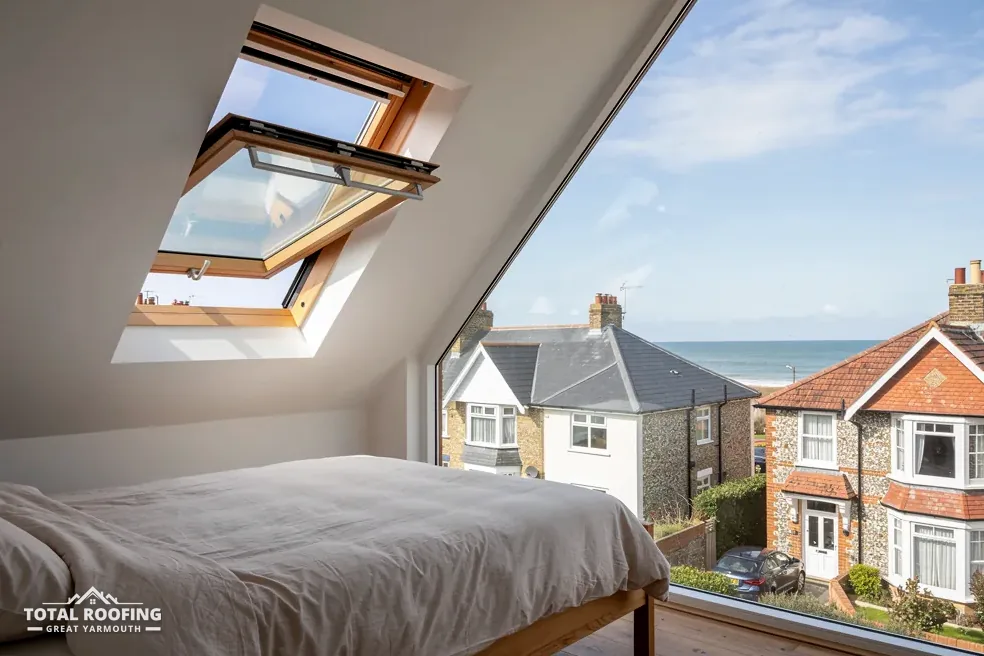
The one price marker for a roof window
MyJobQuote publishes a price marker for roof windows. Its roof window page, dated 22 September 2026, says: "Average cost for a standard mid-range Velux window is £1,100." It gives no VAT basis, so treat the figure as a rough marker for one common specification, not a price for your roof, and expect a real job to land above or below it.
The same page adds that Velux window replacement "costs around £100 less for a straightforward swap, as the opening is already in place." That gap explains why a like-for-like swap and a brand-new opening belong in different price conversations. A swap reuses the hole in the rafters and the battens around it. A new opening means cutting back the covering, trimming rafters, building a frame and forming a fresh weathertight seal: carpentry and roofing work that a swap skips.
Neither figure tells you what your own window will cost, and a marker is only a place to start the conversation. The size, the covering around the frame, the lining inside, the height of the roof and the access all move the number, and they are the headings of this guide. Your figure is set at the survey, once the covering, the rafters and the room have been seen.
Third-party marker only
| Standard mid-range Velux window | average £1,100 |
|---|---|
| Straightforward swap, opening already in place | around £100 less |
Source: MyJobQuote, roof window page dated 22 September 2026. No VAT basis is stated.
Size, opening style and glazing
Roof windows are made in set widths and lengths, and glass area is the plainest driver of cost: a larger pane means more glazing, a bigger frame and a heavier sash to hang. Opening style matters as well. A centre-pivot window rotates about a bar across the middle of the sash, a top-hung one swings out from the head, and an electric or solar-operated model adds a motor and a control. Each is a different product at a different price, and the guide to types of roof window explains how they differ on the roof and inside the room.
Glazing carries a regulation point too. Approved Document L 2021 gives a replacement roof window a U-value of 1.4 W/m²K, or a rating in WER Band B, and a rooflight 2.2 W/m²K. The band is a floor, so a window with a better rating complies too. A lower-priced window that falls short of that test is no saving, because it cannot go in as a replacement.
The glass also decides how the window behaves in use. Laminated inner panes, solar-control coatings and obscure finishes each change the specification and the price. A bathroom window can carry obscure glass, a loft bedroom may want a blind and a coating against summer heat, and a stairwell may only need a fixed pane. Choosing the window for the room, rather than the lowest frame price on a list, keeps the final figure sensible and stops a second order for a window that does not suit.
Swap or new opening: what the work involves
A swap starts with the sash and frame coming out of an opening that is already framed, flashed and lined. The new window is sized to match, set on the same battens and sealed back into the covering. Because the structure round the opening has already been built, there is less carpentry and less disturbance to the tiles or slates.
A new opening starts with the covering stripped back above and beside the position. The battens are cut, and one or more rafters are trimmed to make room. A cut rafter has to be carried on a new header and on trimmers, which hand its share of the roof load to the rafters beside it. The trimming is structural work, and the size of the opening against the rafter spacing decides how much of it there is. The guide on how a roof window is installed walks through the order of work.
A new opening also raises the regulation questions that a swap may not: planning, means of escape for a loft bedroom, and the Building Regulations route for the structure. The building regulations guide for roof windows covers those. The cost effect is simple. More cutting, more timber, more lining and more checking add up to a higher price than a swap, and the MyJobQuote gap of around £100 reflects only the straightforward case.
Two jobs, one window
Swap
- Opening already framed
- Old lining can stay
- Fewer tiles disturbed
New opening
- Covering cut back
- Rafters trimmed, header fitted
- Lining built from scratch
The flashing kit and the covering around the window
A roof window sits in a hole in the roof, and the covering has to be sealed to its frame all the way round. That seal comes from a flashing kit: pressed metal pieces made for one kind of covering. A kit for a flat plain tile does not seal against a deep-profile pantile, and a slate kit differs again. Fitting the wrong one invites a leak, which is why the covering on your roof is one of the first things a survey looks at.
Where several windows go side by side, or one above another, a joined kit takes the place of single ones, and that changes the price of the order. A window close to the ridge, a valley or a chimney also needs more thought, because rain has less roof to run down before it meets the frame.
Pitch is part of this. Each roof window model has a stated pitch range, and a very shallow or very steep slope can call for a different frame or a different fitting height. That is a reason to check the pitch before any window is chosen and not once it has been delivered, and it is why a photo from the ground only goes so far.
What the flashing kit has to match
- The covering: plain tile, pantile, slate or a flat profile
- The depth and profile of the tiles or slates
- A single window or a joined group
- The pitch of the roof slope
- The position against ridge, valley and chimney
Lining, plaster and the finish inside the room
A roof window is only half the job. Inside, the opening needs a lining: boards or plaster that make the light shaft running from the glass down to the ceiling, with insulation packed around the frame. Where the ceiling sits close to the rafters the lining is short. Where there is a deeper roof build-up, the shaft is longer and is splayed so that daylight spreads into the room.
A like-for-like swap can keep the old lining, so that part of the cost falls away. A new opening needs the whole lining built, then decorated. Plaster repair and painting round the opening are part of getting the room back to a finished state, and a quote that stops at the roof tiles has left a room half done.
Blinds are a separate choice. They are made to fit a particular window, so they are easiest to pick once the window is chosen. An electric blind or opening adds a power feed, which brings in an electrician for the wiring. A window reached from a bed or a staircase also needs thought about how the pole, handle or remote will be used, since a window that cannot be reached is a window that never gets opened.
Access, height and scaffold
How the roof is reached is one of the things that changes the price of a roof window. A window in a rear single-storey roof can be reached with a ladder and a roof ladder. A window high on a two-storey house, or over a drive, a pavement or a conservatory, needs a scaffold to work from and to land the new window safely. A job that calls for scaffolding has that cost carried within the written quote, with no separate sum to find.
Scaffolding on the pavement or road needs a highway licence from the county council; we arrange the licence with our scaffolder. That is a real step with a lead time set by the council, and it sits behind the date a window can be fitted. The licence is for the scaffold on the highway, not for the window.
Weather matters too. A roof is open to the sky from the moment the covering comes off until the new window is flashed in, so the work is planned around a dry spell, and a window delivered in the wrong size is a cost nobody wants to repeat. That is another reason to measure on site before ordering, not from a photograph alone.
Reading a written quote for a roof window
A good quote for a roof window names the window, with its size and opening style, and says whether it is a like-for-like swap or a new opening. It names the flashing kit for your covering, what happens to the lining inside, and how the roof will be reached. If a quote from another firm leaves any of those out, ask what it covers before comparing it with anything else, because two totals only compare when the same work sits behind both.
What you are given in writing is a single total, set after the survey, so there is nothing for you to add up. We also look at the whole of the roof around the window, and report what else we saw, whether it is relevant to the window or not: slipped tiles beside the opening, tired lead on a chimney nearby or a gutter at the eaves are easier to deal with while access is already in place.
If you want a first view before booking a survey, send a photo of the window with the roof beside it on WhatsApp. A photo shows the covering, the pitch and the age of the surrounding work, which helps to judge the kit and the access, though it cannot replace a look at the rafters and the inside of the room. The guide to replacing a Velux-type roof window covers the swap itself, and the skylights and roof windows page gathers the rest.
Myth
A roof window costs the same wherever it goes in the roof.
Fact
MyJobQuote puts a straightforward swap around £100 below a new window, because the opening exists.
