
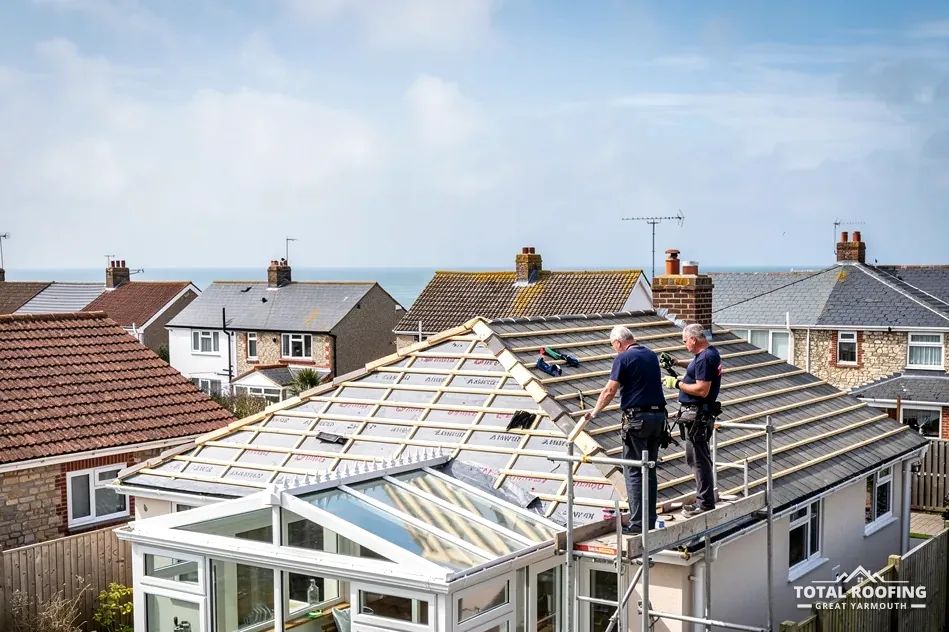
What a gap in the ridge lets in
The ridge tiles cap the line where the two roof slopes meet. Under them runs the top batten and, beneath that, the underlay, which is the flexible membrane laid over the rafters. When one ridge tile goes, the gap exposes the join to the sky, and the covering is no longer finished at the top. Rain driven along the roof can run into the opening and settle on the underlay at the apex.
Underlay is built to shed small amounts of water, but it is a second layer and not the main covering. Wetting at the apex can soak into the top batten and the rafter ends, and from there it can reach the ceiling below. A stain on a bedroom ceiling under the ridge line is the kind of sign that follows. A dry loft after a downpour does not prove the gap is harmless, since a slow leak can sit in the timber for some time before it shows.
Wind is the other issue. A ridge tile that has come away leaves a loose end in the line, and the tiles beside it lose the support of their neighbour. The wind pulls upward on a ridge, which is why Marley says ridge and hip tiles should be "mechanically fixed to resist the calculated wind uplift force". A tile that has gone because its fixing failed raises a fair question about the others along the same run.
What the ground and the loft can show
Start with the ground, and stay there. Move back across the road or the garden until the whole line of the ridge is in view in daylight. You are looking for a break in the row, a tile sitting at an angle or a pale patch where mortar has gone. A look along the length of the roof from the gable end can show a sag or a kink that the front view hides. Binoculars, or a phone camera zoomed in, give a closer look without a ladder. Check the path, the lawn and the flat roofs below for pieces, because a fallen tile is the quickest way to learn which part of the ridge it came from.
Then look at the inside. In the loft, with a torch, look along the apex for daylight, for stained or dark timber and for damp insulation underneath. Stay on the joists or on a boarded floor, because the ceiling between them will not carry a person. If you have no loft access, look at the ceilings on the top floor for fresh brown marks, bubbling paint or a damp smell.
None of this replaces a survey. It gives you facts to pass to the roofer, and photographs taken from the ground are worth keeping for the insurer too. Note the date, the weather and anything you heard, such as a bang in the night, because the roofer and the insurer will both ask when you first noticed. The list gathers the signs, outside ones first.
Signs of a ridge problem
- A break or gap in the row of ridge tiles
- A ridge tile sitting at an angle
- Pale patches where mortar has fallen away
- Tile pieces on the ground or on lower roofs
- Daylight along the apex from inside the loft
- Brown stains on a top-floor ceiling
How serious it is: reading the situation
A single missing tile in a ridge that is otherwise sound is a small repair. The same missing tile in a ridge with cracked mortar all along it is a warning about the whole run, because the same ageing that loosened one tile has been working on the rest. The seriousness comes from what the gap tells you, not only from the size of the hole. A ridge tile is also not an isolated part. The tiles at either side lean on it, and when it goes they are left with a free edge that wind can catch and rain can run under, so a single gap can become two or three if the weather turns before the repair is done.
Marley explains that since the 2015 amendments to BS 5534, mortar "could no longer be relied upon as the only means of securing the roof covering". If a mortar-bedded ridge tile has come away, a roofer first looks at what else held it, and what holds its neighbours. If the answer is only mortar, the repair may need more than a replacement tile.
The table reads four situations against what each one suggests. It is a guide to the conversation with a roofer, not a diagnosis, and a roofer on the roof will see more than a photograph can show.
| What you see | What it suggests |
|---|---|
| One tile gone, others firm | A local repair |
| One tile gone, mortar cracked along the run | The whole ridge needs checking |
| Damp stain under the ridge line | Water has already got in |
| Tiles in line but gaps in the pointing | A mortar problem, not a missing tile |
What to do about it before the roofer arrives
Do not go up to inspect it or to put the tile back. A ridge is the highest place on the roof to work, with the steepest drop below it, and a fall from there is serious. Resetting a fallen tile is the roofer's job, and so is checking everything around it. Our guide to missing mortar on ridge tiles covers the other side of this problem.
Keep the damage as you found it until it has been photographed. If a storm took the tile, the Financial Ombudsman Service says it will usually give weight to expert reports and photos. The Ombudsman says: "a storm usually involves violent winds, usually with rain, hail or snow". It adds: "Rain, hail or snowfall by itself can constitute a storm". Tell your insurer about the damage. Take your photographs while the scene is untouched.
If water is already coming in, place a bucket beneath the drip and move furniture. A temporary make-safe up on the roof is its own piece of work, apart from the proper repair, and it is done to stop water getting in until the right work is arranged. A photo of the gap sent on WhatsApp gets looked at, and the survey that comes next takes in the whole roof, not only the missing tile. The written price follows that survey.
What to do from the ground
- Stay on the ground and do not climb up.
- Photograph the gap, the ridge line and any fallen pieces.
- Check the top-floor ceilings for fresh stains.
- Tell your insurer if a storm caused it.
- Send the photographs and arrange a roofer to look.
How the repair is done and what it costs
Where the ridge is otherwise sound, the repair is to set a new tile in the gap and fix it to the standard the rest of the run follows. Where the mortar along the run has cracked or crumbled, the whole line may be taken up and re-bedded, with each tile mechanically fixed, or replaced with a dry-fix system. Our page on how you fix ridge tiles sets out the methods.
The numbers that follow come from published guides, each dated, and none is a Total Roofing price. In November 2025 Which? asked 11 of its Trusted Traders and reports £80 to £300 for a new ridge tile, excluding VAT. MyJobQuote's page of 1 October 2026 has the average cost of replacing ridge tiles in 2026 at between £225 and £550. Checkatrade's table of repair rates, from June 2026 and exclusive of VAT, lists ridge tile repairs at £50 to £70 per metre.
For an urgent visit, MyJobQuote puts emergency roofer call-out costs at typically £150 to £300, while extensive storm damage repairs can cost £1,200 or more. Keep each figure to its own meaning: the per-metre rate is for repairs and cannot be multiplied into a ridge total, and hips get priced after a survey. A single figure for the whole job appears on the written quote after the visit, whether it covers one tile or the whole run.
Published figures
| New ridge tile (Which?, Nov 2025) | £80 to £300 |
|---|---|
| Average ridge tile replacement (MyJobQuote, Oct 2026) | average £225 to £550 |
| Ridge tile repairs (Checkatrade, June 2026) | £50 to £70 per metre |
| Emergency call-out (MyJobQuote, Oct 2026) | £150 to £300 |
Which? and Checkatrade's table exclude VAT. MyJobQuote gives no VAT basis. Hips: after a survey.
Why the whole roof gets looked at
A missing ridge tile is the visible fault, and the survey that follows is for the rest of the roof. The ridge meets the hips and the verges at its ends, and each of those joints can be affected by the same movement or the same ageing. The underlay and the battens under the gap have been exposed to weather, and they are checked from the inside as well.
Once we have been up and looked, we explain in plain words what the roof showed, the ridge and everything else, so that a ridge repair is not followed by a second visit for something that was already there. The scaffold, where the job needs one, is dealt with inside the single written total. Our roof repairs hub explains how the work is arranged.
If the tile that went is the first fault you have noticed, it is also a reason to look at the other parts of the roofline: the gutters, the fascia boards and the flashings. They sit in the same weather and age on a similar timetable, and a quick look from the ground costs nothing. Hips run down from the ridge to the eaves and carry their own capping tiles, so a hip tile that has slipped can be the same fault in a different place, and the verge at a gable end finishes the roof at its edge. The inspection page on what a roof inspection covers lists what a roofer looks at, from ridge to eaves.
