
Three coverings, three ways of keeping water out
A flat roof is never quite flat. Strictly it is a low-slope roof that has to shed water without the help of steep pitches and overlapping tiles, so the covering itself has to be continuous and watertight. That is a different job from a tiled pitched roof, and it is why the choice of covering matters more here than the choice of tile does on a house roof.
EPDM is a synthetic rubber, supplied as a large sheet. The sheet is rolled out across the deck and bonded or fixed in place, then cut to fit the shape of the roof. GRP is glass-reinforced plastic, better known as fibreglass: resin and glass matting are laid onto the deck on site and cure into a hard shell. Torch-on felt is built up in layers of bitumen-based sheet, the top layer of which is heated with a gas torch so that the underside melts and bonds to the layer below.
None of the three is a universal winner. Each has a job it does well, a weak point to watch and a cost that depends on the roof. The sections below take each in turn, then compare them on joints, edges, walking on the roof and the type of building. If you want a fuller description of any one system, the pages on EPDM rubber roofing, GRP fibreglass roofing and torch-on felt roofing go further.
EPDM: the rubber sheet
EPDM arrives as a single membrane that can be cut to cover a whole roof in one piece, so a small roof may have no joint across the field of the roof at all. Where one is needed on a larger roof, sheets are joined with adhesive or tape. The upstands at the walls and the detail around outlets, vents and rooflights are formed with trims and patches that are stuck down by hand, and the quality of those details decides how the roof performs. A smooth sheet laid over a sound, dry deck, with clean edges and well-formed corners, is a simple roof that is quick to lay.
HomeBuilding and Less put EPDM's lifespan at different figures. HomeBuilding, last updated 30 September 2025, gives EPDM "25-30 years". Less, in a flat roof cost guide updated 9 November 2026, says that "EPDM rubber membrane typically lasts 30 to 50 years". Neither number promises anything for a particular roof, so read the two together as a range of published expectations.
In a survey of 11 Which? Trusted Traders in November 2025, rubber EPDM with new boards came in at £1,950-£4,000 for a single garage (6m x 3m), excluding VAT. MyJobQuote's rubber roofing page (last updated 09/10/26) puts typical rubber roofing prices at around £60 per square metre, which it says makes the average rubber roof cost £1,050 fully installed. Keep an eye on the units: a per-square-metre rate is not a total, and neither guide gives a price for your roof.
What a survey checks on an EPDM roof
- The deck beneath: dry, sound and free of rot
- Edge trims and how the sheet is fixed at the perimeter
- Upstands at walls and the finish at the top
- Patches and seams around outlets, vents and rooflights
- Falls, so that water does not stand in a dip
GRP: the fibreglass shell
GRP is laid wet. Resin and glass-fibre matting go onto a prepared deck, a topcoat is applied, and the whole thing cures into one rigid skin with trims at the edges. Because it is made in place, it can follow a roof of any shape, with no sheet to cut to size. A small, awkward roof with several corners and upstands suits a system that is made on site, and the cured surface is hard and smooth.
A rigid shell asks more of the deck below it. Movement in the structure, such as timber that shrinks and swells with moisture, can crack a hard surface at the joints between boards unless the deck has been prepared to avoid it. The weather during the lay also matters, since resin cures properly only in suitable conditions. These are points to talk through at survey, rather than reasons to rule the system out.
The published lifespans are again from two sources. HomeBuilding gives GRP "25-30 years", and Less says "GRP fibreglass lasts 25 to 40 years with minimal maintenance." Name both and treat them as published estimates. The hard surface also suits a roof that will be walked on, which is why it is a familiar choice for a roof terrace or a balcony. The slope under any of these systems is checked along with the covering.
Torch-on felt: built-up layers
A modern felt roof is built from layers of reinforced bitumen sheet, laid in two or three courses. The top layer is rolled out while the roofer heats the sheet with a gas torch, so the bitumen softens and bonds to the layer below. The overlaps between rolls are sealed in the same way. Because felt comes from rolls, the roof has joints, and the care taken at each overlap is what the roof depends on.
The torch is the point to understand. A naked flame working close to timber, insulation and edges brings a fire risk, which is why how the work is carried out deserves questions, not only which felt is used. Any roofer ought to be able to explain how the fire risk is controlled, and a roof next to thatch, dry timber cladding or stored materials needs particular thought. Not every roof suits it, and some work is better done with a cold-applied or mechanically fixed alternative.
On lifespan, HomeBuilding gives felt "10-15 years" and Less says "Torch-on felt lasts 10 to 20 years depending on quality and installation". Both are the shortest figures of the three systems, though the cost of felt is also among the lowest. Which? gives felt on a single garage as £1,400-£3,500, again for the 6m x 3m size and excluding VAT, from its November 2025 survey. Remember that this is a price range for one size of roof in a published guide, and that the written price for your own roof follows a survey.
The systems side by side
The table puts the published lifespans next to each other and adds how each system is formed, which is where the joints are. The second and third columns carry the lifespan figures, one column for each guide, and the last column says how the covering is built up on the deck.
| Covering | HomeBuilding | Less | How it is formed |
|---|---|---|---|
| EPDM | 25-30 years | 30 to 50 years | One rubber sheet, bonded or fixed |
| GRP | 25-30 years | 25 to 40 years | Resin and glass matting, cured on site |
| Torch-on felt | 10-15 years | 10 to 20 years | Bitumen layers, joined by heat |
Read the figures with their sources. HomeBuilding's numbers are approximate lifespans, and Less qualifies felt with "depending on quality and installation" and GRP with "minimal maintenance". None of them is a guarantee, and a roof laid on a damp deck, or left with a blocked outlet, will fall short of any of them. What the table does show is that the three systems sit in a clear order on published lifespan, and that which one suits depends on the shape of the roof, the way it is used and the budget.
Joints, edges, foot traffic and shape
Joints are where a flat roof fails if it is going to. EPDM keeps them to a minimum on the main field of a small roof but depends on hand-formed details at the corners and upstands. GRP has no sheet joints across the main area of the roof, but it has trims at the edges and a surface that has to be left to cure in the right conditions. Felt has overlaps in every layer, and each is sealed by heat. The system with the fewest joints is not necessarily the one with the most reliable ones, because workmanship at the detail counts more than the count.
Edges and drainage matter equally. Whichever covering is chosen, the roof needs a fall so that water reaches an outlet instead of lying in a dip. BS 6229:2025 sets a minimum finished fall of 1:80 for membrane flat roofs, and IKO reports that reaching a 1:80 fall means designing for 1:40 under the code of practice. Ponding water that does not clear within a short time is a sign that the falls are wrong, and no covering will cure that. What drives the total for a new covering is set out in the written price after a survey.
Foot traffic splits the systems. A roof that is walked on, for maintenance of a window, an air conditioning unit or a balcony, needs a surface that copes with it. GRP's hard skin suits regular walking, and a roof terrace needs the right build-up beneath the walking surface. EPDM and felt can be walked on lightly for access, with a protective layer or walkway added where traffic is planned. Shape is the last test. A plain rectangle suits a sheet; a roof with an odd outline, a dormer cheek or several upstands may suit a system that is made on site.
Plain rectangle or awkward shape
Simple outline
- A single sheet can cover it
- Few hand-formed details
- Quick to lay
Complex outline
- Many corners and upstands
- Detail work decides the result
- Made-on-site systems adapt
Extensions, garages and dormers: matching covering to building
A garage roof can be a plain rectangle that nobody walks on. That makes it a straightforward candidate for any of the three, and the Which? figures above are for a single garage for that reason. The decision turns on the deck, the falls and the budget, and on how long you want the covering to last before it is done again.
An extension's flat roof is attached to the house on one side, so the junction with the wall carries a lot of weight in the decision. The upstand against the wall and the flashing that finishes it have to be formed well on any system. An extension roof that is part of a heated room is also subject to the energy rules. Approved Document L treats a new waterproof membrane laid over a flat roof as renovation (para 11.2(d)), and where more than 50% of a roof's surface is renovated, para 11.3 expects the element as a whole to be improved where feasible. Table 4.3 sets a threshold U-value of 0.35 and an improved value of 0.16 for a renovated roof. Insulation therefore belongs in the conversation about which covering to pick.
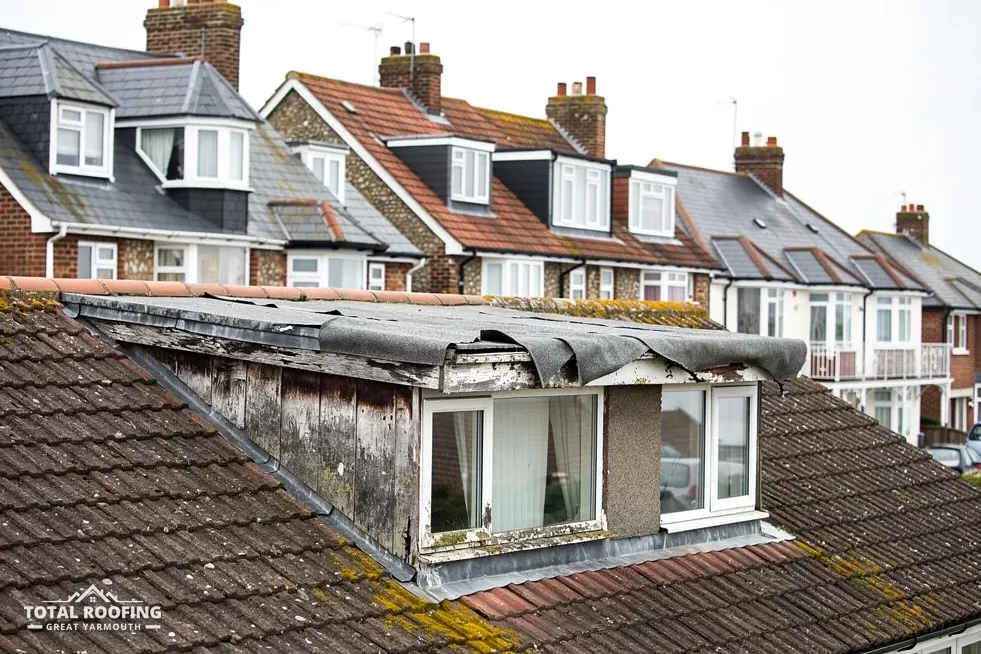
A dormer cheek or a small bay roof is a short, sometimes shaped, roof with several upstands, where a system made in place can follow the outline. The decision between a warm roof and a cold roof is a separate one: CNC Building Control's guide gives different answers for the two: a warm roof needs no ventilation, whereas a cold roof does. That guide comes from CNC, a partnership of five councils (South Norfolk, Norwich City, Broadland, King's Lynn & West Norfolk and Fenland), so the building control team for your address can say what applies to you. Our page on flat roofing sets out the whole range of work.
