The question underneath the question
Whether insurance covers a chimney turns on a different question, the one the insurer asks: what happened to it? A stack that lost pots in a gale is one claim, and a stack whose mortar crumbled over many winters is another. The policy wording sets out what is covered and what is excluded, so the answer for your home sits in your own papers and not in any general rule.
No page about roofing can tell you that a claim will succeed, and nobody should promise it. What can be set out is how the Financial Ombudsman Service approaches storm cases, because it settles disputes between customers and insurers and its published approach shows what an insurer has to be able to demonstrate.
A chimney is also an awkward part of the house to judge from the ground. It stands above the ridge, takes the weather from every direction and has several parts that fail in different ways. That is why the cause matters so much, and why clear photographs taken early are worth more than any argument later.
Our chimney repair service covers the work itself. This post is about the money question, and it is written to help you ask better questions of your insurer.
What counts as a storm
Home policies can cover damage caused by a storm, so the definition can decide a claim. The Financial Ombudsman Service gives its own wording: "a storm usually involves violent winds, usually with rain, hail or snow". It also says that "Rain, hail or snowfall by itself can constitute a storm." The Beaufort Scale, which grades wind by its effects, is also taken into account.
Note the word "usually" in that first line. The Ombudsman is describing what it looks for, not setting a hard line, and each case is decided on its facts. A single windy night with no other damage in the street may be judged differently from a night when neighbouring roofs lost tiles.
For a chimney this matters because a gale can bring down a pot, a cowl or part of the stack in one go, and that is the kind of sudden event a storm cover is written for. A stack that has been loosening for years and then comes down in moderate wind raises a harder question, because the insurer may argue that the weather was only the last step in a long decline.
The words used in your policy for storm, for gradual damage and for wear and tear are the ones that count. Read the sections on exclusions before you ring, and have your policy number and the date of the damage to hand when you do.
Myth
If a chimney comes down in a storm, the insurer always has to pay.
Fact
Your policy and the cause decide it, and the insurer must prove any exclusion it relies on.
Sudden damage or gradual decay
Policies can separate damage that happens in an event from deterioration that builds slowly, and some exclude the second under a heading such as wear and tear, maintenance or gradual damage. Wording varies between insurers, so what follows is a way of thinking about it and not a statement of what any policy says.
On a chimney, the sudden group could include a pot thrown down by wind, a cowl blown off, or a section of stack that has shifted since a recent gale. The slow group could include joints washed out of the brickwork over time, flaunching that has cracked and let rain into the stack, or a flashing that has corroded or lifted.
The Ombudsman says the insurer has to prove the exclusion applies, as an inspection report might show. That is a useful point for anyone facing a refusal on the grounds of wear and tear: the burden does not sit with you to prove the opposite from nothing. The Ombudsman also says that to decide, it will usually consider expert reports and photos, and that the insurer will normally ask a surveyor for a report of the damage. A report is the insurer's own evidence, so it is worth asking to see it.
Your own pictures, taken before anyone touches the stack, are the plain starting point. They show what was there on the day, which is hard to reconstruct once a pot has been swept up or a stack has been taken down.
The parts of a chimney that claims touch
A chimney is a group of parts, and an insurance question may concern only one of them. Knowing the names helps you describe the damage accurately on a claim form and when you speak to a roofer.
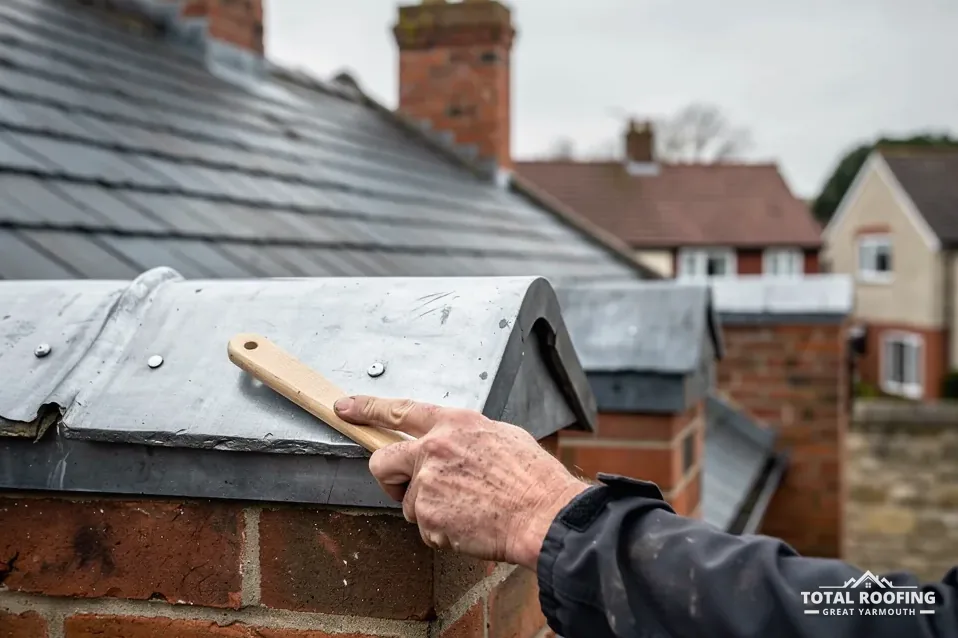
The stack is the brickwork standing above the roof. The flaunching is the mortar slope on top, which holds the pot and sheds water away from the flue. The pot sits on that slope and carries the smoke away. The flashing is lead sheet folded into the joint where the stack meets the roof, to keep rain out of it. Pointing is the mortar filling the joints between bricks, and the chimney breast is the stretch of the same structure inside a room.
Water damage inside the house, such as a brown stain on a chimney breast or a damp patch on an upstairs wall, can start at any of these. Our post on why a chimney leaks goes through the routes water takes.
When you describe the damage to an insurer, say which part is affected and whether it happened at a known moment. A statement such as the pot fell during the gale on a particular night is clearer than one that says the chimney is damaged.
Chimney parts in a claim
- StackBrickwork standing above the roof
- FlaunchingMortar slope that holds the pot
- FlashingLead seal between stack and roof
- PointingMortar joints between the bricks
- Chimney breastThe part of the stack inside the house
What to do in the first hours
If damage has just happened, safety comes before paperwork. Keep family, visitors and parked cars clear of the ground below a damaged stack, and stay off the roof. A leaning or cracked chimney can drop pieces without warning, and the fall from a roof is a worse outcome than a delayed claim.
The Financial Ombudsman Service says it will usually look at expert reports and photos, so photograph the damage before anything is moved. Take wide shots from the garden or the street that show the whole house and the stack, then closer shots of whatever fell, and pictures of any damage inside, such as a ceiling stain. Keep pieces that came down, and write down when it happened and what the weather was doing.
Then tell your insurer promptly, because policies set their own conditions for reporting a claim. Ask what the policy requires before you arrange repairs, and whether the insurer wants to inspect first. Where water is coming in, a temporary cover may be needed to stop further harm, and the insurer should be asked about that as well.
You can WhatsApp photos of the roof to 07880 284133 and we will look at them, or ring 01493 277103.
After chimney damage, in order
- Keep everyone and any cars clear of the stack.
- Photograph the damage from the ground.
- Keep any pieces that fell.
- Tell your insurer and ask what it needs.
- Arrange a safe temporary cover only as advised.
Costs, excess and whether a claim is worth making
A claim is not always the right route, because a policy has an excess and a claim may affect later cover. Your insurer can say how it treats claims, and your policy shows the excess. Weigh both against the likely cost of the work, and ask your insurer whether it would want to inspect before any repair is carried out.
Published guides show the scale for some chimney jobs. MyJobQuote says a patch to the lead flashing on a chimney typically costs around £200, while a full replacement averages around £570, and a full leadwork replacement at between £350 and £920, depending largely on whether scaffolding is needed. All three belong to chimney leadwork alone. The same site puts the average for removing a chimney breast at around £2,500, and for removing the entire stack along with the breast at around £3,000 to £3,500.
Pointing, pot replacement and rebuilding are priced after a survey. Our guide to chimney repair costs explains what drives the cost.
Removing a chimney breast always needs Building Regulations approval, because it is part of the structure. If a stack is to come down, we check the route with building control before work starts, and you can ask your own council's building control team too. A repair that leaves the stack standing is a different matter from taking it down, and the survey settles which one your stack needs.
Published chimney figures
| Chimney lead flashing patch | around £200 on a chimney |
|---|---|
| Chimney lead flashing, full replacement | around £570 on a chimney |
| Chimney leadwork, full replacement | £350 to £920 on a chimney |
| Removing a chimney breast | around £2,500 |
MyJobQuote, pages dated 22 September 2026 and 3 November 2026, no VAT basis stated. Lead figures apply to chimney leadwork only. The written quote you receive comes after a survey of your roof.
If the insurer says no
A refusal is not always the end. Start by asking the insurer for its reasons in writing and the policy clause it relies on. Check that clause against your policy, read the definitions at the back, and compare its wording with what actually happened to the chimney. If the refusal rests on wear and tear, remember the Ombudsman's position that an exclusion has to be proved by the insurer.
If you are still unhappy, take it up with the insurer before anyone else. For most complaints, the Financial Ombudsman Service allows a business up to 8 weeks to consider it; you then have 6 months, counted from its final response, to put the matter to the Ombudsman. You can contact the Financial Ombudsman Service on 0800 023 4567.
For general consumer questions the Citizens Advice consumer helpline is on 0808 223 1133. A roofer's view of the damage can help you describe it. The decision on a claim sits with the insurer and, if it comes to a dispute, with the Ombudsman.
Whatever happens with the claim, an unsafe stack still needs dealing with, because a dispute can take weeks and the next gale will not wait for it. Photograph it, keep the paperwork, and have it looked at so that the repair is not left waiting while the dispute runs.