
Call 01493 277103

Trowse, 20 road miles west

Roofers in Trowse

Trowse is a 27-minute drive from Great Yarmouth, 20 road miles to the west. Part of Trowse sits inside the Broads executive area, so a roof job opens with finding the right planner for your address and goes on to a survey of the full roof.

Get a written quote

Call 01493 277103WhatsApp us

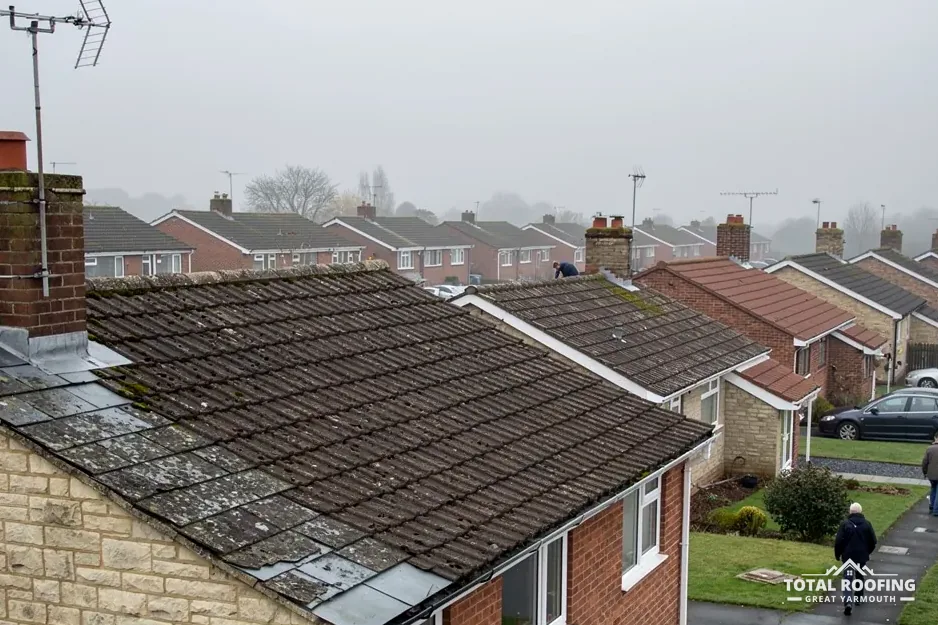
Tiled roofs across a row of houses seen from above
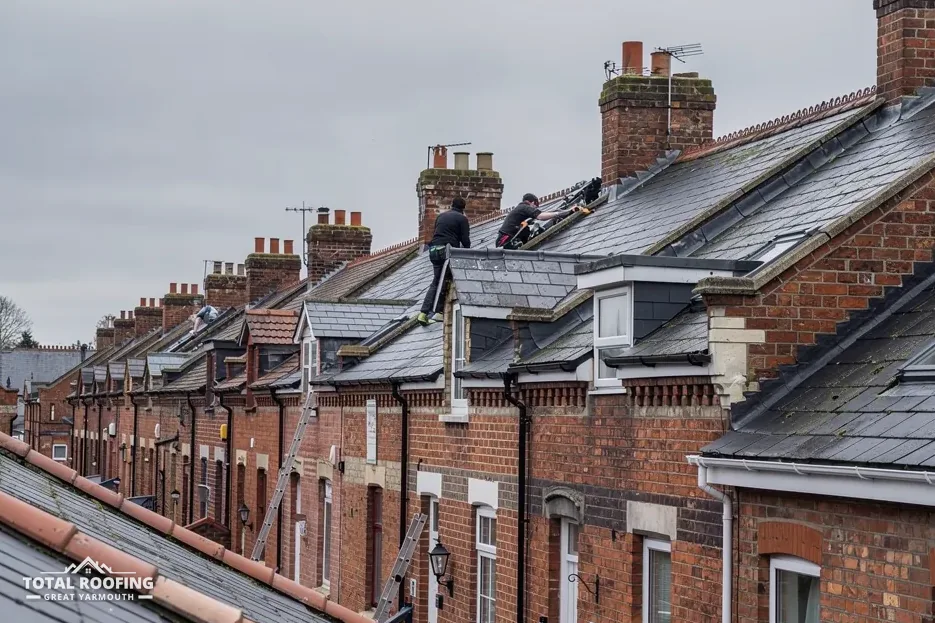
Roofers working along a row of brick Victorian terrace roofs

Trowse: Highland Crescent, St Andrew's, hospital blocks

  • Highland Crescent, numbers 1-13

    South Norfolk Council's Article 4 list includes a 2017 Trowse with Newton direction naming Highland Crescent, numbers 1 to 13, among other streets. Roof work can be caught by it: the council's table lists "altering the existing roof covering of the front or side of a roof which is the principal elevation or is visible from a highway".

    For any address on the Crescent and elsewhere in Trowse, check with the council whether an Article 4 direction applies before a new covering is chosen.

  • St Andrew's church

    St Andrew's church is listed Grade I (National Heritage List entry 1050444, first listed 26 November 1959). As a Church of England church in the Diocese of Norwich it follows the faculty system for roof work, not listed building consent.

    Seventeen listed buildings stand nearby, among them Whitlingham Hospital Blocks 04, 05 and 06, listed Grade II* (entry 1373212, first listed 31 October 1985), and Sunnydale, Grade II (entry 1169781).

  • Designations beside Trowse

    South Norfolk Council has designated the Trowse with Newton Conservation Area, named after the parish as a whole. Trowse has a conservation area, which differs from every road lying inside it.

    Whether your road is in or out is the council's answer to give, and the council is asked at the very start of a roof job.

Trowse: Authority, council, CNC and the Crescent

  • Planning: the Broads Authority (01603 610734) for the part inside its executive area, South Norfolk Council elsewhere.
  • Building control: CNC Building Control, a five-council partnership, 0808 168 5041.
  • Trowse has a conservation area designated by South Norfolk Council; ask the council about Article 4.
  • St Andrew's, Grade I: faculty system. Whitlingham Hospital Blocks, Grade II*: ask the council.
  • Scaffold on a footway or road: Norfolk County Council licence, arranged with our scaffolder.

Tests for permission are in the planning guide; a Trowse address is put to the right planner first.

Map of Trowse and the places nearest to it. Map tiles © Esri; map data © OpenStreetMap contributors.

Ask it straight · Trowse

Trowse roof work: Broads split, St Andrew's, designations, scaffold

Trowse lies in Trowse with Newton parish, which had 883 usual residents at the 2021 Census, a parish figure and not Trowse alone. The four answers take in who decides planning when the Broads boundary crosses the village, how St Andrew's gets roof work approved, what the conservation areas and a scheduled monument add, and where a scaffold licence comes from. Next door are Norwich and Thorpe St Andrew; Framingham Earl and Stoke Holy Cross have pages too.

Part of Trowse is in the Broads: who decides my roof?

The short answer

Planning goes to the Broads Authority for land inside its executive area and to South Norfolk Council for the rest. Building control is separate from both.

The Broads Authority's executive area covers part of Trowse. The Authority puts its role this way: "We are the local planning authority for all land and properties within our executive area." The Broads Authority's planning team answers on 01603 610734. Elsewhere in Trowse, South Norfolk Council decides planning, so an enquiry starts with your address and not with the state of the roof.

Building regulations come from CNC Building Control, a partnership of five councils (South Norfolk, Norwich City, Broadland, King's Lynn & West Norfolk and Fenland) which handles Trowse files from Norwich, on 0808 168 5041, or from a registered building control approver. The Authority has national park status but no building control function. A Trowse house inside its line has two contacts for two separate questions, and the answers do not overlap.

A whole re-roof is a building control job. Stripping all of the covering passes the Planning Portal's 50 per cent mark for the share of the roof affected. Dormers and other enlargements on land inside the Broads follow their own planning rules, which the planning guide sets out. Before a scaffold goes up, we ask the Authority or the council as your address requires, and nothing is ordered until that reply is in. A photo of the roof sent on WhatsApp starts that conversation without waiting for the survey. Planning Portal advice for the whole job is in the planning guide.

Two planners, one CNC

Inside the line

  • Planning: Broads Authority (inside the area)
  • Regulations: CNC

Outside the line

  • Planning: South Norfolk Council
  • Regulations: CNC

How does St Andrew's church in Trowse get roof work approved?

The short answer

By faculty, not listed building consent, because St Andrew's, a Church of England church, is in use. The planning authority still rules on outside changes.

St Andrew's carries a Grade I listing (National Heritage List entry 1050444, first listed 26 November 1959) and lies in the Diocese of Norwich. A Church of England church in use is outside listed building consent under the ecclesiastical exemption, and a faculty authorises its roof work instead. Before any application, the tiles, the lead flashings and the timbers are surveyed, so the parish knows the roof's condition when it applies.

That exemption replaces one consent and nothing more. Changes to the exterior of the church may still need planning permission, which is for the Broads Authority where the site is inside its executive area, and for South Norfolk Council where it is not. Regulations stay with CNC or a registered approver, so a parish planning a roof keeps three separate answers in hand and collects each in its own time.

Other listed buildings named nearby take the ordinary route. Whitlingham Hospital Blocks 04, 05 and 06 are listed Grade II* (entry 1373212, first listed 31 October 1985), and Sunnydale is Grade II (entry 1169781). For a listed building the test is whether works would act "in any manner which would affect its character as a building of special architectural or historic interest", and the consent is given by whichever planning authority covers that site, so the address is checked first.

Listed entries named near Trowse

  • Church of St Andrew, Grade I, entry 1050444
  • Whitlingham Hospital Blocks 04, 05, 06, Grade II*, entry 1373212
  • Sunnydale, Grade II, entry 1169781

What do Trowse's designations add to a roof job?

The short answer

A conservation area adds a question for the council, and a scheduled monument runs on a separate consent system. A road name settles neither.

South Norfolk Council has designated the Trowse with Newton Conservation Area, which appears on its list under the parish name. South Norfolk and Broadland's page says there are 52 conservation areas within South Norfolk, each with a boundary held by the council. An Article 4 direction can remove further permitted development rights, so check with the council first. Quote the house number and road when you ask the council, and keep its reply.

South Norfolk Council's Article 4 list has a 2017 entry for Trowse with Newton that names Highland Crescent, numbers 1 to 13, among other streets. Check with the council whether an Article 4 direction applies to your own address, and have the reply in hand before a roof change is drawn, because the answer can alter what is proposed. A conservation area and an Article 4 direction are different instruments: either can apply to an address without the other, which is why the council is asked about each one by name.

A scheduled monument follows other rules again. Arminghall, sites discovered by air photographs, is a scheduled monument (National Heritage List entry 1003620). The 1979 Ancient Monuments and Archaeological Areas Act makes works to a scheduled monument an offence unless authorisation exists. Applications go via Historic England, and the Secretary of State gives the final consent. That route does not run through the council, and it is a different matter from the roof of an ordinary house.

Designations around Trowse

  • Conservation areaDesignated by South Norfolk Council here
  • Article 4Can withdraw permitted development rights
  • Scheduled monumentConsent via Historic England

Where does a scaffold licence for a Trowse house come from?

The short answer

Norfolk County Council issues it, at £178.33 for the first 28 days. We arrange the licence with our scaffolder.

A scaffold that obstructs a footway or carriageway cannot stay without a licence under section 169 of the Highways Act 1980, and Norfolk County Council is the highway authority for Trowse. Norfolk County Council sets £178.33 for the first 28 days and charges the same sum for each further 28 days. Its published page asks applicants to "Please allow 7 calendar days for applications to be processed", so the application goes in early.

Norfolk County Council also calls for a new application whenever scaffolding goes up. For a Trowse job we arrange the licence with our scaffolder, and scaffold is folded into the one total on the written quote after the survey. A later visit, for a chimney or a gutter repair, needs a fresh licence whenever a frame has to go up again.

If another firm's price mentions scaffold, find out whether the licence and any extension are covered. An extension is a further period at the same fee, and a roof left open for longer than planned can reach one. Where a roof is reachable from a drive or garden with no pole on the highway, the survey says so, and then no licence enters the job at all.

Myth

A scaffold licence covers the job, however long it runs.

Fact

Norfolk charges per 28-day period and asks for a new application each time.

Trowse underlay, pitch, falls, call-outs and asbestos

Why does underlay type matter in a Trowse loft?

Marley's cold-roof guidance for high-resistance underlay is 25mm of eaves ventilation at 15 degrees or less and 10mm above 15 degrees, and it adds that the underlay blocks vapour, so the eaves gap stays open. A low-resistance underlay under an air-permeable covering needs far less. Only a look from the loft side shows which type a house has, and the survey makes that look before a covering is specified.

How steep must clay pantiles sit on a Trowse extension?

It depends on the product. Sandtoft's data sheet gives its clay Old English Pantile a minimum pitch of 30 degrees with a 75 mm headlap, while Marley gives 15 degrees for Lincoln clay and 25 for Anglia concrete. Always check the product sheet before specifying. See pitched roofing for what the survey measures.

Why is a Trowse flat roof laid steeper than 1:80?

NFRC says BS 6229:2025 sets a minimum 1:80 finished fall for general roof areas and internal gutters. IKO says the code of practice points to a design fall of 1:40, so that 1:80 is reached on the finished roof. A flat roof that ponds water shows it as stains and sagging. Our flat roofing page explains how membranes are laid to a fall.

How much does an emergency roofer's visit cost near Trowse?

MyJobQuote gives typical emergency roofer call-out costs of £150 to £300, while "extensive storm damage repairs can cost £1,200 or more" (page dated 22 October 2026, no VAT basis stated). The higher figure covers extensive repairs only and is never a quote for a particular roof. See emergency roof repairs for making a damaged roof safe. A photo on WhatsApp (07880 284133) helps us see what has moved.

What do asbestos surveys and removal cost for a Trowse roof?

MyJobQuote gives an average of around £325 for an asbestos survey in 2026, and around £2,750 for asbestos removal from a roof in the UK (page dated 9 September 2026, no VAT basis stated). Norfolk's recycling centres take no asbestos, as Norfolk County Council states. Any specialist removal is priced once the sheeting has been looked at. A photo of the sheeting sent on WhatsApp gives a first look, and nobody should break a sheet to see what is inside.

Trowse: get the roof priced

Tell us about your roof

10-year workmanship guarantee, in writing

Call WhatsApp Written quote