
Call 01493 277103

Thorpe St Andrew, 17.5 road miles

Roofers in Thorpe St Andrew

Thorpe St Andrew lies 17.5 road miles from Great Yarmouth, a 25-minute drive to the west on the edge of Norwich. Each roof here gets a whole-roof survey, you are told plainly what we found, and we check the council route before any work is booked.

Get a written quote

Call 01493 277103WhatsApp us

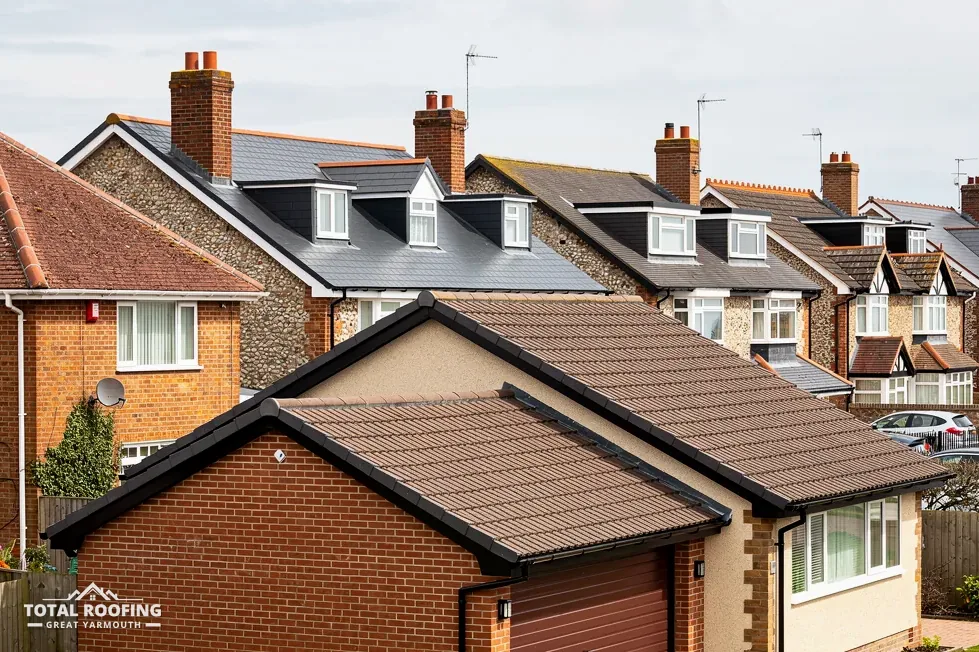
A detached brick garage with a newly re-tiled pitched roof
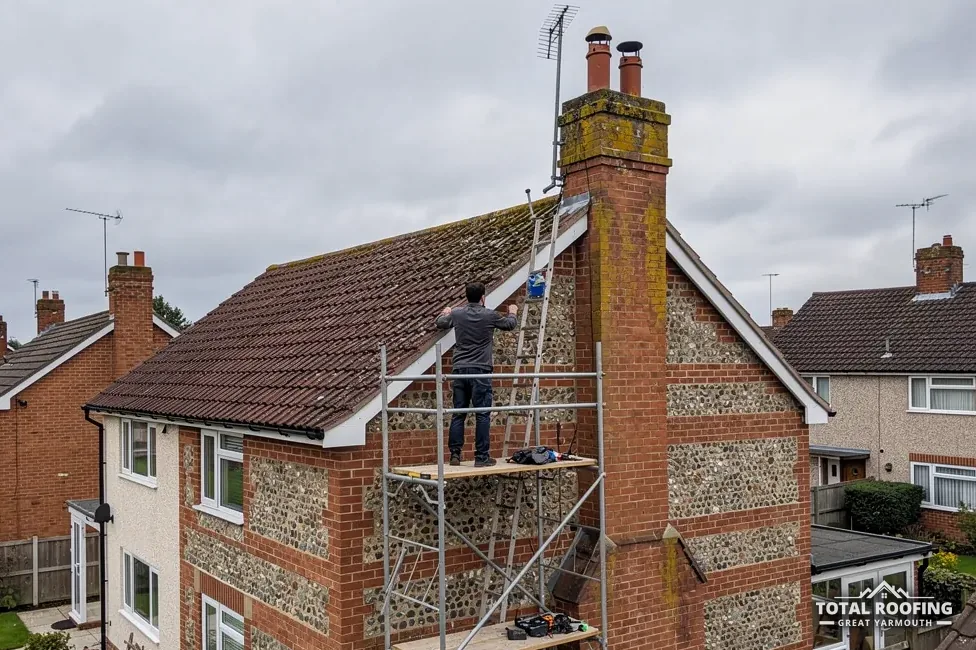
A roofer on scaffolding beside a tall brick chimney on a tiled house roof

Conservation area, flat roofs and cold lofts

  • Houses in the conservation area

    Thorpe St Andrew has a conservation area designated by Broadland District Council. Which houses fall inside it is a matter of address, and the council settles it. Ask at the same time whether an Article 4 direction applies to the street.

    The roof survey does not change either way. Tiles, ridge, gable ends, valley channels and wall junctions are all read, and each is explained in turn.

  • Extensions and flat roofs

    A flat-roofed kitchen, garage or porch is judged by its falls, its edge details and its membrane. The code that now applies to flat roofs with flexible waterproof coverings is BS 6229:2025, and the survey judges the roof by it.

    Ponding, blistered felt and lifted edges are the faults looked for, along with the deck underneath, the outlets and any upstand that has pulled away from the wall.

  • Lofts, warm and cold

    Whether a pitched roof is warm or cold decides how it is ventilated. The two are built differently, and a mistake with insulation can leave a loft damp.

    From the hatch we read the underlay, the eaves and the insulation together, then explain which type of roof you have and what that means for damp, with the reasons given in plain words.

Roof rules for Thorpe St Andrew homes

  • Planning is Broadland District Council's call for Thorpe St Andrew homes; give the address when you ask.
  • Building control: CNC Building Control, a partnership of five councils, based in Norwich.
  • Conservation area: designated by Broadland District Council; ask whether your address and Article 4 are affected.
  • Norfolk County Council licenses scaffolding that stands over a highway.

Our planning guide sets out where roof work needs permission, and before any quote is written we settle the council route for your house with Broadland.

Map of Thorpe St Andrew and the places nearest to it. Map tiles © Esri; map data © OpenStreetMap contributors.

Ask it straight · Thorpe St Andrew

Thorpe St Andrew roofs: conservation area, ventilation, flat roofs and scaffold timing

Thorpe St. Andrew parish had 14,526 usual residents at the 2021 Census. Four roof questions follow: how the conservation area bears on a repair, whether a loft needs ventilation, how flat a flat roof can be, and how long a scaffold licence takes to arrive.

Is my Thorpe St Andrew street inside the conservation area?

The short answer

Only Broadland District Council can confirm that for an address. The parish has a conservation area, and it is worth asking about Article 4 at the same call.

The parish has a conservation area, designated by Broadland District Council, and a roof job there is judged by the usual council route. A change of covering that alters how the building looks is the kind of work to mention when you ring. A general description cannot say whether a particular street is in it or out of it, so ask Broadland District Council, giving your full address, and ask it in writing if you want an answer you can keep. South Norfolk and Broadland share a page that states: "There are 21 conservation areas within Broadland, and 52 within South Norfolk."

An Article 4 direction can remove further permitted development rights, so check with the council first. Broadland District Council lists a 1972 Broads Authority direction under Thorpe St Andrew on mooring vessels on land covered by water, which says nothing about house roofs; for a change of covering, the council answers per address. Our planning guide separates re-roofing from the larger alterations that need permission.

Building control sits elsewhere. In Thorpe St Andrew it is CNC Building Control, a partnership of five councils (South Norfolk, Norwich City, Broadland, King's Lynn & West Norfolk and Fenland), giving its Norwich office number as 0808 168 5041, or else a registered building control approver. Minor repairs sit under the Planning Portal's two limits, though CNC notes that "If the repair work is significant, or the building is thatched then the Building Regulations may apply."

Questions for the council about one address

  1. Is the house inside the conservation area?
  2. Does an Article 4 direction apply to it?
  3. Does the work need building control?
  4. Then the survey leads to one written total

Does the loft of my Thorpe St Andrew house need ventilation?

The short answer

A cold roof does, a warm roof does not. That is CNC's guidance, and for a cold roof under high-resistance underlay Marley sets out the eaves gap.

CNC Building Control's warm-roof guide is blunt about the difference. For a warm roof, "No ventilation is required for these types of roofs." For a cold roof, "Ventilation is required for these roofs." The insulation sits at the rafters in a warm roof and at the ceiling in a cold one, which is why the two behave differently when moist air from the house reaches the loft. A cold roof needs air to pass through the loft space to carry that moisture away.

For a cold roof laid with a high-resistance (HR) underlay, Marley's figures are 25 mm of eaves ventilation at 15° or less, and 10 mm where the pitch is steeper than 15°. The underlay in that arrangement passes little moisture, which is why those eaves gaps matter. Blocked soffit vents, insulation pushed hard into the eaves and a bathroom fan venting into the loft are all worth checking from the hatch.

In a Thorpe St Andrew survey the loft is read as part of the roof: underlay, timbers, insulation depth, eaves gaps and the ceiling below. A roof that has been insulated after it was built, or converted for storage, is checked for what that did to the airflow. If something needs changing, it is explained with the reason.

Warm roof or cold roof

Warm roof

  • Insulation at the rafters
  • CNC: no ventilation required

Cold roof

  • Insulation at the ceiling
  • CNC: ventilation required

How flat can a flat roof be before it ponds?

The short answer

BS 6229:2025 asks for a minimum 1:80 finished fall, and IKO says the roof should be designed to 1:40 to reach it.

The present code for membrane flat roofs is BS 6229:2025, which covers continuously supported flexible waterproof coverings and not lead. The NFRC reports that it sets "a minimum 1:80 finished fall for general roof areas and internal gutters". IKO writes: "To achieve a 1:80 fall, the code of practice says that the roof should be designed for a fall of 1:40".

A shallow fall that holds water is a fault in itself, and it ages the membrane early. HomeBuilding and Less disagree on how long each covering lasts. HomeBuilding gives EPDM 25-30 years, GRP 25-30 and felt 10-15; Less gives EPDM 30 to 50, GRP 25 to 40 and torch-on felt 10 to 20 "depending on quality and installation". Nobody should read a single figure as a promise, because the quality of the original laying and the condition of the deck both shape how long a membrane survives.

On a Thorpe St Andrew extension or garage, the survey measures the falls, looks at upstands, outlets and laps, and checks the deck from below where it can be seen. Under the energy rules, fitting a new waterproof layer to a flat roof is renovation, so the building control route is asked about. Our flat roofing page sets out the options, and the reasons for each are explained to you after the survey.

Myth

A flat roof can be laid dead level.

Fact

BS 6229:2025 asks for a minimum 1:80 finished fall.

How long does a scaffold licence take in Thorpe St Andrew?

The short answer

Norfolk County Council wants 7 calendar days in hand for an application, and £178.33 covers the first 28 days, with £178.33 more for each further 28 days.

Section 169 of the Highways Act 1980 requires a licence for scaffolding that obstructs a highway, and Norfolk County Council issues it here. Wherever a frame comes near the carriageway in Thorpe St Andrew, it is a matter for the highway authority, not for Broadland District Council.

The council's page says "Please allow 7 calendar days for applications to be processed". Norfolk County Council's fee is £178.33 for the first 28 days, with each further 28 days charged at the same rate, and every fresh erection of scaffolding means a fresh application. Because the application period is the council's own, it is the first thing considered when a start date is discussed.

We arrange the licence with our scaffolder, so nothing lands on your side. At survey we also look at where a frame can stand: the width of the pavement, whether the pavement is shared, bay windows and porches that interrupt the line, and cables at the eaves. A long job is renewed in 28-day periods and the frame stays up until work is complete. A second visit later, for a chimney or a porch, is a separate erection and so a separate licence. Planning a job in one go can keep that to a single application, which is worth raising at the survey.

Frame questions noted at survey

  • Width of footway beneath the eaves
  • Bays and porches breaking the line
  • Cables or street furniture nearby
  • Neighbouring access that must stay clear

Thorpe St Andrew roofs: gutters, asbestos, foam, prices

Why do the gutters on my Thorpe St Andrew house overflow?

A blocked outlet is one cause, and a run that has lost its slope towards the outlet is another. A sagging run holds water and spills it over the fascia, and a loose bracket can tip a good gutter out of line. The survey follows the water from the roof edge to the downpipe and the drain. Our guttering, soffits and fascias page explains the repair, and a photo sent over WhatsApp (07880 284133) gets a look from us.

Is asbestos cement from a Thorpe St Andrew garage accepted at the tip?

Not in Norfolk: the county council does not accept any asbestos at its recycling centres. HSE says "Use a lockable skip for asbestos", and notes that asbestos cement is non-licensed work only if it is carefully removed without breaking up. The same HSE page says "AC roofs are always fragile", so a damaged sheet is a job for a specialist. Norfolk County Council advises a licenced specialist contractor to remove and dispose of all types of asbestos, and a split sheet stays untouched until a specialist has looked.

Can spray foam under my Thorpe St Andrew roof affect a mortgage?

It can. RICS reported "concern within specific sectors of the lending market, such as equity release mortgages". Government guidance says "Many mortgage providers are open to lending on properties with spray foam, subject to their own requirements", yet removal "will not always guarantee that they will still lend". Take advice from a specialist surveyor. Our spray foam removal page has more.

What does a Thorpe St Andrew re-roof cost?

Which? Trusted Traders give £7,000 to £21,000 excluding VAT (November 2025) for replacing the roof of an average three-bedroom house. What you pay depends on the roof's area, the covering you pick, the way in and the timbers beneath the old tiles. The written figure is a single total, drawn up from the survey.

What should I do first after wind lifts tiles in Thorpe St Andrew?

Pictures of the damage, taken from the ground with nothing yet moved, are the first step, and the insurer is the second call. The Financial Ombudsman Service puts it this way: "a storm usually involves violent winds, usually with rain, hail or snow". Tiles that have come off are better recorded from the ground than fetched down from a roof, and the insurer will want to see how far the damage extends before repairs start. A temporary cover over an open slope can be fitted once the pictures exist.

Price your Thorpe St Andrew roof

Tell us about your roof

10-year workmanship guarantee, in writing

Call WhatsApp Written quote