
Call 01493 277103

Fleggburgh, 7.4 road miles north-west

Roofers in Fleggburgh

Fleggburgh lies to the north-west, 7.4 road miles away from the centre of Great Yarmouth. For roof repairs, re-roofs or leadwork here we survey the whole roof, tell you in plain words what turned up, and check the planning route with the council before work begins.

Get a written quote

Call 01493 277103WhatsApp us

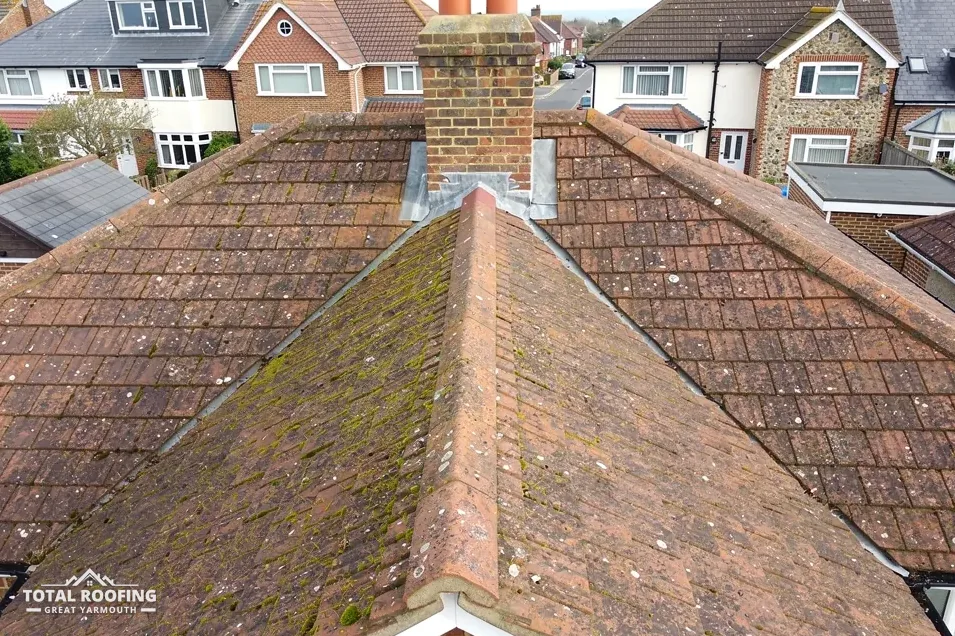
A high view looking down on a clay tile roof, its ridge, hips and brick chimney
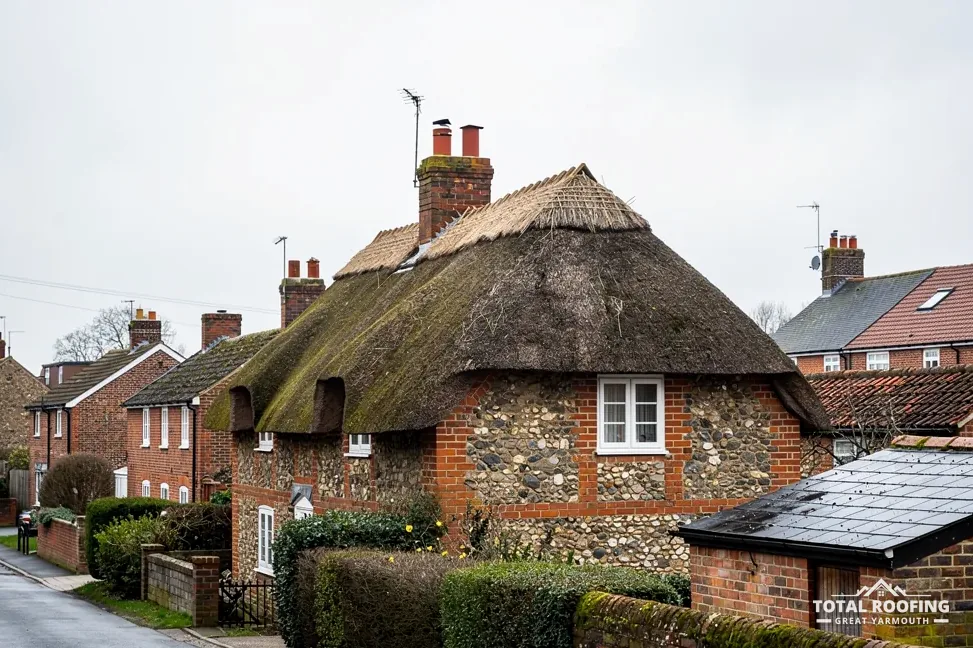
A thatched flint cottage among tiled houses

St Margaret's, the chapel and The Shrubbery

  • Round St Margaret's church

    St Margaret's church carries a Grade II* listing (National Heritage List entry 1372907, first listed 25 September 1962). Eight listed buildings lie nearby, so a list entry is a fair first question for a Fleggburgh owner.

    A house beside a church or a listed neighbour is surveyed like any other roof, covering to timbers, with a candid note on each part.

  • The Shrubbery and the chapel

    The Shrubbery is listed Grade II (entry 1152231, first listed 20 February 1952) and the Wesleyan Chapel is Grade II too (entry 1372908). Listed building consent is the route for roof changes affecting a listed house's character.

    For the chapel, ask Great Yarmouth Borough Council which consent route applies, since that turns on how the building is held and used.

  • River and marsh edges

    Fleggburgh lies beyond the Broads executive area, but only just. Land at a river or marsh edge can be Broads Authority land, so quote the address when you ask who decides.

    Flood risk is worked out per site, never for the whole village at once. Floodline is on 0345 988 1188, and the GOV.UK service reports by area.

Fleggburgh planning and consent at a glance

  • Planning: Great Yarmouth Borough Council decides. Marsh or riverside edge land can be Broads Authority land: check.
  • Building control: Great Yarmouth Borough Council's building control team, or a registered approver.
  • Conservation area: Rollesby has one nearby; ask the council about your address. Check for Article 4.
  • St Margaret's (Grade II*) goes through the faculty system; Grade II houses need listed building consent.

The planning guide covers permission tests; before any Fleggburgh job starts we confirm with the council which route applies.

Map of Fleggburgh and the places nearest to it. Map tiles © Esri; map data © OpenStreetMap contributors.

Ask it straight · Fleggburgh

Fleggburgh roofs: St Margaret's, loft ventilation, the Broads edge and scaffold

Fleggburgh parish had 1,087 usual residents at the 2021 Census. A parish church, several listed buildings and a boundary with the Broads each bring their own paperwork, which the four answers below separate. Within a few miles lie Rollesby, Filby, Martham and Bastwick.

Who signs off roof repairs to St Margaret's church?

The short answer

The Church of England faculty system, not listed building consent. Planning for outside alterations is a separate matter, and Great Yarmouth Borough Council decides it.

St Margaret's belongs to the Church of England, still holds services, sits in the Diocese of Norwich and is listed Grade II* (entry 1372907). Churches in that position benefit from the ecclesiastical exemption: works to the building go through the faculty system, and listed building consent is not the route that applies. The first call for a churchwarden with a leaking roof is therefore the diocese, not the council's conservation desk.

The exemption replaces listed building consent and nothing more. Where the ordinary rules call for planning permission on an exterior alteration, that stays in force, and for Fleggburgh the deciding body is Great Yarmouth Borough Council. A churchwarden can ring the borough's planning team to ask whether a like-for-like repair needs an application at all. Building regulations are a third strand, handled by the borough's building control team or a registered approver.

A parish roof is surveyed no differently from a house roof: covering, leadwork, parapet and valley gutters, rainwater goods and the timbers seen from inside. A church roof can carry lead at valleys, gutters and parapets, so the flashings and any sheet laid in gutters are all examined, and the findings name what is failing and what is simply worn. A leak that shows inside a church can start some distance from where the stain appears, so the roof is followed upslope from the damp. Where scaffold is needed on the churchyard side, the access is settled during the survey visit, together with how any licence is arranged.

Church and house routes

St Margaret's

  • Faculty system, Diocese of Norwich
  • Exterior planning rules remain
  • Grade II*, entry 1372907

The Shrubbery

  • Listed building consent
  • Covers works touching character
  • Grade II, entry 1152231

Does a Fleggburgh cold roof need ventilation after re-covering?

The short answer

Yes, with a high-resistance underlay in a cold roof: Marley gives 25 mm of eaves ventilation at 15° or less, and 10 mm above 15°.

Ventilation exists to manage condensation. Warm, damp air from the rooms below rises into the loft, and a cold roof gives it somewhere to leave. When a Fleggburgh roof is stripped and relaid with a high-resistance underlay, Marley's guidance, drawn from BS 5250, sets the eaves opening at 25 mm where the pitch is 15° or less and 10 mm above 15°. Marley adds that this kind of underlay is not vapour-permeable, so the roof space has to be vented some other way.

That is why the survey measures what is already there before a covering is chosen: the gap at the foot of each slope, whether insulation has been pushed hard against the eaves, and which type of underlay lies beneath the battens, since that decides whether a vent is needed at all. A sealed eaves detail under a new underlay is precisely the situation those figures are meant to prevent. Pitch matters because the two figures change at 15°, so every slope is measured separately and a low-pitched porch or lean-to roof is not assumed to match the main roof.

Fixings are checked in the same visit. Marley says installing to BS 5534 "isn't required by law", yet since the 2015 amendments mortar "could no longer be relied upon as the only means of securing the roof covering", so ridge and verge details are specified for the site's exposure. Our roof replacement page covers the whole job, from stripping to the final ridge.

Loft ventilation terms

  • Cold roofInsulation at ceiling level, ventilated void above.
  • HR underlayHigh-resistance underlay; passes no vapour.
  • Eaves gapOpening at the foot of each slope.
  • CondensationMoisture settling on cold surfaces in the loft.

Is my Fleggburgh plot Broads Authority land or the borough's?

The short answer

The village answers to Great Yarmouth Borough Council. Land at the river or marsh edge can belong to the Broads Authority, so the address decides.

Fleggburgh itself lies outside the Broads Authority's executive area, though not by much. Planning questions in the village itself go to Great Yarmouth Borough Council. The Authority describes its own reach as "all land and properties within our executive area", so a plot beside the river or on the marsh edge may fall on its side of the line, and a planning question there goes to the Authority.

That is why we ask for the full address; a postcode alone is not enough for the checking we do, because one postcode can cover houses on both sides of a boundary. If a plot is in doubt, both offices are asked, and the answer decides who receives any planning application. Building regulations are unaffected: the borough council's building control team, or a registered building control approver, handles them.

A low-lying site raises a second point, flood risk. GOV.UK's long-term flood risk service reports on an area, and it "does not tell you how likely it is that an individual property will flood". For a planning application the Environment Agency's flood map for planning shows a site's flood zone. Neither changes how the roof is surveyed, but both can shape what a neighbouring extension needs, and both are free to look at before you decide anything.

Questions for an edge-of-Broads address

  • Is the plot inside the executive area?
  • Which office takes a planning application?
  • Does a conservation area cover the street?
  • Is the building listed?
  • What does the flood map for planning show?

How is a scaffold licence handled on a Fleggburgh road?

The short answer

Norfolk County Council issues it, charging £178.33 for the first 28 days and the same sum for every later period. We arrange the licence with our scaffolder.

Section 169 of the Highways Act 1980 requires a licence for a frame standing on the pavement, or leaning out across it, and the county highway authority issues it. For Fleggburgh that is Norfolk County Council. Norfolk County Council's page says "Please allow 7 calendar days for applications to be processed." The fee is £178.33 for the first 28 days, and each renewal of 28 days is charged at the same figure.

Norfolk County Council asks for a new application every time a scaffold goes up. We arrange the licence with our scaffolder, and the scaffold a job needs forms part of the written quote. A roof that takes longer than the first 28 days is renewed, with Norfolk County Council charging the same fee for each further 28 days. A narrow frontage or a bend in the road changes where the frame can stand, which the survey takes in on site before the licence is arranged.

Outbuildings bring a disposal point. Norfolk County Council does not accept any asbestos at its recycling centres. HSE's guidance is to "assume that there is asbestos" in a building built or refurbished before 2000, and "AC roofs are always fragile", so a cement sheet roof is never walked on, even when it looks sound from a ladder. HSE says "Use a lockable skip for asbestos", and that applies once the sheets have been identified and whoever removes them has confirmed the category of work.

Scaffold licence in order

  1. Survey the roof and note the road frontage
  2. Allow 7 calendar days for processing
  3. Licence runs 28 days at a time
  4. Renew for each further 28 days

Fleggburgh leadwork, foam, flat roofs and contracts

Is lead worth renewing around a Fleggburgh chimney stack?

The question is worth settling while the roof is open and the old lead is exposed. MyJobQuote says correctly installed lead flashing can last for over 80 years. Leadworx says code 4 has become the standard choice for general flashing work, and the specification sets the code for each detail. Stack, soakers and lead are all checked together at the survey. Our lead roofing and leadwork page explains the work.

Does spray foam in a Fleggburgh loft stop a sale?

Not by itself. RICS reported in March 2023 concern within specific sectors of the lending market, such as equity release mortgages. The government's October 2026 policy paper says "Many mortgage providers are open to lending on properties with spray foam, subject to their own requirements." Removal "will not always guarantee that they will still lend", so ask your lender and a specialist surveyor first.

What fall should a flat roof on my Fleggburgh extension have?

BS 6229:2025 sets a minimum finished fall of 1:80. IKO reports a design figure of 1:40 from the same code. Standing water on a flat roof means fall has been lost somewhere, whether in the deck, the membrane laps or the outlets. The survey checks all three before any recovering is proposed, and the fall is part of what the written price rests on.

Signed a roofing contract at my Fleggburgh home: can I change my mind?

Yes, for a short while. Where a contract is signed in your home following the visit, the cancellation period ends at the end of 14 days after the day on which the contract is entered into. If you want the work to begin before then, say so in writing; that request keeps your right, but payment can fall due for what has been done. An urgent repair you asked us to visit for has no cancellation right.

Can I send a photograph before booking a Fleggburgh survey?

Yes. Message 07880 284133 on WhatsApp, giving your road and a short note on the problem, perhaps an open ridge joint or a brown patch spreading across a ceiling. We study the picture, then explain what it reveals and where it comes up short. Climbing into the loft and onto the slopes is the only way to see the entire roof.

Have the Fleggburgh roof priced

Tell us about your roof

10-year workmanship guarantee, in writing

Call WhatsApp Written quote