
The short answer
Rain drums on a skylight because the glass is thin, the roof around it is light and there is little between the drops and your ears. Some noise is a loose part that can be fixed. The rest comes from the glazing, and a replacement unit with laminated glass reduces it.
Why a roof window carries rain noise into the room
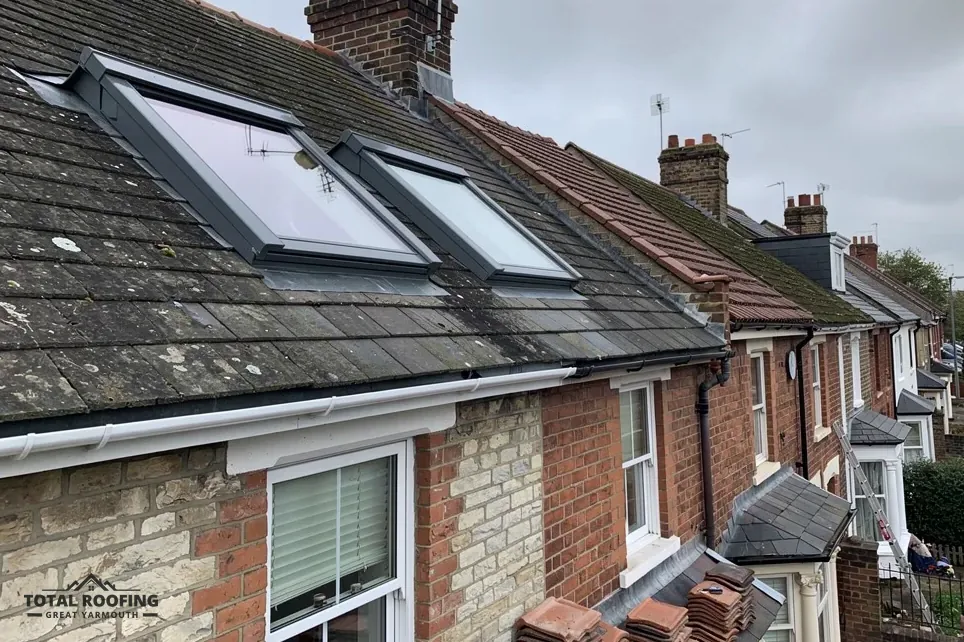
A roof window is a pane of glass set into the slope of a roof. Rain lands on it directly, and the glass turns into a small drum skin, passing each impact to the frame and then to the room beneath. Walls and ceilings are heavier and deadened by their build-up, so the same rain on a wall is hardly noticed.
A loft room makes this worse. The ceiling is the roof, with only a few layers of board, insulation and covering between the weather and the people inside. There is no empty loft void to soak up sound, as there would be above a conventional ceiling, and the room may well be a bedroom, which is where noise is felt most.
Noise also has more than one source. Part of it is the glass itself, part is a rattling or ticking part of the frame, and part is water running down the roof and over the flashing. Working out which of these you are hearing is the first step, because the cure for each is different. Our page on the types of roof window shows the glazed units referred to below.
Checks that find a fixable cause
Before assuming the glass is to blame, listen to what kind of sound it is. A steady hiss or drum that rises with the rain is the glazing. A tick, a tap or a metallic buzz that comes and goes with the wind points to something loose.
- Sash stay or friction arm: a worn one can let the sash tap its frame in a gust.
- Seals round the sash: a perished or dislodged strip leaves a hard contact point.
- Flashing kit: a lifted edge can buzz in wind and drip in rain.
- Tiles or slates beside the frame: a loose one can click and slide.
- Gutter or downpipe near the window: a poor fall or a blockage can spill and splash.
Some of these are small repairs, and some are signs that the window has aged. A seal or a stay can be renewed on the existing frame. A flashing kit that has lifted needs the covering round the window opened up, so it is a roof job and a ladder is not enough. If you are unsure what the noise is, a photo on WhatsApp, 07880 284133, lets us see the window, and the survey sorts the cause from the symptom.
Glazing choices that quieten rain
The type of glass changes how much sound passes through it. Laminated glass has a thin plastic interlayer between two panes, which damps the vibration that a single sheet carries. A double-glazed unit with one laminated pane breaks up the sound path further, because the two panes are different thicknesses and respond to different frequencies.
Roof window makers sell acoustic versions for exactly this reason, with a laminated outer pane and a larger air gap, and some offer an acoustic upgrade for their standard models. Check the maker's own data for the figure on the unit you are comparing, since this page cannot rate a particular model.
A quieter window still has to meet the thermal rule. For a replacement roof window, Approved Document L 2021 Table 4.2 limits a replacement roof window to 1.4 W/m²K, with WER Band B accepted as the minimum alternative, and a rooflight to 2.2 W/m²K. Those figures cover heat loss and say nothing about sound, so the energy label does not tell you how loud the window will be in rain. Ask for the acoustic claim in the maker's own data, since it is a different measure.
Swapping the unit, or damping the room
If the glass is the problem, the real cure is a new unit. Fitting the new unit into the old opening is the smaller job, and our guide to Velux-type window replacement covers matching the size and the kit. MyJobQuote's roof window page, last updated 22 September 2026, gives £1,100 as an average for a Velux unit in the middle of the range, and a straightforward swap comes in around £100 lower. Those are published averages for a standard unit, so an acoustic model should be priced from its own data.
Indoors, soft finishes help a little. Curtains, a thick blind or a rug cut the echo in the room, though they do not stop the drumming itself. The noise is arriving through the glass, so it can only be reduced by changing what the glass is made of.
Surveying the whole roof can also show what is happening around the window, such as a drip from a gutter or a loose flashing. The written price that follows covers the work needed for your window and the roof around it, set out as a single sum. The hub for skylights and roof windows lists the other roof window jobs.
