
The short answer
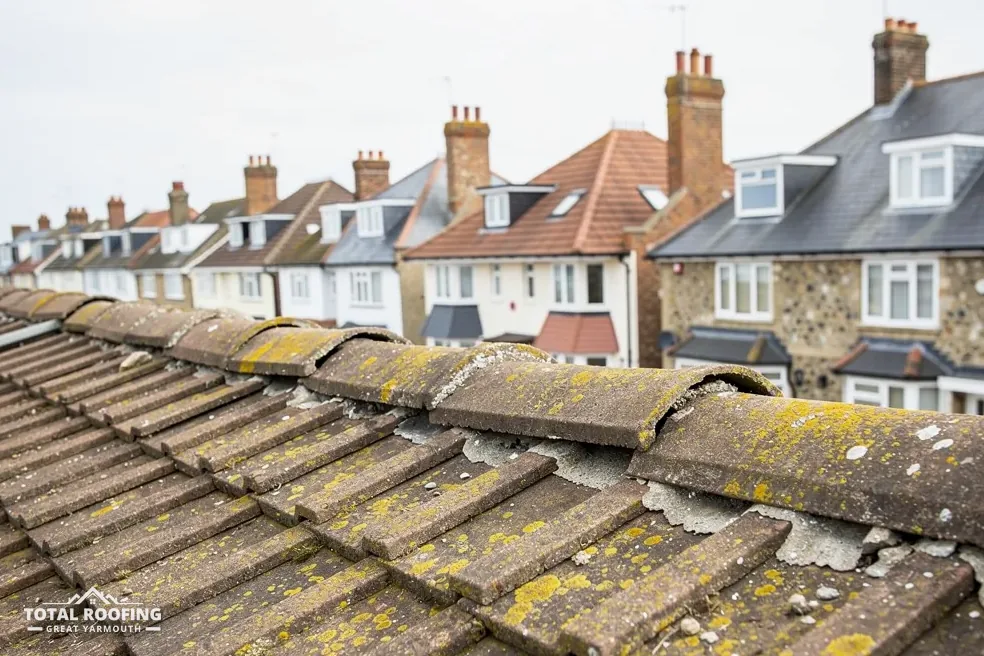
Torching is lime mortar pointed up under the heads of the pantiles from the loft side, filling the gaps between tile and batten. It was done to close the roof against wind and driven rain before underlay was fitted. Where it has crumbled, the choice is re-torching or a re-roof with an underlay.
What torching is
Pantiles hang from battens, and the gaps where each tile meets the one below and the batten under it are small but real. Torching fills them. A mortar based on lime is trowelled onto the underside of the tiles from inside the loft and pressed into the gaps along the heads of the tiles, then struck off. When set, it forms a fixed seal between the tile and the course beneath.
From the loft hatch you can see it: a grey, rough band along the underside of the tiles, sometimes with daylight showing where pieces have dropped out, and crumbs of old mortar lying on the ceiling joists or insulation. A roof with no underlay at all shows tile undersides directly, and torching is the only barrier at that point.
Torching is an older method, and where a roof has it, it is part of how that roof was built. Our guide to what a pantile roof is covers the tile, and the headlap that torching works around is explained in pantile pitch and headlap.
Why it was done
A pantile roof has no underlay in the older form of build, and the tiles are laid on battens with open gaps beneath. Wind can lift snow and fine rain through those gaps, and the draught under the tiles can also lift the tiles themselves. Torching closed the gaps from below and held the tiles in place, which kept the loft dry and the tiles from rattling in the wind.
Lime was the material because it was what builders used, and it remains workable on old roofs: it is softer than modern cement mortar and moves a little with the building. A hard cement mortar can crack and shed more quickly on a roof that flexes with the weather.
Torching is not a fixing for the tiles in the sense BS 5534 now uses the word. Marley, a tile maker, says the 2015 amendments to that standard made it clear that mortar "could no longer be relied upon as the only means of securing the roof covering". A torched roof is therefore looked at for what actually holds each tile down, as well as for the state of the mortar.
Signs the torching has failed
Mortar fails with age, with the movement of the roof and with the damp that gets behind it. The signs show up with a torch in the loft, which is the place to look, because from the ground a torched roof gives nothing away.
- Pieces of grey mortar on the loft floor or insulation
- Daylight showing through the tile heads
- Fine dust, or powder, in the loft after a windy night
- Damp marks beneath the tile joints
- Loose or rattling tiles in a gale
Failed torching need not cause a leak by itself, since the tile laps shed ordinary rain. The risk is wind-driven rain and snow, which can be pushed up the laps past the tile, and a gale, when an unsupported tile is free to lift. The survey notes how much of the underside has lost its mortar, whether the battens beneath are sound, and whether the tiles above still sit firmly against the courses below, because a roof can show crumbled torching and still be holding.
Re-torching or re-roofing with a membrane
There are two routes. Re-torching removes the loose mortar and puts new lime mortar back into the gaps, which keeps the roof as it was built and suits a roof whose tiles and battens are sound. A re-roof strips the tiles, fits an underlay membrane over new or sound battens and relays the pantiles on top, which gives the roof a second barrier beneath the tiles.
The roof covering underneath changes the loft too. An underlay changes how moisture moves through the roof, so a re-roof is looked at for ventilation as well. Which route fits depends on the tiles, the battens, any listed status and the budget. For clay pantile work we cover the re-roof route in re-roofing in clay pantiles.
For cost, The Which? Trusted Traders price for replacing up to six damaged tiles is £75 to £400 before VAT (November 2025). Checkatrade's pitched clay tile repair rate is £110 to £160 per m², exclusive of VAT (June 2026). Neither is a torching price, and our figure follows the survey. See pitched roofing for the wider work.
