
What a pantile is and why the name matters
A pantile is a roofing tile with a wavy, S-shaped profile, so that a row of them looks like a shallow corrugation running up the slope. It is a single-lap tile: each tile overlaps its neighbour in the same row by a small amount at the side, and the courses overlap each other up the slope by a measured distance called the headlap. Plain tiles are small flat rectangles, hung in far more overlapping rows.
The name Norfolk pantile is used for the clay version of this profile. The same profile comes as a clay tile or a concrete one, and the two differ in weight, in how they weather and in how well a repair matches the rest of the slope. That difference is the first thing to settle before pricing anything. Among Marley's products are a clay Lincoln pantile and a concrete Anglia pantile, while Canterbury and Anglia are Marley product names and not places.
A pantile roof is built, and fails, in the same ways whatever else stands on the street, so the sections below describe the roof and not the place. Each section covers one part of the decision, from the tile itself to the price.
Pantile words
- HeadlapExtent to which a course covers the one below
- Single-lapEach tile laps its neighbour once, not twice
- Batten gaugeThe set spacing of the battens up the slope
- TorchingMortar pointing laid under the tiles from inside
Pitch, headlap and weight: the published figures
The figures below come from manufacturers' product sheets, and a product sheet is the thing to check, because tiles of the same general shape are not interchangeable. Sandtoft, a Wienerberger brand, gives the clay Old English Pantile in its range a minimum roof pitch of 30 degrees, 75 mm of headlap, a fixed batten gauge of 290 mm and 41.6 kg per m² as laid. The data sheet is version 1.1, dated 2 April 2025.
Other pantiles carry other figures. Marley gives its Lincoln clay pantile a 15 degree minimum pitch and its concrete Anglia 25 degrees. The gap between 15 and 30 degrees shows why nobody can quote a single pitch for pantiles as a class. A roofer needs to know which tile is on the roof, or which tile is going on it, before anything about pitch and headlap can be said. For a re-roof that means reading the sheet for the new tile as well as identifying the old one, and checking both against the pitch of your roof.
A slope flatter than the tile's minimum pitch is a different problem from a slipped tile: rain drains off it more slowly and wind can push it back under the laps. Our page on pantile pitch and headlap explains how pitch and overlap work together, and the pitched roofing hub covers the other coverings.
Slipped and cracked pantiles
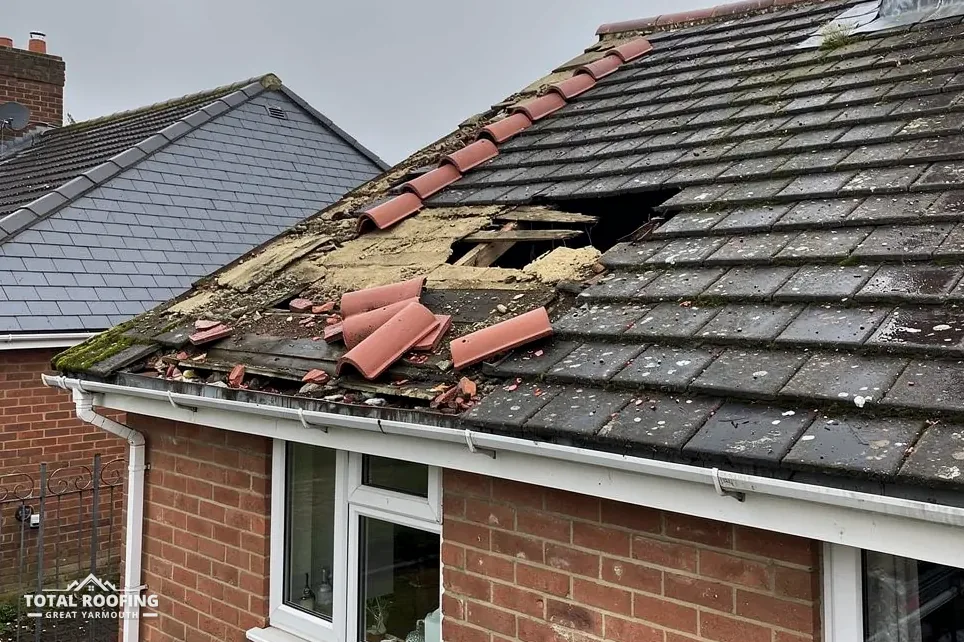
A pantile slips when whatever holds it to the batten lets go, and it cracks when it takes a knock, from a ladder, a fallen branch or a foot. Either way the effect is a gap in the covering, and rain can run through the gap onto the underlay below. Underlay is a flexible membrane laid under the battens as a second line of defence, but it is not meant to be the main waterproofing for long.
Replacing a single tile is a small job when its neighbours are undamaged and the battens beneath are firm. The surrounding tiles are lifted, the broken one is taken out, a new tile of the same profile goes in, and the neighbours are put back and fixed. The difficulty comes with matching: an old clay tile has weathered, and a new one will look lighter beside it, although its colour changes as it weathers too.
The cause of the slip matters more than the slip itself. A tile that has moved because of a knock is a one-off. A tile that has moved because its fixing has corroded, or because the batten under it has softened, is a warning about its neighbours. That difference is the reason for the survey before the quote, and the reason we look along the whole slope and not only at the gap you pointed out.
Checked around a slipped pantile
- The tiles either side, for movement or cracks
- How each tile is fixed to its batten
- The condition of the batten under the gap
- The underlay beneath, seen from the loft
- Daylight or damp staining on the inside
- The ridge and verge at the top of the slope
Torching: the mortar under the tiles
Torching is a layer of mortar pointed up under the tiles from inside the loft, filling the gap between the underside of the tile and the batten or rafter beneath. It is an older method of closing a roof against wind-blown rain and dust, and some pantile roofs carry it and some do not. Whether yours has it is something you can see from the loft with a torch, as a grey or off-white line under the tiles.
When torching has cracked and fallen away, the pieces collect on the loft floor or on the top of the insulation. Finding crumbs of old mortar there says only that the torching is breaking down. It does not mean the roof is leaking, and it does not mean the tiles above are failing. It does mean the roof has lost a layer it once had.
A re-lay is a good moment to deal with it. Once the tiles are off, the roofer can put in underlay and battens to current practice, and the question of re-torching is then a decision about the finished roof, not a patch made in the dark. Our page on re-roofing in clay pantiles explains what a full strip and re-lay involves.
Repair, re-lay or replace
There are three honest options for a pantile roof, and each answers a different condition. A repair replaces or re-fixes individual tiles and leaves the rest alone. A re-lay strips the slope, renews the underlay and battens where they need it, sorts the old tiles and puts the sound ones back, topping up with new or reclaimed tiles for those that cannot be reused. A replacement puts a new covering over a new substructure.
Marley, in a piece on tile life expectancy, quotes a minimum life expectancy of 60 years for clay roof tiles, which comes from the BRE, and says tiles are expected to last around 60 years without making that a promise of longevity. HomeBuilding, last updated on 30 September 2025, gives approximate lifespans of 60 to 80 years for clay tiles and 40 to 50 years for plain concrete tiles. Both sources are named together because they are not identical.
A tile that is old is not a tile that has failed, and the parts of one roof wear out on different timetables. The tiles may be sound while the underlay beneath them has perished or the battens have softened, which is why the survey goes beneath the covering and into the loft as well.
Re-lay or a new covering
Re-lay
- Sound tiles reused
- New underlay and battens
- Odd tiles topped up
New covering
- All tiles replaced
- Weight to check
- Matching less of an issue
Matching tiles, and the weight rule
Matching is the part of pantile work that owners worry about, and it is a fair worry. Reclaimed clay pantiles are sold for exactly this reason, because an old roof that needs a handful of tiles can be repaired from a reclaimed batch whose colour and profile sit close to the existing ones. A new tile in the same profile is a second option, and it will sit lighter for a while.
Changing to a different type of tile is a separate decision from repairing the existing one, and a heavier covering raises a regulatory point. In the Planning Portal's guide, Building Regulations approval is required for a new covering whose weight is raised by 15 per cent or more, and the guide suggests a structural engineer or surveyor check before the work begins. Approved Document A treats a roof load increased by more than 15% as a significant change.
Neither the Portal nor Approved Document A compares one material with another, so no one should tell you in advance that a switch is fine on weight. The one weight figure to hand is Sandtoft's 41.6 kg per m² as laid for that clay tile, and it belongs to that tile alone. Where a different tile is proposed, the weight of both coverings is worked out first. Our guide to what a pantile roof is goes through the profile in more detail.
What pantile repair costs, from published guides
The figures below are third-party guides, each with its date, and none is our own price list. Once the roof has been surveyed, the written quote is one sum for the work described, whether that is six tiles or a whole slope.
Start with the smallest job. Which? Trusted Traders give £75 to £400 for replacing one to six standard roof tiles that are broken or missing, from a survey of 11 Which? Trusted Traders in November 2025, excluding VAT. MyJobQuote's 2026 guide puts an average roof repair at around £650, on a page last updated on 6 October 2026, with no VAT basis stated. Checkatrade's repair table, updated in June 2026 and exclusive of VAT, has repairs on a pitched clay tile roof at £110 to £160 per m².
Keep the per-m² figure as a per-m² figure. Multiplying it by the area of a roof would give a total that the table does not state, and a re-lay or a replacement has other work to price besides the repair rate. The spread between the three guides also shows how much depends on the roof itself: its access, its pitch, the number of tiles involved and what lies under them. If the survey finds only a few cracked tiles, the written price is for that repair. If it finds soft battens or perished underlay, the price covers the larger job, and the written quote says which it is.
Published repair figures
| One to six tiles replaced (Which?, Nov 2025) | £75 to £400 |
|---|---|
| Average roof repair (MyJobQuote, Oct 2026) | around £650 |
| Clay tile repairs (Checkatrade, June 2026) | £110 to £160 per m² |
Which? and Checkatrade's table exclude VAT. MyJobQuote states no VAT basis. Larger jobs are priced after a survey.
