
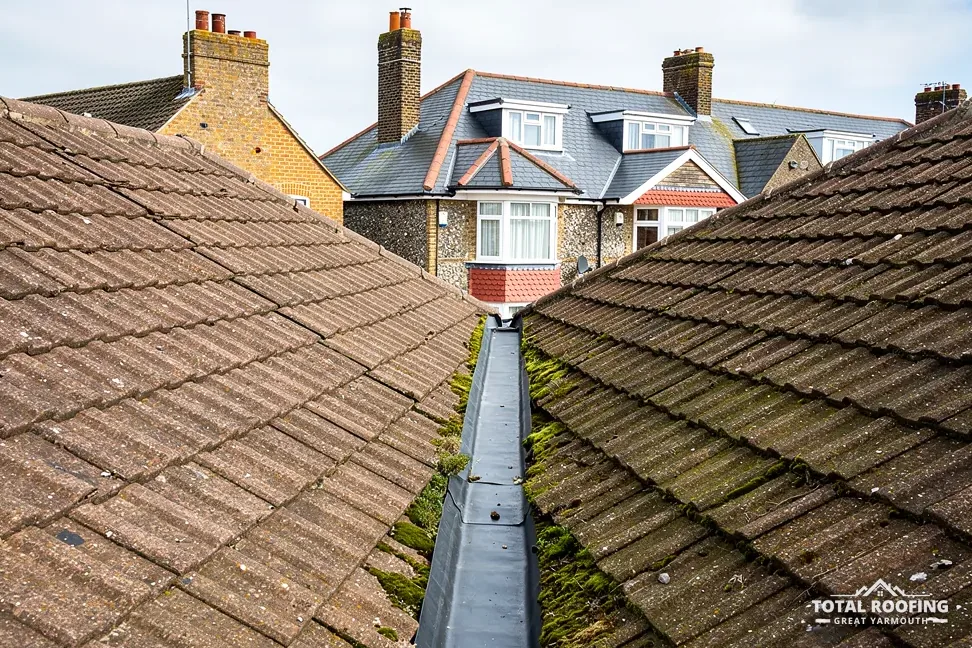
Green moss on your tiles: a problem or only an eyesore?
Moss is a plant that grows wherever a roof surface stays damp, and it settles first on the slopes and edges that dry slowest after rain. A thin green film across one slope is a surface matter. Thick cushions that pack the gaps between tiles are a different thing, because they can hide cracked or slipped pieces that you would otherwise see from the garden.
Looking up from the ground with binoculars is a sensible start. Check the tile edges, the ridge line and the areas around the chimney and any roof window, because those are the places where a small fault lets water in. Damp patches on a bedroom ceiling below the same slope are worth noting alongside whatever you can see outside. If the ceiling stain is dry and old, raise it when the survey is arranged, since a fresh stain and an old one point to different questions about the roof above.
A survey covers every slope, not merely the patch you can see from the path. We look at all of it before quoting, moss included, and we say what else we found. Our guide to what a roof inspection covers lists the parts that get checked, from the covering to the flashings and the gutters.
Checks you can make from the ground
- Thick growth packed into the gaps between tiles
- Tiles with raised, chipped or broken edges
- Dark streaks under the ridge or beside the chimney
- Growth or green staining on gutters and downpipes
- Brown stains on a ceiling under the same slope
- Grit or granules collected in the gutter
What moss does to a roof covering
Moss soaks up water and lets it go slowly, so the surface beneath it stays wet for longer after the rain has stopped. A clay tile, a concrete tile or a natural slate that stays wet for long spells is harder on its own surface than one that dries between showers. That is the reasoning behind taking thick growth off. That reasoning carries no figure in years, so be wary of anyone who promises a set number of extra years from a clean.
Growth also sits in the laps, where one tile overlaps the next. Thick pads there can hold the lower edge of the tile above slightly raised, and rain can then be pushed back along the joint instead of running down it. Whether that matters on your roof depends on the pitch, the type of covering and how the battens and underlay have fared, which is what a survey is for. Makers publish minimum pitches because a covering depends on water running off it: Cupa, for example, reports that BS 5534 gives a minimum pitch for natural slate of 20 degrees at moderate exposure, with a 500mm slate and a 115mm overlap.
Moss that dries out and dies back does not vanish. Brown or black dead growth is still growth, and it breaks up and washes into the gutters, leaving bare patches where it was. Pieces of it end up in the downpipe and at the outlet.
None of this makes moss an emergency. A sound, well laid covering can carry some growth, and a worn one can leak with none at all. The moss is a reason to go and look, not a diagnosis.
Myth
Moss always means the roof is failing and must be replaced.
Fact
Moss shows that a surface stays damp. Whether the covering beneath is sound takes a survey to tell.
Hand removal, biocide and the case against a pressure jet
Two broad methods deal with moss. The first is physical: brushing or scraping the growth off by hand with a soft brush or a plastic scraper that will not gouge the surface. The second is chemical: a biocide wash that kills the growth so that it dies back and washes away over the following weeks. The two are used together, with thick pads scraped off first and the remainder treated.
Marley, the tile maker, warns against a third method. It says: "The use of high powered jet washes is not recommended as it can damage the surface of the slate or tile, thus reducing its expected life considerably". The reasoning is easy to follow. The face of a tile or slate is part of how it sheds water, and a jet strong enough to strip moss can strip that face too. A jet also pushes water sideways into the laps, towards the loft.
Treatment has its own drawbacks. A biocide has to be used as the maker directs, and the run-off goes into the gutters and onto whatever sits below, so plants, ponds and paving need thought. Whoever treats a roof should be able to tell you which product is going on and where the rinse water will go. Check the label rather than relying on a description.
Cleaning also puts someone on the roof. Wet moss is slippery, and a tile that looks firm can crack underfoot. Where a ladder alone is not enough, scaffold sits alongside everything else in the one written quote. A scaffold erected across a footway or the carriageway needs a Highways Act 1980 licence from the county council, and we arrange the licence with our scaffolder.
A sensible order for a moss clean
- Check for nests and bat signs before any work begins.
- Choose a dry day and a safe way up.
- Scrape or brush off the thick growth gently.
- Apply a biocide as its maker directs, if one is used.
- Clear the gutters of everything that has come down.
- Look at the tiles and ridge again once the surface is clean.
Gutters, downpipes and the moss that comes down
Moss leaves a roof in clumps, and the gutter is where it lands. A gutter holding a few handfuls of moss and grit can overflow in heavy rain, and the overflow sheets down the wall or in behind the fascia. Clearing the gutter and checking the downpipe belongs to the same visit as the roof clean, not a later one.
The gutter maker Brett Martin sets the fall at "1mm for every 600mm" towards the outlet, and moss and silt that settle in the run work against that slope by holding water back. If water stands in a gutter after the rain has stopped, either debris or a sagging section is the cause, and that is worth a look from a ladder or from a photo.
Grit and granules in a gutter can come from the roof's surface wearing, so moss is not the only thing that collects there. A handful of grit now and then is nothing to worry about, but a gutter that fills again soon after being cleared suggests the surface above is shedding. Our roof cleaning methods guide sets out the approaches in more detail, including how the clearing fits around the roof work.
Downpipes deserve the same attention as the run above them. A clump of moss that reaches the bend at the foot of a pipe can sit there until the next heavy shower, and the water then backs up the pipe and out of the joints. Looking at the pipe's base while the gutter is being cleared takes a minute and rules that out.
Nests and bats: when removal has to wait
Before anyone scrapes a roof, find out what is living on or under it. Section 1 of the Wildlife and Countryside Act 1981 covers anyone who intentionally "takes, damages or destroys the nest of any wild bird while that nest is in use or being built". Birds build at the edge of a roof covering, in gutters and behind fascias, so scraping around the eaves can disturb a nest that you had not noticed.
Rather than work to a calendar, look at the roof. If you see birds flying in and out of the eaves or gutter, hold the job over until the birds have finished with it. The date of the month does not change that.
Bats are protected in a different way. Damaging or destroying a bat roost is an offence whatever the intent, and GOV.UK's bat guidance names "repairing or replacing a roof" in its list of activities for which Natural England can issue a licence. Cleaning moss is a lighter job than re-roofing, but if you find droppings or bats at the eaves or under the tiles, stop and take advice from Natural England before anything else is done.
If a survey does find damage under the moss and a repair follows, the same checks come before that work as well.
What moss removal costs, and when a repair is the better spend
Published cost guides give a starting point, and the written quote you receive after a survey is one total price for your roof. Checkatrade puts roof cleaning at £8.50 to £14 per m² (April 2026), and gives its own total for an average-sized semi-detached home, which it says depends on the cleaning method or treatment. A per m² figure is a unit rate, so it cannot be turned into a price for your house without a measured roof. The cleaning method, the amount of growth and how the roof is accessed all move the total.
Cleaning only makes sense when the covering beneath is sound. If tiles are cracked, slipped or missing, those are repair costs, and cleaning over them changes nothing about the leak. The sum to compare is a clean plus a repair against the repair alone. Our guide to roof repair cost sets out what the published figures cover.
If it is unclear whether the cause is moss, a worn covering or both, roof repairs is the place to start. A WhatsApp photo is a fair first step, and we will have a look at it before booking a survey. The survey then ends in one written total price for the work it finds.
Published figures for cleaning and small repairs
| Roof cleaning, per m² | £8.50 to £14 (Checkatrade, April 2026) |
|---|---|
| Average-sized semi-detached home, cleaned | £637.50 to £862.50 (Checkatrade's own total) |
| Average roof repair | around £650 (MyJobQuote, 2026) |
| One to six broken or missing tiles | £75 to £400 (Which? Trusted Traders) |
Checkatrade roof cleaning guide, last updated April 2026, no VAT basis stated; its semi-detached total depends on the method or treatment. MyJobQuote roof maintenance page, 6 October 2026, no VAT basis stated. Which? Trusted Traders, survey of 11 traders, November 2025, excluding VAT. The per m² figure is a rate, not a total.
