
Call 01493 277103

Spixworth, 21.8 road miles west

Roofers in Spixworth

Spixworth, a parish of 3,707 residents, lies 21.8 road miles to the west of Great Yarmouth. Every roof gets a survey covering all of it, ridge to gutter line, and you hear in plain words what turned up before a single written price is given.

Get a written quote

Call 01493 277103WhatsApp us

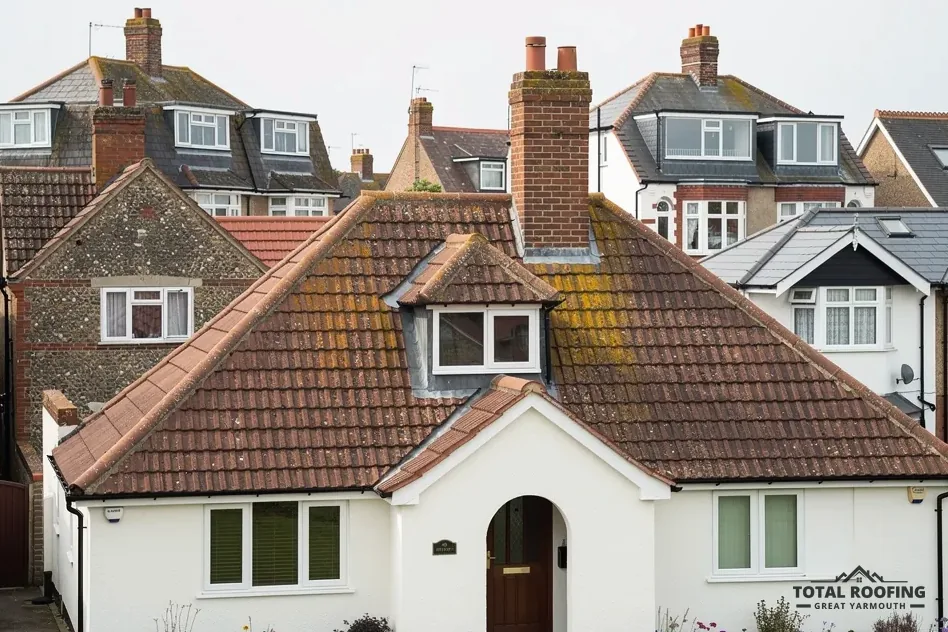
An interwar bungalow with a clay tile roof, a small dormer and an arched porch
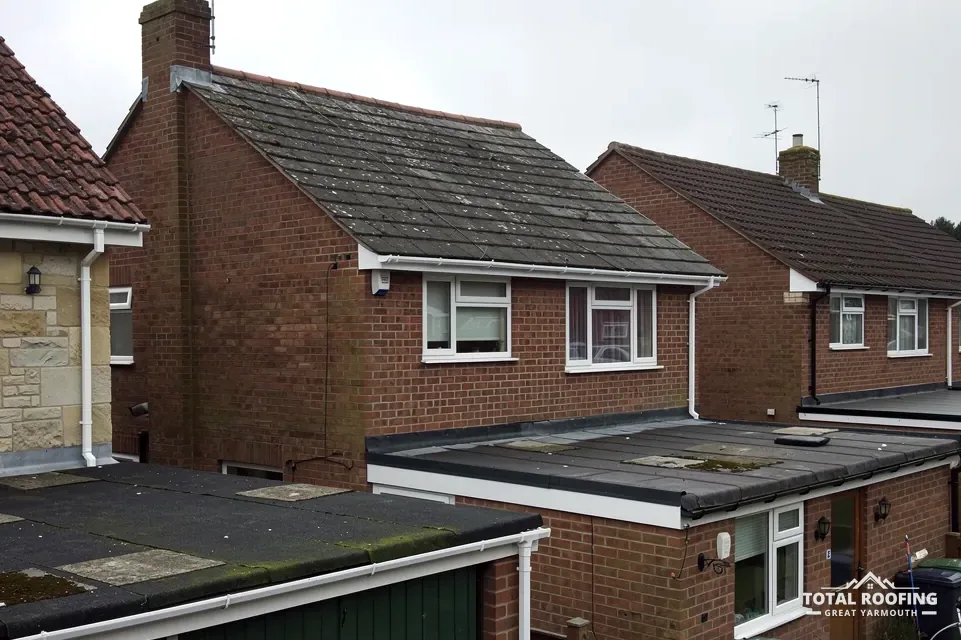
Flat-roofed garages behind brick semi-detached houses

St Peter's, the Old Rectory and Gaffers Cottage

  • The Church of St Peter

    St Peter's, the parish church, is listed Grade I (National Heritage List entry 1152695, first listed 10 May 1961). As a Church of England church in the Diocese of Norwich, it takes roof repairs through the faculty system and not through listed building consent.

    The exemption replaces listed building consent and nothing more, so a planning question about the outside of the building stays with Broadland District Council.

  • The Old Rectory

    The Old Rectory is listed Grade II (entry 1372966, first listed 27 February 1984). Altering the character of a house like this calls for listed building consent, and that comes before a single tile is lifted.

    No step is skipped on a listed roof: covering and ridge, verges and valleys, flashings and timbers, but the choice of replacement material is part of what the council weighs. Lead, mortar and fixings are named in the survey so that the consent request is specific.

  • Gaffers Cottage and its neighbours

    Gaffers Cottage is Grade II as well (entry 1372985). Nine listed buildings lie near Spixworth, so a house with a plain frontage may carry a listing itself, or sit alongside one that does.

    For a particular address, check with Broadland District Council, which can say whether a listing, a conservation area or an Article 4 direction touches it. A call before the quote saves a change of plan after the tiles are ordered, and it costs nothing.

Spixworth: who rules on planning and listings

  • Planning: Broadland District Council decides; Spixworth lies outside the Broads executive area.
  • CNC Building Control, a partnership of five councils, takes building control applications for this parish.
  • Conservation areas and listings are confirmed for your own address by Broadland District Council.
  • The Grade I church takes the faculty route; the Old Rectory and Gaffers Cottage need listed building consent.
  • Norfolk County Council licenses a scaffold over the pavement or road; we arrange it with our scaffolder.

The planning guide covers the permission rules, and the council is asked first, before work starts.

Map of Spixworth and the places nearest to it. Map tiles © Esri; map data © OpenStreetMap contributors.

Ask it straight · Spixworth

Spixworth roofs: the church and listed houses, wildlife, flat roof falls and spray foam

Spixworth parish had 3,707 usual residents at the 2021 Census. Four questions are worth answering here: how the Grade I church and two listed houses reach approval, what the law says about birds and bats in a roof, what fall a flat roof must have, and where spray foam leaves a mortgage.

Which consent applies to Spixworth's church and listed houses?

The short answer

The Grade I church follows the Church of England faculty system. The Old Rectory and Gaffers Cottage, both Grade II, need listed building consent.

St Peter's, the Grade I church, belongs to the Church of England, and the Diocese of Norwich oversees its faculty process. The ecclesiastical exemption lifts a Church of England church out of listed building consent while it is used for worship. Broadland District Council still hears a planning question, because the exemption never reaches planning permission for exterior work. A faculty petition is decided in the consistory court of the Diocese of Norwich, where the chancellor of the diocese is the judge. A roofer's part is to survey the roof and describe what it needs in plain terms, so the petition rests on the facts of the building.

The two houses take the ordinary listed route. The Old Rectory (entry 1372966) and Gaffers Cottage (entry 1372985) are both Grade II, and the Planning (Listed Buildings and Conservation Areas) Act needs consent for work "in any manner which would affect its character as a building of special architectural or historic interest". Re-covering with a different material is the plainest example.

Nine listed buildings lie near the village, and the council settles from an address whether a particular house is one of them. Where a roof needs a repair rather than a re-cover, the same question still comes first, because a repair can change a listed house's appearance as readily as a new covering. Our roof repairs page describes the survey, so the consent request describes the whole roof, not one slipped tile.

Church and houses

St Peter's church

  • Faculty system, Diocese of Norwich
  • Grade I, entry 1152695
  • Planning still applies

Old Rectory

  • Consent from the council
  • Grade II, entry 1372966
  • Character is the test

Does spray foam in a Spixworth loft affect a mortgage?

The short answer

It can. RICS reported lender concern in 2023, while government guidance says many providers are open to lending, so check with the lender and a specialist surveyor.

Spray foam sprayed onto the underside of a roof hides the timbers. RICS publishes a consumer guide, and it says a timber roof structure under spray foam "cannot be fully seen or inspected". The same guide tells owners to check whether their mortgage provider's policy allows the product. In March 2023 RICS reported "concern within specific sectors of the lending market, such as equity release mortgages".

The government's position, in a policy paper dated 22 October 2026, is softer: "Many mortgage providers are open to lending on properties with spray foam, subject to their own requirements." It warns that removal "will not always guarantee that they will still lend", and that you should take advice from a specialist surveyor first. The Energy Saving Trust says having it "doesn't automatically prevent you from getting a mortgage, but some lenders may ask for extra checks".

Cold calls offering to remove spray foam have increased, according to the same paper, so an unsolicited offer deserves caution. Our spray foam insulation removal page covers how removal is done. Before anything is stripped, a Spixworth owner should speak to the lender, and a surveyor should decide whether the timbers beneath need inspecting. The Energy Saving Trust adds that closed-cell foam "doesn't let moisture pass through it easily", and that the rot risk "should be much lower with open-cell foam", which is why a timber check is worth asking for.

Before spray foam comes out

  • Ask your lender what its policy says
  • Take advice from a specialist surveyor
  • Treat unsolicited removal offers with caution
  • Have the timbers beneath inspected once exposed

What if a Spixworth loft holds a nest or bats?

The short answer

Stop and take advice: a nest in use or being built is protected, as is a bat roost with or without intent, and roof repair can need a Natural England licence.

Two separate rules apply. The Wildlife and Countryside Act 1981 makes it an offence for a person who intentionally "takes, damages or destroys the nest of any wild bird while that nest is in use or being built". The word intentionally matters, and so does the phrase in use or being built, which separates an active nest from an empty old one.

Bats are protected more tightly. According to GOV.UK, every bat species, with its breeding sites and resting places, is fully protected, and "repairing or replacing a roof" can call for a Natural England licence. Regulation 43 of the Habitats Regulations treats harm to a bat's breeding or resting places as an offence regardless of intent, with no test of what the person meant to do. Disturbance and obstructing access are offences if done "intentionally or recklessly".

In practice the survey is where this surfaces. Droppings in the loft, a gap under a ridge tile with staining around it or a bird flying in and out of the eaves are all reasons to stop and take advice before anything is lifted. The roof will wait while the right questions are asked, and the plan for the covering is made around whatever is found.

Myth

Harming a bat roost is only wrong if it was meant.

Fact

Intent is not tested when a roost is damaged or destroyed.

What fall should a flat roof in Spixworth have?

The short answer

BS 6229:2025 sets a minimum 1:80 finished fall. According to IKO, the code of practice puts the design fall steeper, at 1:40.

Flat roofs are never quite flat. The current standard is BS 6229:2025, published on 16 December 2025 when the 2018 edition was withdrawn, and it covers flat roofs with continuously supported flexible waterproof coverings. In practice that is membranes, and lead sits outside it. NFRC's summary says it sets "a minimum 1:80 finished fall" for general roof areas and internal gutters.

The finished fall is what the roof must have once built. Design is a different number: IKO says "To achieve a 1:80 fall, the code of practice says that the roof should be designed for a fall of 1:40". A fall designed at only 1:80 can finish flatter than that, once decking, boards and the membrane have settled, and then water lies on the surface.

On a Spixworth extension or garage the survey checks for exactly this: ponding after rain, a membrane that has stretched or split, and outlets set higher than the surrounding surface. A roof that holds a puddle for long after rain has a fall problem, and the cure is in the boards and falls beneath the membrane, not in another coat on top. In Approved Document L, para 11.2(d) names replacing the membrane on a flat roof as renovation, and the flat roofing page covers the systems. A renovated roof can also trigger an insulation upgrade, which building control confirms.

Flat roof falls

  • Finished fallThe slope the completed roof actually has.
  • Design fallThe steeper slope drawn so tolerances still leave a fall.
  • PondingWater lying on the surface after rain.
  • BS 6229Flat roof code of practice, 2025 edition current.

Spixworth roofs: re-slating, scaffolds, storms, cost, flooding

Does re-slating a Spixworth garage roof need building regulations approval?

Not normally, if the work stays within both Planning Portal limits: "Less than 25 per cent of the total 'building envelope'" affected, and "Less than 50 per cent of the roof is affected". Recovering the whole roof goes past the second limit and brings in building control. CNC Building Control, a partnership of five councils, is the first call for a Spixworth address, and a registered building control approver is the alternative to it.

Does a Spixworth street scaffold need a licence, and who gets it?

We arrange the licence with our scaffolder. Norfolk County Council issues it, charging £178.33 for the first 28 days and £178.33 for every following 28 days. Each new scaffold means a new application, and the council advises you to "Please allow 7 calendar days for applications to be processed". Mention a narrow street at the survey, because the frame layout and the licence follow from it.

Slates came down in a Spixworth gale: what does the Ombudsman look for?

The Financial Ombudsman Service says "we'll usually look at expert reports and photos", and defines a storm as something that "usually involves violent winds, usually with rain, hail or snow". Photograph the damage before it is touched, and tell your insurer promptly. A photo sent to WhatsApp (07880 284133) also gets a look from us, and we say what it does and does not show, as the survey alone settles what lies under the covering.

What does a full re-roof run to in Spixworth?

Which? Trusted Traders put £7,000 to £21,000 excluding VAT on replacing the whole of an average three-bedroom house's roof (November 2025, a survey of 11 traders). A bigger roof, a steep one or one with awkward access moves the figure up. Your quote arrives as a single written total, prepared once the Spixworth survey is complete.

Can I look up flood risk for Spixworth?

Yes, for an area. GOV.UK's long-term flood risk service shows area risk, and "it does not tell you how likely it is that an individual property will flood". The flood map for planning, from the Environment Agency, gives a site's zone when an application needs one. Floodline's number is 0345 988 1188.

Parishes around Spixworth within two miles

Price your Spixworth roof in writing

Tell us about your roof

10-year workmanship guarantee, in writing

Call WhatsApp Written quote