
Call 01493 277103

Ludham, 12.6 road miles north-west

Roofers in Ludham

Ludham is partly inside the Broads, 12.6 road miles to the north-west by road from Great Yarmouth, and part of it falls under the Broads Authority. Roof work begins by looking over every slope and finding out early which planning office covers your address.

Get a written quote

Call 01493 277103WhatsApp us

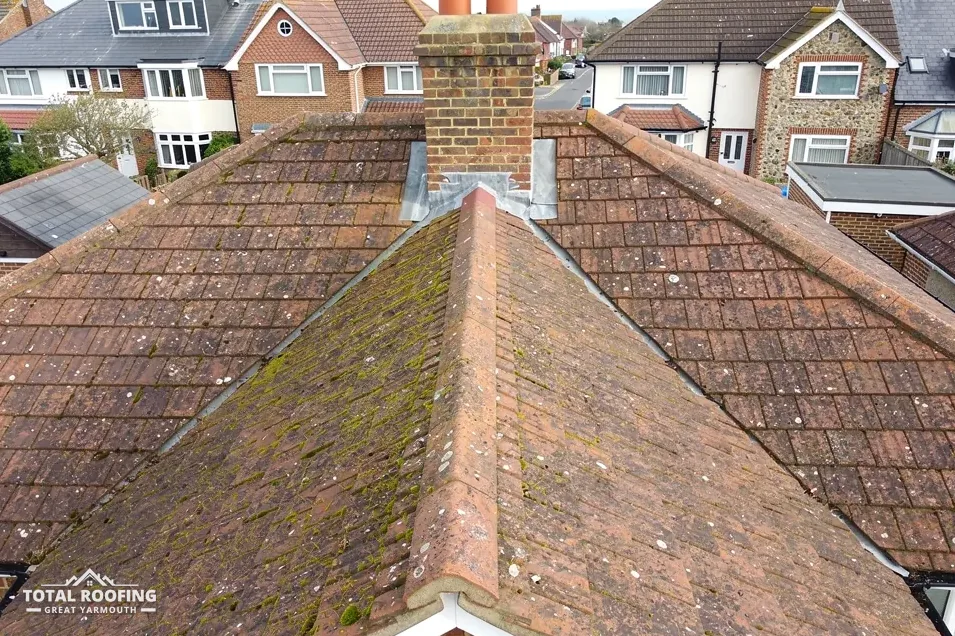
A high view looking down on a clay tile roof, its ridge, hips and brick chimney
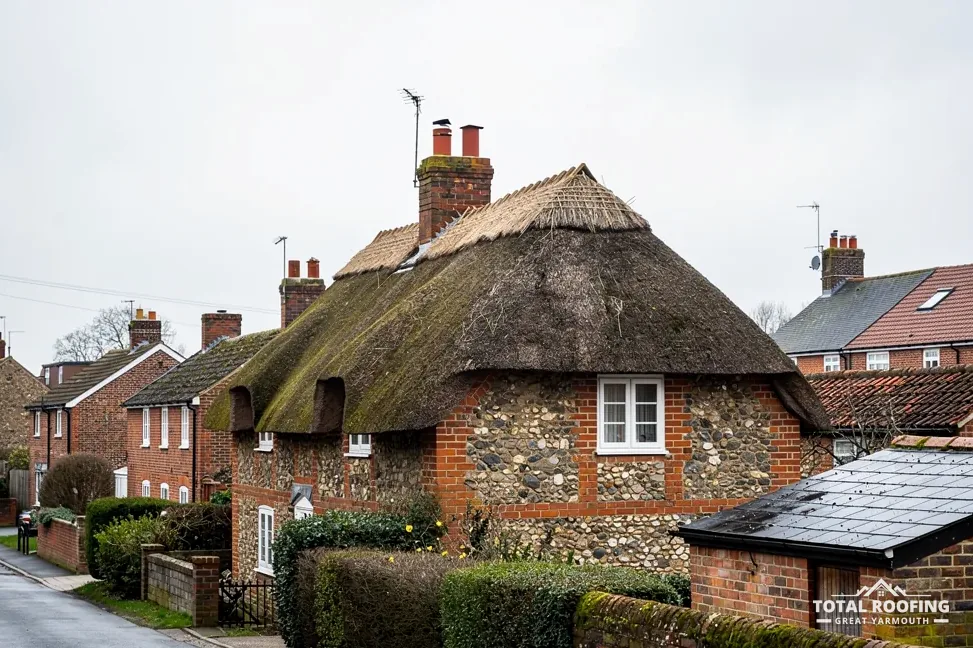
A thatched flint cottage among tiled houses

Ludham's church, saddler's shop and Broads edge

  • Inside the Broads area

    Part of Ludham lies inside the Broads Authority's executive area. On land inside the executive area, planning goes to the Broads Authority (01603 610734), while North Norfolk District Council decides the rest of the village. The full address tells you which office to ring first, so have it to hand.

    Building regulations stay with North Norfolk District Council's building control team on 01263 516345, or a registered approver, however the planning line falls through the village.

  • St Catherine's and Church View

    The Church of St Catherine is listed Grade I (National Heritage List entry 1049913, first listed 16 April 1955). Nine listed buildings stand around the village, Church View (entry 1171967) among them, listed Grade II.

    A roof beside the church is surveyed like any other, from the covering down to the timbers, and every finding is set out in plain terms.

  • The saddler's shop and directions

    The Former Saddler's Shop with Cottage adjoining to west is listed Grade II (entry 1373442, first listed 24 October 1972). Ludham also has a conservation area, shared between North Norfolk District Council and the Broads Authority.

    North Norfolk District Council lists older Article 4 directions for land at Ludham, from 1972 and 1973. What they remove for a house is for the council to confirm, so ask whether an Article 4 direction applies.

Ludham roof work: who decides what

  • Planning: Broads Authority within its executive area, North Norfolk District Council beyond it. Check the address.
  • Building control: North Norfolk District Council's own team, 01263 516345, or a registered approver.
  • Conservation area: shared by the district council and the Broads Authority; ask whether your road is in it.
  • St Catherine's (Grade I): faculty system. Listed houses: listed building consent.

The planning guide explains which roof jobs call for permission; the right route for a Ludham property is confirmed first.

Map of Ludham and the places nearest to it. Map tiles © Esri; map data © OpenStreetMap contributors.

Ask it straight · Ludham

Ludham roofs: two planning offices, a Grade I church, a saddler's shop, spray foam

Ludham parish had 1,281 usual residents at the 2021 Census. A village that is split by the Broads boundary, holds a Grade I church and has a conservation area raises several questions for a roof job, and the answers that follow go through them one at a time. Potter Heigham, Catfield, Bastwick and Horning are the nearest neighbours.

Is my Ludham roof the Broads Authority's business or the district's?

The short answer

The plot decides: the Broads Authority decides within the line inside its executive area, North Norfolk District Council elsewhere, with building control the district's either way.

Ludham is divided. The Broads Authority says of itself: "We are the local planning authority for all land and properties within our executive area", and part of the village lies inside it. On that land a planning question, such as a covering that changes the roof's appearance, goes to the Authority. North Norfolk District Council answers the same question for the rest of Ludham.

Regulations do not follow the boundary. National park status does not make the Authority a building control body; its remit is planning. For a re-roof, building regulations are handled by North Norfolk District Council's own team on 01263 516345, or by a registered building control approver, on either side of the line. Both offices can be asked in one call, and we ask before the work is priced, so the answer is known when the written total is given.

Because the line cuts through the village, the address settles it and a village name does not. Plots near the water are the ones to check first, and a plot that straddles the line is put to both offices. Whatever the answer, the roof is surveyed whole, from the covering and the ridge to verges, leadwork, gutters and the timber that shows in the loft. Our roof replacement page describes a full re-cover from strip-out to ridge.

Two offices, one village

Inside the line

  • Broads Authority decides within the line
  • District team for regulations
  • Check the address

Outside the line

  • District council for planning
  • District team for regulations
  • Check the address

Who agrees a roof repair at St Catherine's church in Ludham?

The short answer

The Church of England faculty system, not listed building consent. St Catherine's is Grade I, and planning for exterior work can still apply.

St Catherine's is listed Grade I (entry 1049913), the highest grade, and it is an active Church of England church within the Diocese of Norwich. The ecclesiastical exemption therefore applies: works are authorised through the faculty system, and nobody seeks listed building consent from the council. A churchwarden with a leak rings the diocese before the council.

The exemption takes away a single consent. Where the ordinary planning tests are met, permission for exterior work must still be sought, and in Ludham the answer to who decides depends on whether the church stands inside the Broads Authority's area or outside it. The address on a map settles that, and the regulations side goes to the district council's building control team or a registered approver.

A church roof earns the same survey as a house, only longer: each slope's covering, the ridge and verges, lead where valleys and parapets meet masonry, the gutters along the walls and timber visible from inside. The findings tell failed parts from merely old ones, which matters to a parish deciding what must be done this year and what can wait for the next round of fundraising. Scaffold beside a road is covered by a licence from Norfolk County Council, which we arrange with our scaffolder, so the programme can be planned in stages, and where the frame goes is settled at the survey, not on the first morning of work.

Surveyed on a church roof

  • Covering on each slope
  • Ridge, hips and verges
  • Leadwork at valleys and parapets
  • Gutters and downpipes
  • Timbers seen from inside

How do the conservation area and old directions affect a Ludham roof?

The short answer

Ask North Norfolk District Council whether your address is inside the conservation area and whether any Article 4 direction applies, before a covering or window changes.

Ludham has a conservation area, shared by North Norfolk District Council and the Broads Authority. Being inside it does not make a house listed. Which roads it takes in is a question for the planning body for your address, which holds the map and can answer from the address alone. A listed house is a separate matter, and a separate list: the Former Saddler's Shop with Cottage adjoining to west is Grade II (entry 1373442), and Church View is Grade II (entry 1171967).

The district council's list holds older directions for land at Ludham, made by Norfolk County Council in 1972 and 1973. The list gives no contents, so whether any of them touches what a householder can do to a roof is for the council to confirm. An Article 4 direction can remove further permitted development rights, so check with the council whether one applies to you.

Listed building consent is the route for work on a listed house that affects its character, and a new covering, a different ridge, replacement lead or an added rooflight can each do so. A repair that keeps the covering already there is a smaller step, and the council can say whether it needs a decision. The survey looks at what is failing in each part of the roof, so any conversation with the council starts from the roof as it is rather than from a general description. Our roof repairs page describes patching and re-bedding.

Before work on an older Ludham roof

  1. Find out if the building is listed
  2. Ask about the conservation area
  3. Ask about Article 4 directions
  4. Survey the whole roof
  5. Agree the route with the council

Will spray foam in my Ludham loft affect a mortgage or sale?

The short answer

Not automatically. Lenders' views vary, and removal will not always guarantee that they will still lend, so take advice from a specialist surveyor first.

Three sources bear on this. In its March 2023 release, RICS reported "concern within specific sectors of the lending market, such as equity release mortgages". The government's policy paper of 22 October 2026 says "Many mortgage providers are open to lending on properties with spray foam, subject to their own requirements." The Energy Saving Trust adds that foam "doesn't automatically prevent you from getting a mortgage, but some lenders may ask for extra checks".

Removing it is not a cure. The same paper says taking the foam out "will not always guarantee that they will still lend", and tells owners to consult a specialist surveyor before deciding anything. It also cautions against cold calls and unsolicited offers to sell foam or to remove it. Your own lender's policy decides, so ask the lender before anything is stripped out.

Roof timbers matter too, since foam can hide them from anyone looking. RICS says that once the roof timbers are covered with spray foam they cannot be fully seen or inspected, and the Energy Saving Trust says closed-cell foam "doesn't let moisture pass through it easily" while this risk should be much lower with open-cell foam. The survey looks at what can be seen from the loft, and says plainly where foam hides the timber from view, so the findings never claim more than was actually visible. Our spray foam insulation removal page explains the removal route.

Myth

Foam in a Ludham loft rules out any mortgage.

Fact

Lenders vary, and the government paper stresses that each sets its own requirements.

Ludham chimneys, insulation, slate and bills

What is involved in removing a chimney breast from a Ludham cottage?

Removing a chimney breast always needs Building Regulations approval, because it is part of the structure. With the breast on a party wall, the owner carrying out the work must give the neighbour notice at least two months before the date on which the proposed work will begin; if the neighbour objects, the party wall procedure brings surveyors in. Taking out the breast can leave the stack above unsupported, which the survey checks.

Does a Ludham re-roof mean upgrading the loft insulation?

It can. Paragraph 11.3 of Approved Document L asks for the whole element to be improved where feasible once more than 50% of its surface is renovated; Table 4.3 gives 0.35 as the threshold and 0.16 as the improved figure. Paragraph 4.13 limits the upgrade to what pays back within a 15-year simple payback. Building control decides how that applies to a particular roof.

How long does a slate roof last in Ludham?

HomeBuilding, last updated 30 September 2025, gives approximate lifespans of 100+ years for Welsh slate, 75-100 years for Spanish slate and 50-80 years for reclaimed Welsh slate, against 60-80 years for clay tile and 40-50 for plain concrete tile. Those are guide ranges, not promises for any one roof, so the survey judges the slates you actually have, including how they are fixed.

Why does water drip behind the gutter at my Ludham cottage?

The gutter may have lost its fall. Brett Martin gives "1mm for every 600mm" towards the outlet, so a bracket that has dropped lets water back up against the fascia and run behind it. A blocked outlet does the same. The survey checks falls, joints and brackets along the whole run before any repair is chosen.

What does Checkatrade say pitched roof repairs cost per square metre?

In Checkatrade's June 2026 table a pitched clay tile roof repair tends to cost between £110 and £160 per m², while natural slate could cost around £190 per m², all exclusive of VAT. Those are per-square-metre figures from a guide, not a quote for your roof, which is priced as one written total after the survey.

Ludham roof, one written price

Tell us about your roof

10-year workmanship guarantee, in writing

Call WhatsApp Written quote